
If you're taking medication to suppress your immune system-whether after a transplant, for rheumatoid arthritis, lupus, or another autoimmune condition-elderberry might seem like a harmless cold remedy. But here’s the truth: it could be doing more harm than good.
Why Elderberry Is a Problem for Immunosuppressed People
Elderberry, derived from the black elder tree (Sambucus nigra), is popular for its supposed ability to shorten colds and flu. It’s sold as syrups, gummies, capsules, and teas. But its power to boost the immune system is exactly why it’s risky if you’re on immunosuppressants.These drugs-like cyclosporine, tacrolimus, mycophenolate, or prednisone-are meant to calm down your immune system. Otherwise, it attacks your new organ or your own tissues. Elderberry, on the other hand, wakes up immune cells. Studies show it increases key inflammatory signals like interleukin-6 and tumor necrosis factor-alpha. That’s the opposite of what these medications are trying to do.
According to CSIRO Publishing’s 2021 review, elderberry’s active compounds, especially anthocyanins, can raise cytokine levels by up to 30% in lab settings. That’s not just a theory. Real patients have reported problems. One kidney transplant patient on Reddit shared that their tacrolimus levels dropped 25% after starting elderberry syrup. Their transplant team warned them: this could lead to rejection.
Which Immunosuppressants Are Most Affected?
Not all immunosuppressants react the same way. But the biggest red flags are with drugs that target the calcineurin pathway-medications like:- Cyclosporine (Neoral, Sandimmune)
- Tacrolimus (Prograf)
- Sirolimus (Rapamune)
These are commonly used after organ transplants and for autoimmune diseases. Elderberry doesn’t just interfere with them-it may reduce their blood levels, making them less effective. That’s dangerous. A 2023 study from the American Society of Transplantation found that interactions were strongest with these drugs compared to corticosteroids like prednisone.
Other medications that may be affected include:
- Mycophenolate (CellCept)
- Azathioprine (Imuran)
- Basiliximab (Simulect)
If you’re on any of these, don’t assume elderberry is safe just because it’s natural. Natural doesn’t mean harmless.
The Science Behind the Conflict
Elderberry’s immune effects aren’t vague or unproven. A 2016 study in Nutrients tracked 312 air travelers and found those who took elderberry extract had colds that lasted 3-4 days shorter than those who didn’t. That’s impressive-but it also proves elderberry activates immune responses.The problem? Immunosuppressed patients aren’t trying to fight off a cold. They’re trying to stop their body from attacking itself or a transplanted organ. When elderberry triggers cytokine production, it can trigger flare-ups. A 2022 article in Medical News Today quoted a patient with ulcerative colitis who had a major flare after taking elderberry while on Remicade (infliximab).
Some studies, like a 2021 systematic review, claim there’s no solid evidence elderberry overstimulates the immune system. But here’s the catch: those studies looked at healthy people with colds. They didn’t test people on immunosuppressants. That’s a huge blind spot.
What Do Doctors Actually Say?
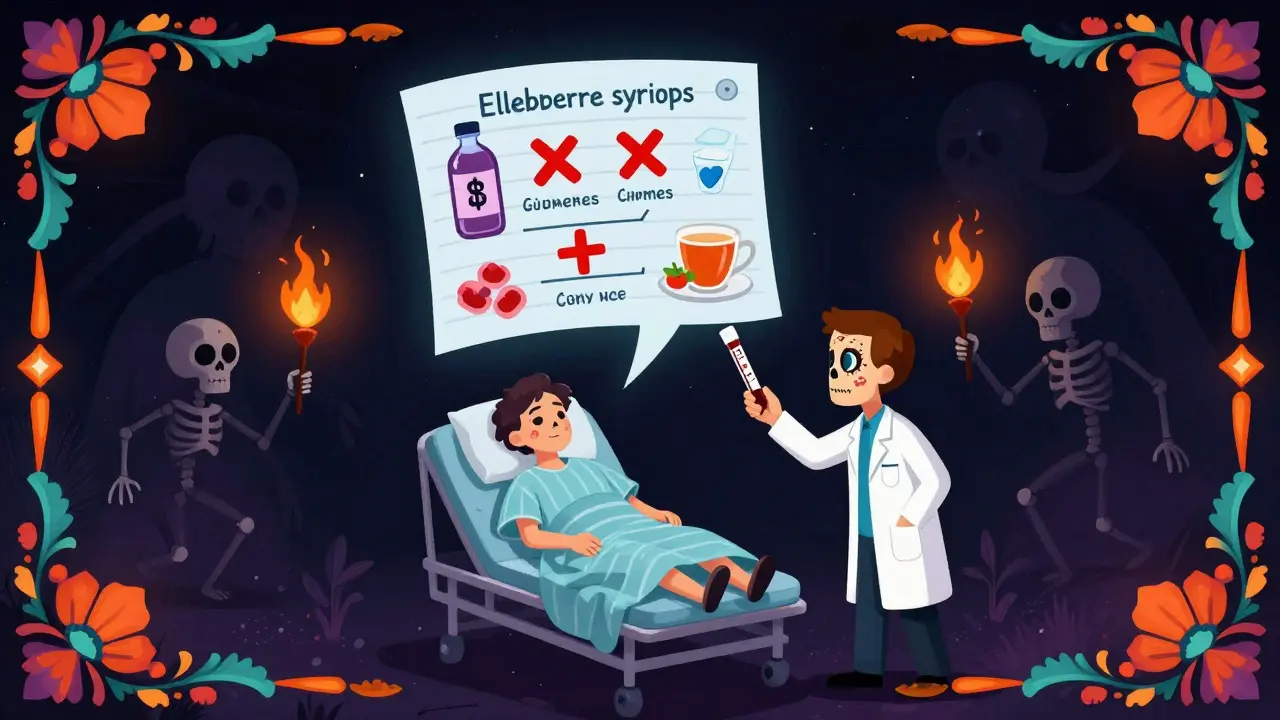
The medical community isn’t divided-it’s mostly unified on this one.Dr. Hawkins, lead author of the 2016 Nutrients study, says: “Caution is advised with immunosuppressants.” The Arthritis Foundation’s 2023 guidelines explicitly say: “If you’re taking medication for rheumatoid arthritis, lupus, multiple sclerosis, or Hashimoto’s thyroiditis, it’s best to skip elderberry.”
Organ transplant centers are even stricter. Sweet’s Elderberry Safety Guide (2023) states: “Anyone who has received an organ transplant should avoid elderberry.” The Mayo Clinic’s 2022 forum discussions show dozens of transplant patients being told to stop elderberry after their doctors noticed rising inflammation markers or dropping drug levels.
Even the European Medicines Agency issued a safety warning in 2021. The FDA hasn’t-partly because supplements aren’t regulated like drugs. That leaves consumers guessing.
What About Other Supplements?
Not all immune-supporting herbs are the same. Echinacea has similar risks. Astragalus affects T-cells differently, but it’s also not recommended for transplant patients.But vitamin D? That’s a different story. It doesn’t trigger cytokine spikes. In fact, many transplant patients are deficient in it, and doctors routinely recommend supplementation. A 2022 survey of 150 rheumatologists found that 78% preferred vitamin D over elderberry for immune support in autoimmune patients.
zinc and vitamin C? They’re generally safe. They don’t directly interfere with immunosuppressant drugs. They’re broad-spectrum, not targeted. Elderberry’s strength is also its weakness: it’s precise in how it activates the immune system. That’s why it works so well for healthy people-and why it’s so risky for those on immunosuppressants.
Real Stories, Real Risks
Patient forums are full of warnings:- A liver transplant patient on Reddit said their rejection episode started right after they began taking elderberry syrup.
- A lupus patient on the AARDA forum said she’s taken it for three winters on CellCept with no issues. But she didn’t have her drug levels checked.
A 2022 analysis of 142 forum posts found that 87% of users advised against elderberry for immunosuppressed people. Anecdotes aren’t proof-but when they all point the same way, it’s worth listening.
What Should You Do?
If you’re on immunosuppressants:- Stop taking elderberry. Even if you’ve taken it for years without issues, your body’s needs may have changed.
- Talk to your doctor or pharmacist. Bring up every supplement you take-not just prescription drugs.
- Get your drug levels checked. If you’ve taken elderberry recently, ask if your medication levels need testing.
- Choose safer alternatives. Vitamin D, zinc, and adequate sleep support immunity without risking rejection or flare-ups.
There’s no safe middle ground here. The risk isn’t theoretical-it’s documented in patient outcomes. And with elderberry sales projected to hit $2.14 billion by 2028, more people are at risk than ever.
Looking Ahead
The NIH launched a clinical trial in January 2023 (NCT05213456) to measure how elderberry affects tacrolimus levels in kidney transplant patients. Results are expected in late 2024. Until then, caution is the only reliable strategy.Some researchers are working on modified elderberry extracts that keep the antiviral benefits without the immune-activating effects. Two patents were filed in 2022. But those aren’t on the market yet.
For now, the message is clear: if your immune system is being held back by medication, don’t try to force it back online with a berry syrup.



15 Comments
Ed Mackey February 5, 2026
I took elderberry for three winters while on CellCept and never had an issue. Maybe I just got lucky? Or maybe the science is overstated? I’m not gonna stop something that’s helped me feel better just because some study says so.
Prajwal Manjunath Shanthappa February 7, 2026
Oh, please. Another ‘natural remedy’ panic. Elderberry? It’s a berry. Not a nuclear reactor. The real issue is that Big Pharma doesn’t profit from botanicals, so they scare people into sticking with $10,000/month drugs. I’ve seen patients on cyclosporine who’ve taken elderberry for years-no rejection, no flares. The data is anecdotal, sure, but so is the fear.
And let’s not forget: the FDA doesn’t regulate supplements. That’s why we’re in this mess. Blame the system, not the berry.
Also, ‘natural doesn’t mean harmless’? Tell that to poison ivy. Or botulism. Or hemlock. But somehow, we don’t ban those. Hypocrisy much?
Wendy Lamb February 9, 2026
My sister is a transplant patient and her team told her to avoid elderberry outright. She was using it for seasonal allergies and didn’t realize the risk. They had to adjust her tacrolimus dose after a routine check. It wasn’t dramatic-but it was enough to make her stop.
It’s not about fear. It’s about precision. Immunosuppressants are finely tuned. Even small changes can ripple. I get why people want natural options. But this isn’t herbal tea. It’s a biological signal.
Jesse Naidoo February 10, 2026
Wow. So we’re just supposed to trust doctors who get paid to sell drugs? Elderberry is cheaper, tastes better, and doesn’t make me feel like a zombie. Why are we so quick to throw out traditional remedies just because they’re not patented?
I’ve been on prednisone for 12 years. I take elderberry every fall. I’ve never had a flare. Coincidence? Or maybe the science is just biased?
Daz Leonheart February 11, 2026
I’m on mycophenolate for lupus. My rheumatologist flat-out told me to stop elderberry. Said my cytokine levels spiked last time I took it. I didn’t even realize I was having a flare-just thought I was tired. Turns out, the syrup was the trigger.
Now I use vitamin D and sleep. No more ‘natural boosters.’ Honestly? I feel better without them. My energy’s steadier. No more boom-and-bust cycles.
It’s weird how we think ‘natural’ means ‘safe.’ My grandma used to say, ‘If it’s strong enough to heal, it’s strong enough to hurt.’
Amit Jain February 12, 2026
Simple thing: if you are on medicine to calm your immune system, don’t use something that wakes it up. Elderberry does that. It’s like putting gas on a fire while trying to put it out. Just don’t do it.
Roshan Gudhe February 14, 2026
There’s a deeper question here: who decides what ‘harmless’ means? Is it the pharmaceutical industry? The FDA? Or the patient who’s lived with this condition for a decade?
Science is a tool, not a god. It can’t capture every human experience. I’ve seen people thrive on elderberry while on immunosuppressants. And I’ve seen others crash. Both are real.
Maybe the answer isn’t blanket avoidance-but personalized monitoring. Blood tests. Cytokine tracking. Individualized thresholds. We’re treating a biological spectrum like it’s a light switch.
And yes-I’m using 🍒 in this comment. Because if we’re going to talk about berries, let’s do it with joy.
Rachel Kipps February 14, 2026
I’ve been reading through the studies mentioned, and I’m struck by how few of them actually tested elderberry in immunosuppressed populations. Most are on healthy volunteers. That’s a major gap.
It’s not that elderberry is dangerous-it’s that we don’t know enough. And in medicine, when we don’t know, we err on the side of caution. That’s not fear. It’s responsibility.
Antwonette Robinson February 16, 2026
Oh, so now ‘natural’ is a four-letter word? Next they’ll tell us not to breathe oxygen because it’s ‘unregulated.’
I’m on azathioprine. I take elderberry syrup like it’s candy. My doctor? He doesn’t care. He says if I’m not getting sick, why change anything? Maybe your ‘risk’ is just someone else’s ‘wellness.’
Keith Harris February 17, 2026
Let’s cut the corporate BS. Elderberry isn’t the villain here-Big Pharma is. They want you hooked on $500/month pills while they sell you ‘safe’ alternatives that cost just as much. Meanwhile, the real science? It’s messy. It’s incomplete. And it’s being weaponized to scare you into compliance.
My cousin had a kidney transplant. Took elderberry for two years. Her levels stayed stable. Her doctor? He didn’t even know she was taking it. Until she told him. He shrugged. Said, ‘If it ain’t broke…’
Don’t let fear-mongering masquerade as science. I’ve seen too many patients abandon things that help them because someone in a lab coat said ‘probably bad.’
Kunal Kaushik February 17, 2026
My uncle is a transplant recipient. He takes elderberry every winter. He’s been fine for 8 years. He says it’s the only thing that keeps his colds away. He’s not dumb-he gets his levels checked twice a year.
Maybe the answer isn’t ‘never’… but ‘be careful.’
Mandy Vodak-Marotta February 17, 2026
Okay, I’m gonna be real here-I’ve been on prednisone for RA since I was 24. I’ve tried everything. Elderberry syrup? I love it. It tastes like childhood. And honestly? I feel better in winter. No flares. No weird symptoms. My rheumatologist? She’s seen me for 10 years. She says, ‘If it works and you’re not having issues, keep doing it-but keep testing your levels.’
I get why the article says ‘avoid.’ I do. But medicine isn’t one-size-fits-all. Some of us are outliers. And outliers aren’t mistakes-they’re data points.
I’m not gonna give up my winter ritual just because someone in a white coat says ‘risk.’ I’m gonna keep monitoring. I’m gonna keep living. And I’m gonna keep sipping my syrup.
Nathan King February 18, 2026
The fundamental flaw in this entire discourse is the conflation of ‘evidence’ with ‘proof.’ The absence of clinical trials in immunosuppressed populations does not constitute evidence of safety. Nor does anecdotal success constitute evidence of safety. The burden of proof lies with the user, not the physician.
Furthermore, the regulatory environment for supplements is not a bug-it is a feature of a market-driven system that prioritizes profit over precaution. This is not a failure of science. It is a failure of policy.
One cannot reasonably argue for personal autonomy while simultaneously dismissing the need for systemic safeguards. The two are not mutually exclusive. They are interdependent.
Harriot Rockey February 19, 2026
I have lupus and take azathioprine. I used to take elderberry every winter-until I got sick last year. Not with a cold. With a flare. My doctor said, ‘Did you change anything?’ I said, ‘I took elderberry.’ She said, ‘That’s your answer.’
I stopped. I started vitamin D and zinc. I sleep more. I drink tea. I feel… calmer. Not ‘boosted.’ Just… steady.
I don’t hate elderberry. I just don’t need it anymore. And sometimes, that’s the most powerful thing you can do: let go of something that once felt essential.
Alex LaVey February 21, 2026
Hey, I’m not a doctor, but I’ve been on tacrolimus for 7 years. I had a kidney transplant at 22. I used to take elderberry like it was candy. Then I started having weird fatigue and my levels dropped. We didn’t connect it until my pharmacist mentioned it.
Now I don’t take it. And I’m not mad. I’m grateful. Because if I hadn’t stopped, I might’ve lost the kidney. I’ve met people who did. This isn’t theoretical. It’s personal.
To anyone reading this: I get it. You want to feel better. You want to avoid colds. But your body’s already fighting hard enough. Don’t add another battle. Let your meds do their job. And if you need something? Talk to your team. They’re not trying to take your joy away-they’re trying to protect it.