

By 2025, legal changes aren’t just coming-they’re already here. Across the U.S., over 4,800 new regulations were published in 2024 alone, and that number is climbing. If you’re running a business, managing payroll, handling housing projects, or even just filing taxes, you’re not just watching the law change-you’re living it. The real challenge? The rules aren’t moving in one direction. Some areas are getting tighter. Others are being loosened. And in between, you’re expected to keep up.
California’s Labor Laws Are Getting More Complex
In California, the changes are sharp and fast. Assembly Bill 406, which took effect October 1, 2025, didn’t just tweak one law-it rewrote how employers handle leave for victims of violence and their families. It merged two separate leave provisions into the Fair Employment and Housing Act (FEHA), meaning HR teams now have to update handbooks, posters, and training materials overnight. Employers who didn’t act fast are already facing complaints.At the same time, the state expanded Paid Family Leave. Starting July 1, 2028, workers can take leave to care for a ‘designated person’-someone they’re emotionally close to, even if they’re not related by blood. That’s a big shift. It’s not just about spouses or kids anymore. It’s about chosen family. But here’s the catch: companies have three years to prepare. Most won’t. That’s when compliance failures will spike.
And don’t forget pay transparency. Senate Bill 642 updated the state’s Equal Pay Act, requiring more detailed salary range disclosures in job postings. If your HR system still pulls data from 2023, you’re out of compliance. The Civil Rights Department has already issued updated model notices. Ignoring them isn’t an option.
The Federal Government Is Rolling Back Rules-But Only in Some Places
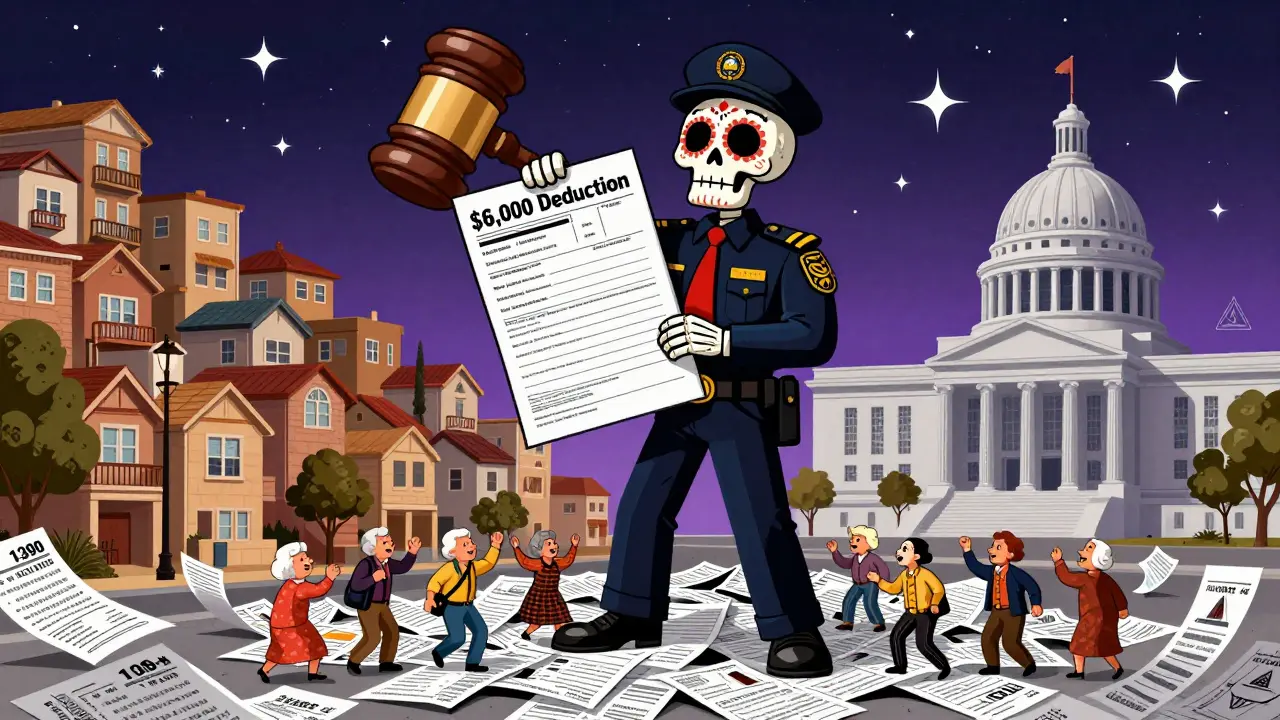
While California tightens the screws, Washington is doing the opposite in key areas. The 119th Congress passed Public Law 119-21, nicknamed the “One, Big, Beautiful Bill,” which overhauled tax rules. The biggest change? A $6,000 deduction for people 65 and older. That’s a direct win for retirees. But it’s not just about savings. The IRS also rolled back the 1099-K reporting threshold from $600 to $20,000. If you’re a freelancer or small business owner who uses PayPal or Venmo, this matters. You’ll get fewer tax forms. Less paperwork. Less stress.But here’s what’s tricky: deregulation doesn’t mean simplicity. When the government removes a rule, you still have to prove you’re not breaking anything else. For example, Medicare Advantage and ACA subsidies are being relaxed at the federal level. That sounds good-until your state adds new rules on top. In California, New York, and Illinois, insurers now face stricter benefit requirements even as federal oversight fades. You can’t assume federal changes make your job easier. You have to check your state’s rules every quarter.
Housing Is Getting a Legal Boost-But Only in California
California’s housing crisis got a legal jolt with AB 130 and SB 131. These bills carved out sweeping exemptions to the California Environmental Quality Act (CEQA), which used to delay projects for years. Now, qualifying housing and infrastructure projects can skip lengthy environmental reviews. The result? Developers estimate approval times will drop by 18 to 24 months. That’s huge. It could mean 15-20% more housing units built each year.But this isn’t a free pass. The law only applies to projects that meet strict affordability and density standards. If you’re a developer, you’ll need to track eligibility rules carefully. If you’re a homeowner in a neighborhood facing new construction, you’ll see changes fast. And if you’re a city planner? You’re now managing a system that’s moving faster than your old tools can handle.
Law Enforcement Can Carry Guns Almost Everywhere-Now
H.R.2243, the LEOSA Reform Act of 2025, passed the House in May and sits in the Senate. If it becomes law, qualified active and retired law enforcement officers will be allowed to carry concealed firearms in places they couldn’t before: school zones, national parks, private property open to the public, and even some federal buildings. States can lower the required training frequency for retired officers, too.This isn’t about politics. It’s about practicality. Officers who retired 15 years ago still carry guns. They’re trained. They’re responsible. But under old rules, they couldn’t legally carry in most places outside their home state. This bill fixes that. But it also creates new legal gray areas. What happens if a retired officer is denied entry to a private business that still bans firearms? Who enforces the rules? Courts will have to sort it out-and that means liability risks for businesses that don’t update their policies.
Supreme Court Changes Are Coming-And They’ll Reshape Rights
The Roberts Court turns 20 in 2025. And this term, it’s poised to make its most consequential rulings in decades. Legal analysts predict major shifts in presidential power, voting rights, and federal agency authority. The court is likely to limit how much power agencies like the EPA or SEC have to write their own rules. That could mean fewer regulations-but also more legal uncertainty.For businesses, this means two things. First, if a federal rule disappears, don’t assume it’s gone forever. States will fill the gap. Second, if you’re in a regulated industry, you’ll need lawyers who understand constitutional law. Bloomberg Law reports legal departments have increased constitutional expertise by 25% since early 2025. That’s not an overreaction. It’s a survival tactic.
Tax Rules Are Shifting-And Your Bookkeeper Needs to Know
The $6,000 deduction for seniors is the headline. But there’s more. The IRS has already issued FS-2025-07 and FS-2025-08, clarifying how the “One, Big, Beautiful Bill” affects Employee Retention Credits and 1099-K reporting. If your accountant is still using 2024 tax guides, you’re at risk. The American Institute of Professional Bookkeepers saw a 40% jump in tax update course enrollments in 2025. That’s not a trend. That’s a warning.Also watch for inflation adjustments for 2026. The IRS confirmed they’ll be released in late 2025, and they’ll include changes from the new law. If you’re filing quarterly estimates or planning retirement contributions, you’ll need updated numbers. Don’t wait for your CPA to tell you. Ask them now.
Compliance Is No Longer a Department-It’s a Company-Wide System
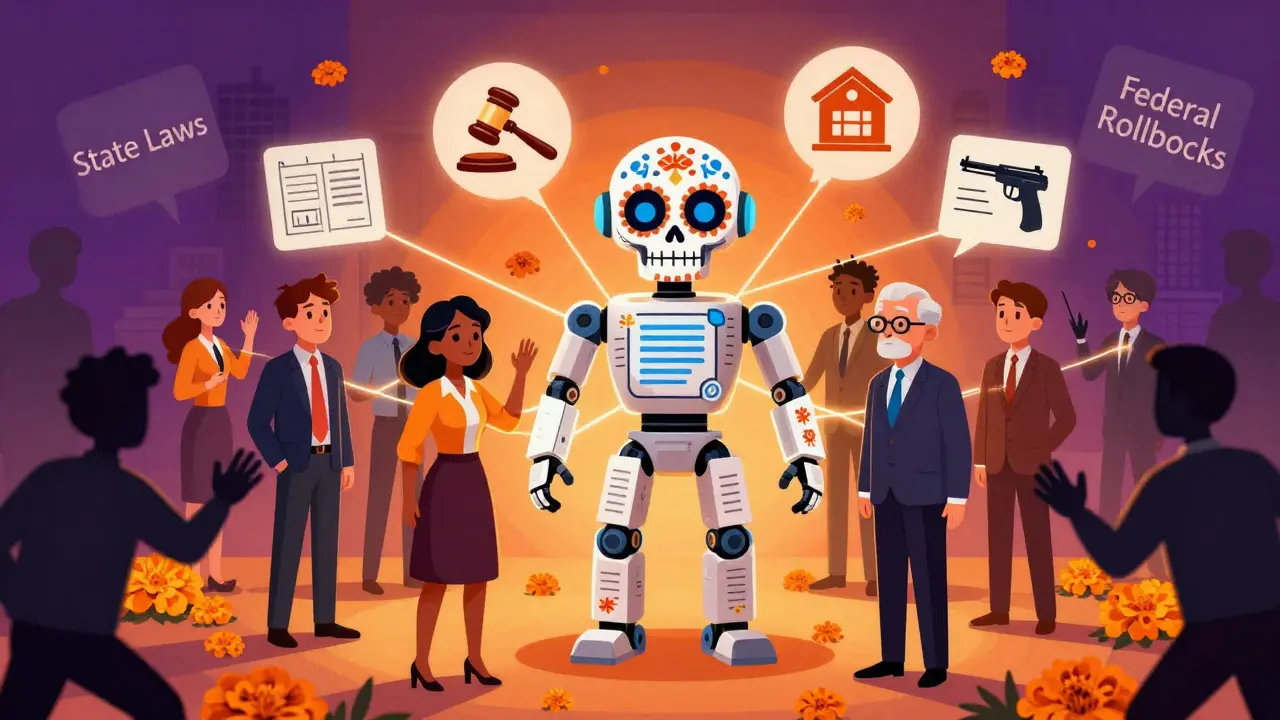
The biggest takeaway? Compliance isn’t something HR or legal handles alone anymore. It’s a company-wide function. RegEd’s data shows organizations that treat compliance as a one-time project are falling behind. Those that succeed have cross-functional teams-HR, legal, finance, IT-working together to track changes in real time.California employers report spending $1,200 to $1,800 per employee on training for AB 406. That’s not a cost. It’s an investment. Companies that didn’t train managers saw a 30% rise in employee complaints within three months of the law taking effect. Meanwhile, Gartner predicts the RegTech market will grow 35% in 2025. AI-powered tools that scan for new laws, flag changes, and auto-update policies are no longer luxury items. They’re essential.
Deloitte found 78% of Fortune 500 companies plan to use AI for regulatory monitoring by 2026. If you’re a small business, you might think that’s out of reach. But cloud-based compliance platforms now cost less than $100 a month. That’s cheaper than hiring a part-time HR assistant. And it’s smarter than hoping your lawyer remembers to call you.
What Happens If You Ignore This?
PwC estimates companies that don’t adapt to regulatory change face 15-25% higher compliance costs over time. That means fines. Lawsuits. Lost licenses. Reputational damage. In California, the Civil Rights Department has already filed 142 enforcement actions against employers for outdated leave notices since October 2025.It’s not about being perfect. It’s about being aware. You don’t need to read every bill. But you do need a system. A calendar. A person responsible. A tool that tells you when something changes.
The law isn’t slowing down. If anything, it’s speeding up. The question isn’t whether you’ll keep up. It’s whether you’re ready to move before the next change hits.
Are new laws in 2025 only affecting California?
No. While California has some of the most visible changes-especially around labor and housing-other states like New York, Illinois, and Washington are also passing major laws. At the federal level, tax rules, firearms regulations, and sentencing guidelines are changing nationwide. The key is that states are expanding rules in areas where the federal government is rolling back oversight, creating a patchwork of requirements.
Do I need to update my payroll system for the 2025 changes?
Yes-if you have employees in California. AB 406 changed how paid sick leave and victims’ leave are calculated and reported. If your payroll software doesn’t reflect the updated FEHA provisions, you’re at risk of underpaying or misclassifying leave. Even if you’re not in California, check your state’s labor laws. Over 37 states passed new employment rules in 2025.
What does the new $6,000 tax deduction mean for me?
If you’re 65 or older and file as an individual, you can now deduct $6,000 from your taxable income for tax years 2025 through 2028. This reduces your tax bill directly. But it doesn’t change your filing status or require extra forms. Just claim it on your 1040. If you’re a dependent or under 65, this doesn’t apply. The IRS has updated instructions in Publication 17 for 2025.
Will the LEOSA Reform Act affect private businesses?
Possibly. If the law passes, qualified law enforcement officers will be allowed to carry concealed firearms in places like shopping malls, restaurants, and parks-even if your business bans guns. You can still post signs prohibiting firearms, but enforcement becomes complicated. You may need to update your security policies and train staff on how to respond. Consult a local attorney to understand your rights under state law.
How can small businesses keep up with all these changes?
Start with three things: 1) Subscribe to your state’s official legal updates (most are free), 2) Use a low-cost RegTech tool like ComplianceQuest or LexisNexis Regulatory, and 3) Assign one person to track changes monthly. You don’t need a legal team. You need a system. Many small business owners spend less than $150/year on tools and still stay compliant.
Is the Supreme Court’s upcoming term going to change everyday business?
Yes. If the Court limits federal agencies’ power to create rules, industries like healthcare, finance, and environmental services could see sudden shifts. For example, if the EPA can’t enforce new emissions standards, states might step in with stricter rules. Businesses need to prepare for regulatory volatility, not just federal inaction. Legal teams are already hiring constitutional law specialists.






15 Comments
Kuldipsinh Rathod December 27, 2025
Man, I just got back from a meeting with our HR team and we’re scrambling to update our leave policies. AB 406 hit us like a truck. We didn’t even realize we were missing the ‘designated person’ part until someone pointed it out. Now we’re rewriting handbooks, training slides, everything. Feels like we’re playing catch-up in a hurricane.
SHAKTI BHARDWAJ December 28, 2025
WHY IS CALIFORNIA ALWAYS THE ONE DRAMATIZING EVERYTHING?? I mean, seriously?? ‘designated person’?? Next they’ll make me fill out a form to prove my dog is emotionally close enough to be my ‘family’!! I’m not paying for that!!
Matthew Ingersoll December 28, 2025
The federal tax deduction for seniors is a solid move. But the real story is the patchwork of state-level rules. I’ve got clients in Texas, Florida, and California-all with completely different compliance needs. Federal deregulation doesn’t mean less work. It means more complexity. You can’t assume anything anymore.
carissa projo December 30, 2025
It’s not just about following rules-it’s about recognizing how deeply these changes reflect our evolving values. The ‘designated person’ clause? That’s not bureaucracy. That’s dignity. It’s saying love isn’t defined by blood, and care isn’t bound by marriage certificates. This is the law catching up to how people actually live. And honestly? It’s beautiful.
josue robert figueroa salazar December 31, 2025
Too many rules. Too many forms. Too many people acting like compliance is a religion. Just stop. Let people do their jobs. The government should get out of the way, not make everyone hire a lawyer to check their pay stubs.
david jackson January 1, 2026
Let me tell you something that keeps me up at night: the Supreme Court’s upcoming rulings. If they gut agency authority, we’re not just talking about EPA guidelines or SEC filings-we’re talking about a legal vacuum. States will rush in, but not uniformly. You’ll have one state requiring carbon tracking and another banning it entirely. Small businesses? They’ll get crushed under the weight of conflicting laws. It’s not chaos-it’s a legal grenade with the pin pulled.
Jody Kennedy January 2, 2026
Guys, I know it feels overwhelming but hear me out-you don’t need to read every bill. You just need one person on your team who checks the state’s legal update portal every Monday. I’ve been doing it for my cousin’s bakery. She spends $80/month on a RegTech tool and hasn’t had a single violation since January. It’s not magic. It’s routine.
christian ebongue January 2, 2026
LEOSA Reform? Cool. Now every retired cop with a grudge can walk into your Starbucks with a Glock. And you can’t even say no because now it’s federal law. Great. Just great. Next thing you know, your lunch break gets interrupted by a 70-year-old veteran who thinks your latte is ‘a threat to public safety’.
jesse chen January 3, 2026
Just wanted to say-thank you for writing this. I’ve been trying to explain to my boss why we can’t just ‘wait and see’ what happens with the new tax rules, and this post nails it. The fact that the IRS already issued FS-2025-07 and -08 means we’re already behind. We’re updating our payroll system this week. No excuses.
Joanne Smith January 5, 2026
They say AI-powered compliance tools are ‘essential’ now. Funny-five years ago, that sounded like sci-fi. Now it’s cheaper than my monthly coffee habit. I used to dread tax season. Now I just hit ‘update’ and let the bot scan for changes. I still check the results-but I’m not the one reading 400 pages of legislative text. Some things just shouldn’t be human jobs anymore.
Prasanthi Kontemukkala January 7, 2026
I come from a small town in India where laws move slowly-but I’ve seen how sudden changes can break people. This post reminds me that even in fast-moving places like California, the goal shouldn’t be to punish mistakes, but to help people adapt. Training isn’t a cost. It’s a bridge. And bridges take time to build-but they save lives.
Alex Ragen January 8, 2026
It’s fascinating, really, how the entire legal landscape is being reconfigured under the guise of ‘progress’-yet no one stops to ask whether these changes are coherent, or merely performative. The ‘designated person’ provision is poetic, yes-but is it jurisprudentially sound? And when federal power recedes, who is left to interpret the constitutional boundaries of state overreach? Are we witnessing the collapse of a coherent legal order-or merely its evolution into something more… decentralized? I’m not sure I like the sound of that.
Lori Anne Franklin January 9, 2026
OMG I just realized my accountant is still using 2024 guides… I’m gonna call them right now. I don’t wanna get audited because I didn’t know about the $6k deduction. This post is a lifesaver!!
Bryan Woods January 10, 2026
There’s a quiet revolution happening here. It’s not in the headlines, but in the spreadsheets, HR portals, and payroll systems being updated across the country. The real winners aren’t the politicians-they’re the small teams who treat compliance like a daily habit, not a quarterly panic. That’s the future.
Ryan Cheng January 11, 2026
For anyone thinking ‘I’m too small for this’-you’re wrong. I run a 3-person design shop. We use a $90/month tool that auto-updates our policies and sends us alerts. We spend less than 3 hours a month on compliance. That’s less time than I spend scrolling TikTok. If you’re not doing this, you’re just gambling with your business. And that’s not smart-it’s reckless.