
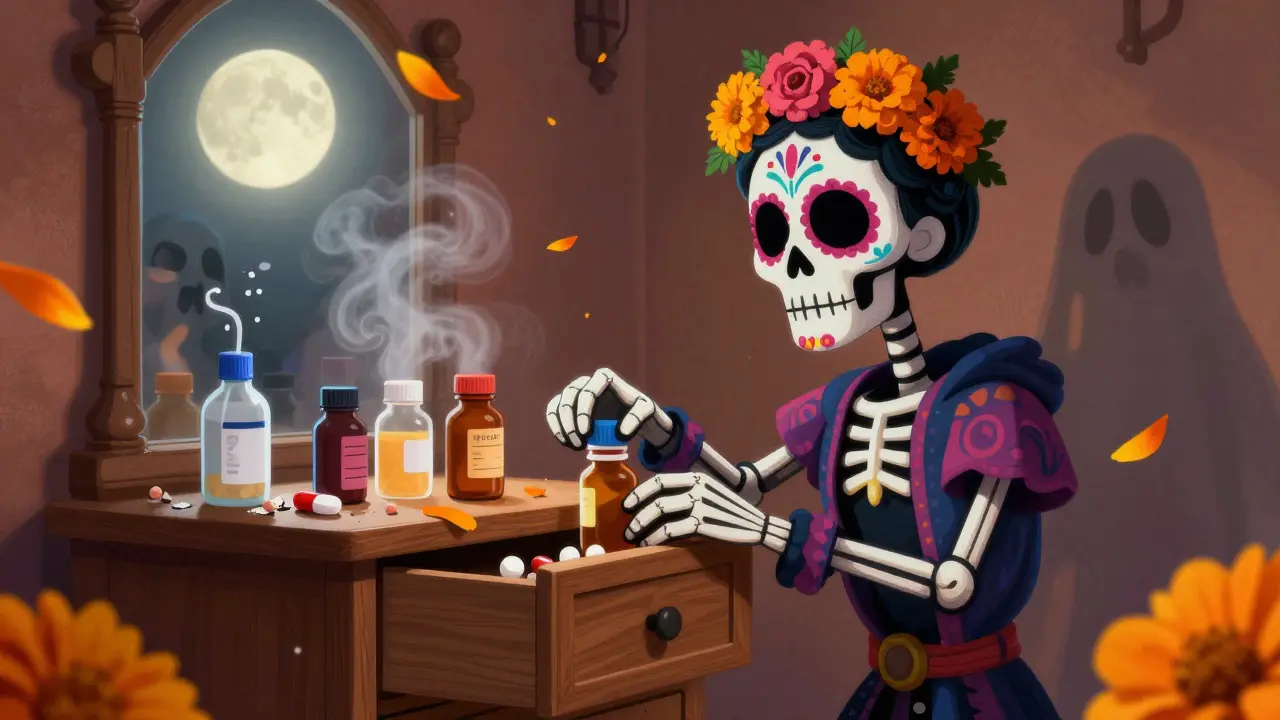
Most people don’t think about where they keep their pills until they find a bottle of antibiotics that looks weird or smells like vinegar. By then, it’s too late. The medication storage habits you’ve had for years - like keeping pills in the bathroom cabinet or near the stove - could be making your drugs less effective, or even dangerous. The good news? Fixing this is simple, cheap, and can save you money and protect your health.
Why Your Pills Might Be Dying Before Their Expiration Date
Expiration dates aren’t just a suggestion. They’re the last day a drug is guaranteed to work as labeled - meaning it still has 90-110% of the strength printed on the bottle. That’s based on strict testing by manufacturers under ideal conditions. But your bathroom? It’s the worst place for meds. A 2023 UCHealth study showed that humidity in bathrooms spikes to 85-95% during showers. That’s enough to break down aspirin three times faster than normal. Heat makes it worse. Storing meds near the kitchen stove? Temperatures can jump 15°C in under 30 minutes. That’s enough to degrade 42% of common antibiotics within three months. The FDA says 37% of premature expiration cases in homes come from bad storage. And humidity? It’s the #1 killer - responsible for 68% of those cases. Your pills aren’t going bad because they’re old. They’re going bad because they’re cooked, steamed, or damp.What the Experts Say About Proper Storage
The United States Pharmacopeia (USP) says solid pills and capsules should be kept between 20-25°C (68-77°F) with humidity below 60%. That’s not a guess - it’s lab-tested science. Liquid meds like insulin or eye drops need even tighter control. Insulin must be refrigerated at 2-8°C (36-46°F) until first use. After that, it’s fine at room temperature for up to 28 days - but only if it’s not sitting in direct sunlight. Nitroglycerin? It’s light-sensitive. Keep it in its original dark glass bottle. Even a clear plastic container can cut its effectiveness by half. And never transfer pills to a pill organizer unless you’re using them within a week - those containers don’t protect against moisture or light. The original prescription bottle isn’t just for labeling. It’s engineered to block UV light. Amber glass blocks 97% of harmful rays. Clear plastic? Only 20%. That’s why your pills degrade faster when you dump them into a random container.Where to Store Medications (And Where Not To)
Here’s the short list:- Do: Store in a cool, dry, dark place - like a bedroom dresser drawer.
- Do: Use a locked cabinet if you have kids or pets.
- Do: Keep the original bottle with the safety cap tightly closed.
- Don’t: Keep meds in the bathroom.
- Don’t: Leave them on the kitchen counter near the oven or microwave.
- Don’t: Store in the car - summer temps can hit 60°C inside.
Signs Your Medication Has Gone Bad
You don’t need a lab test to tell if something’s wrong. Look for these red flags:- Tablets or capsules that are discolored - more than 15% darker or lighter than when you bought them.
- Pills that crumble easily or stick together.
- Liquid meds with visible particles, cloudiness, or strange sediment.
- Aspirin that smells like vinegar - that’s acetylsalicylic acid breaking down.
- Eye drops that change color or develop a strange odor.
How to Track Expirations Before They Hit
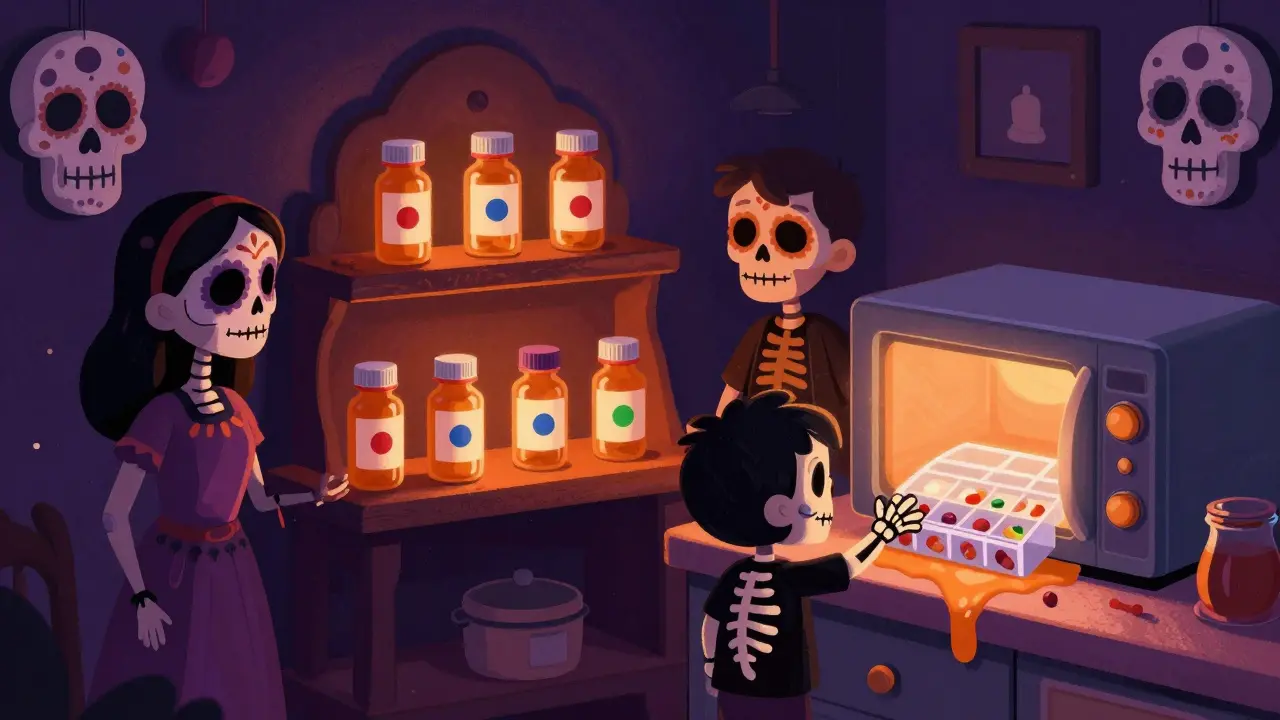
The average household has 12-15 different medications. Tracking them all is hard. But there’s a system that works. The University of Wisconsin’s Research Animal Resources Center used color-coded dot stickers to reduce expired meds by 63%. Here’s how:- Red dot: Expires this year
- Blue dot: Expires next year
- Green dot: Expires in two years
What About Smart Devices and New Tech?
Technology is catching up. Devices like the MedMinder Pro track temperature and humidity inside the pillbox and send alerts if conditions go out of range. They’re not cheap - around $150 - but they’re useful if you’re managing multiple critical meds. Pharmaceutical companies are also improving. Merck’s new heat-stable insulin, approved in December 2023, can stay potent at 30°C for 56 days. That’s a game-changer for people without reliable refrigeration. And new prescription bottles are being tested with built-in silica gel to keep humidity low. Early trials show they cut moisture exposure by 45%. They’re not on shelves yet - but they’re coming.
What to Do With Old or Expired Meds
Never flush them. Never throw them in the trash without mixing them with coffee grounds or cat litter. Both methods are unsafe and pollute water supplies. The safest way? Use a drug take-back program. The DEA runs National Prescription Drug Take Back Day twice a year. Next one is October 26, 2024. There are over 11,000 drop-off locations nationwide - pharmacies, police stations, hospitals. If you can’t wait for the next event, many pharmacies - including CVS and Walgreens - have permanent drop boxes. Ask at the counter. They’re free, secure, and environmentally safe.Why This Matters More Than You Think
The U.S. wastes $20 billion a year on expired meds. That’s not just money - it’s wasted care. People with high blood pressure, diabetes, or heart conditions who take degraded meds are at real risk. A study in JAMA Internal Medicine found rural households lose meds 41% faster than urban ones because they lack climate-controlled storage. And it’s not just about potency. Expired eye drops can grow deadly bacteria. The American Society of Health-System Pharmacists found 78% of out-of-date eye drops were contaminated with Pseudomonas aeruginosa - a bacteria that causes serious eye infections. Proper storage isn’t about being neat. It’s about staying healthy.Start Today: Your 5-Minute Medication Storage Plan
1. Find your meds. Pull out every pill, liquid, patch, and inhaler in your home. 2. Check expiration dates. Write them down or use color dots. 3. Move them. Get them out of the bathroom, kitchen, or car. Put them in a locked drawer or cabinet in a cool, dry room. 4. Keep originals. Never transfer to random containers unless it’s for immediate use. 5. Set a reminder. Pick one day a month - say, the 1st - to check your stash. Do it together if you live with others. That’s it. Five minutes. No apps needed. No gadgets required. Just better habits.Can I still use medicine after the expiration date?
The FDA’s Shelf Life Extension Program found that 90% of military stockpiled drugs remained effective years past their expiration - but only because they were stored in climate-controlled warehouses. Household conditions are different. Heat, moisture, and light degrade meds faster. Don’t assume it’s safe. If it’s expired, and you’re not sure how it was stored, don’t take it.
Is it okay to store pills in the fridge?
Only if the label says so. Most pills don’t need refrigeration - and cold, damp air can actually cause condensation inside the bottle, which leads to moisture damage. Only refrigerate insulin, certain liquid antibiotics, or other meds explicitly labeled for cold storage. Keep them in the center of the fridge, not the door, where temperatures swing.
What if I accidentally left my medicine in a hot car?
Throw it out. Temperatures over 40°C can permanently damage pills and liquids. Even if it looks fine, the chemical structure may have changed. You won’t know if it’s still working - and taking a degraded dose could be dangerous, especially for heart or seizure meds.
Do over-the-counter meds expire faster than prescription ones?
No. Both are tested to the same standards. But OTC meds are often stored worse - left on counters, in purses, or in bathrooms. That’s why they seem to expire faster. It’s not the drug - it’s the storage.
Can I use expired epinephrine auto-injectors?
Never. Epinephrine breaks down quickly when exposed to heat or light. An expired EpiPen may not deliver the full dose during an allergic reaction. If it’s expired, replace it immediately. Your life depends on it working.
Are there any medications that last longer than others?
Yes. Solid tablets like aspirin, ibuprofen, or acetaminophen tend to be more stable than liquids or injectables. But even these can degrade if stored poorly. Always follow the label. If it says “store below 25°C,” don’t ignore it.

8 Comments
Eileen Reilly January 10, 2026
lol i keep my ibuprofen in the bathroom cuz its right next to the toothbrush and i forget to take it otherwise. guess im just a walking lab experiment now.
TiM Vince January 10, 2026
My grandma in rural Kentucky stores all her meds in a shoebox under the bed. No fridge, no drawer, just dust and cat hair. She’s 89 and still walks two miles a day. Maybe the science is wrong, or maybe she’s just tougher than the FDA.
Alice Elanora Shepherd January 12, 2026
Thank you for this. I’ve been telling my sister for years not to keep her insulin in the kitchen cabinet-she swears it’s fine because it’s "not that hot." But last month, her glucose levels spiked for no reason. Turns out the bottle had been near the oven for six months. We moved it to the bedroom drawer, and within a week, her numbers stabilized. This isn’t just advice-it’s life-saving.
Abner San Diego January 13, 2026
So what, now I gotta buy a $150 smart box just to store my allergy pills? Next they’ll be taxing me for not using climate-controlled pill vaults. I’m not a lab rat, I’m a human. Let me live.
steve ker January 14, 2026
Storage guidelines are corporate propaganda. Real medicine doesn’t need climate control. Look at traditional healers in the Global South-they store everything in woven baskets under the sun. And yet people live. Your fear is manufactured.
Sonal Guha January 15, 2026
Aspirin smells like vinegar? That’s just the smell of capitalism rotting from the inside. They make pills to expire. They want you buying more. The science is rigged.
Prachi Chauhan January 17, 2026
Think about it-our bodies are made of water, heat, and change. We survive monsoons and desert heat. Why do we treat pills like fragile glass? Maybe the real problem isn’t storage-it’s how we’ve forgotten how to trust our own biology. The body knows what it needs. The bottle just tells us when to panic.
Christina Widodo January 17, 2026
Wait so if I leave my epinephrine in the car for 10 minutes during a heatwave it’s basically useless? That’s terrifying. I’m moving mine to the glovebox with a cold pack tomorrow. Thanks for the wake-up call.