
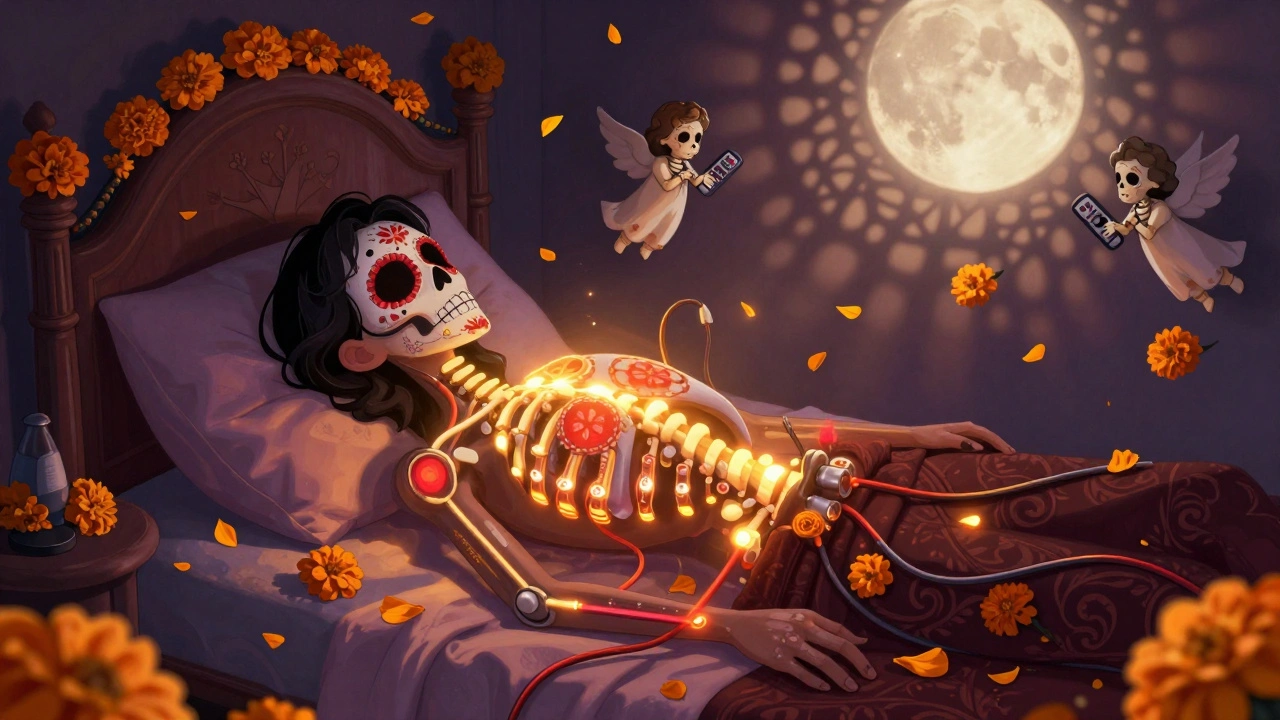
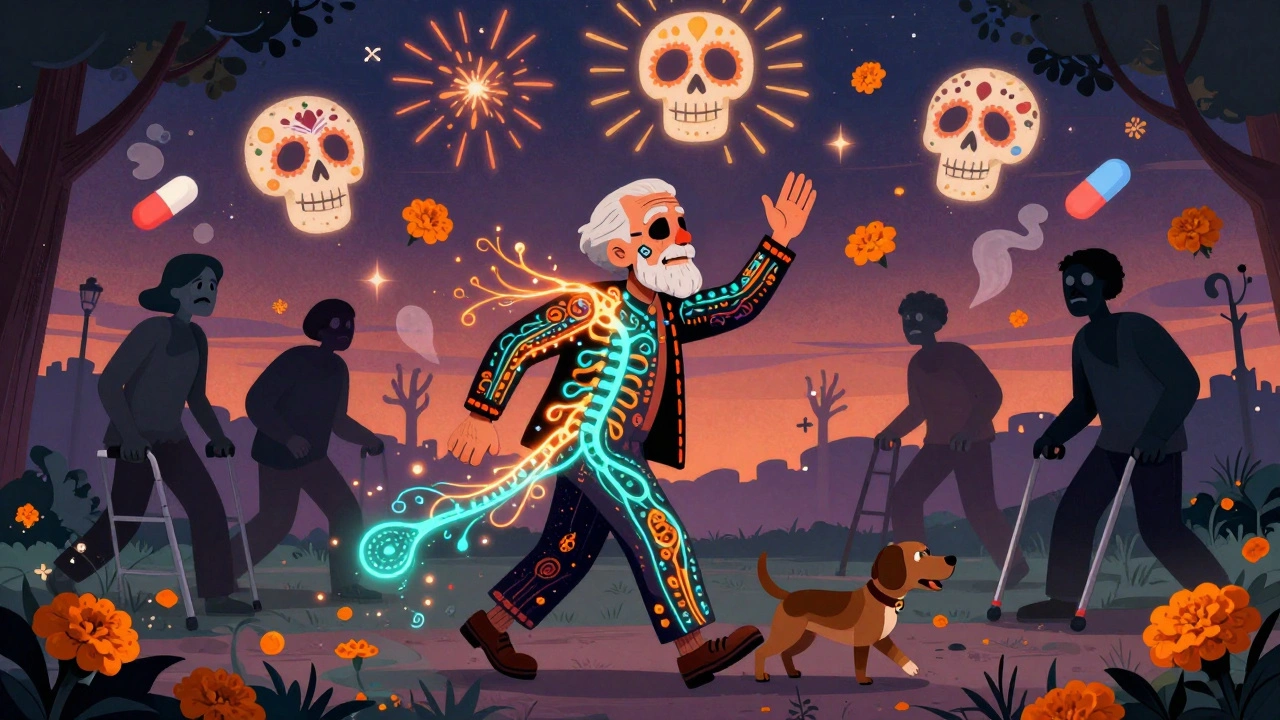
When your back or leg pain won’t quit, no matter how many pills you take or physical therapy sessions you attend, there’s a moment when you start asking: Is there another way? For thousands of people with chronic pain that doesn’t respond to drugs or surgery, spinal cord stimulation (SCS) offers a real alternative. It’s not a cure. But for many, it’s the difference between spending your days in bed and spending them walking the dog, playing with grandkids, or sleeping through the night.
What Is Spinal Cord Stimulation?
Spinal cord stimulation is a medical device that sends mild electrical pulses to your spinal cord to block pain signals before they reach your brain. Think of it like a noise-canceling headset for your nerves. Instead of hearing the scream of pain, your brain gets a gentle tingling-or sometimes, nothing at all. The system has three parts: thin wires (leads) placed near your spinal cord, a small battery-powered generator (like a pacemaker), and a remote you use to turn it on and adjust settings.
This isn’t new. The first device was implanted in 1967. But today’s systems are smarter, safer, and more effective than ever. Modern SCS doesn’t just rely on the old-school tingling sensation (called paresthesia). Newer models use high-frequency pulses (up to 10,000 Hz) or burst patterns that mimic how your nerves naturally fire. These can reduce pain without any tingling, which many patients prefer.
Major brands like Boston Scientific, Medtronic, and Abbott offer different systems. Boston Scientific’s WaveWriter Alpha™ Prime, for example, delivers multiwave therapy and has a battery that lasts up to 24 months. Medtronic’s Intellis™ 2 can sense when you stand up or lie down and adjust the stimulation automatically. These aren’t just upgrades-they’re changes that make the therapy more comfortable and reliable.
Who Is a Good Candidate for SCS?
Not everyone with pain is a candidate. SCS isn’t for headaches, muscle strains, or arthritis that responds to physical therapy. It’s designed for chronic, nerve-related pain that’s lasted at least 6 to 12 months and hasn’t improved with other treatments.
The best candidates usually have one or more of these conditions:
- Failed back surgery syndrome (pain that continues after spine surgery)
- Complex regional pain syndrome (CRPS), especially in the arms or legs
- Chronic leg or back pain from nerve damage (like diabetic neuropathy or sciatica)
- Pain that hasn’t responded to opioids, nerve blocks, or physical therapy
But physical diagnosis isn’t enough. Psychological health matters just as much. Studies show patients with untreated depression or anxiety are 35% less likely to benefit from SCS. If you’re struggling emotionally, therapy or medication may be needed before the device is even considered.
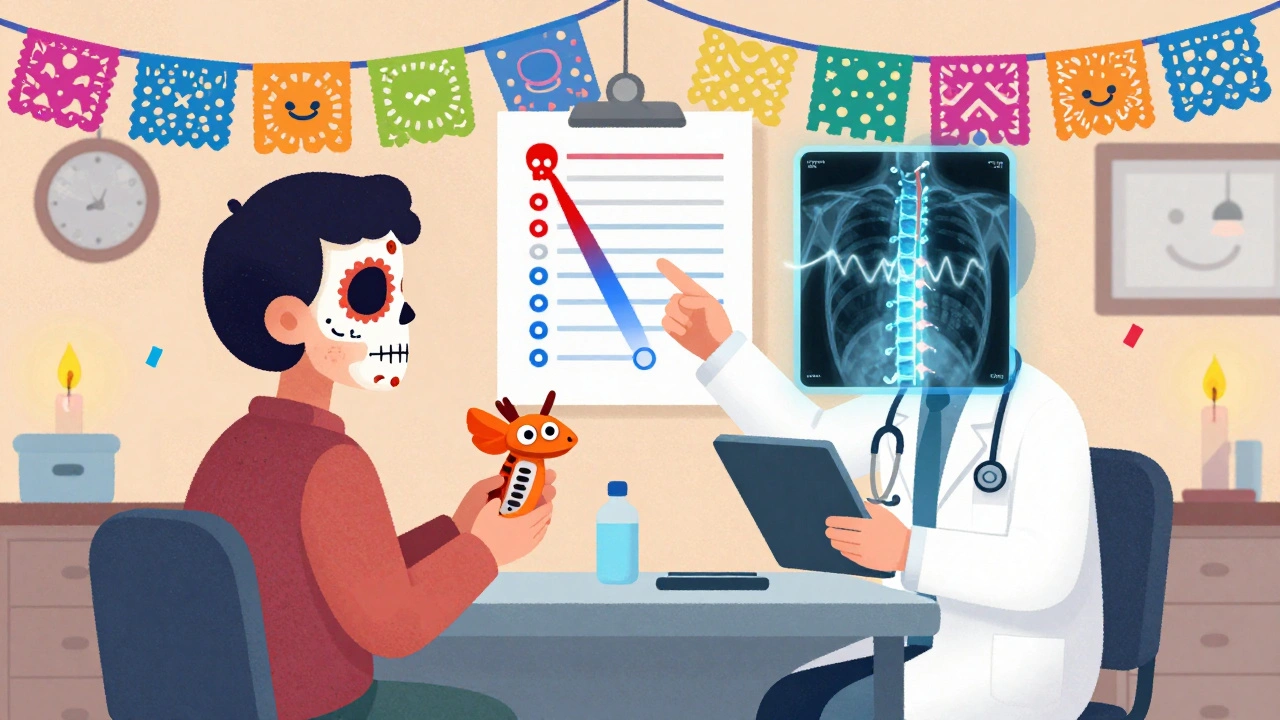
Another key factor: you need to pass a trial. Before implanting a permanent device, doctors put temporary leads in for 5-7 days. You wear an external generator and see if your pain drops by at least 50%. If it doesn’t, the permanent implant won’t be recommended. This trial step is critical-over 40% of people who skip proper screening end up disappointed.
How It Works: The Two-Step Process
Getting SCS isn’t a single surgery. It’s a two-phase process.
Phase 1: The Trial
You’re sedated, and thin leads are threaded through a needle into the epidural space near your spine-no major incision needed. These leads connect to a small external box you carry in your pocket or clip to your belt. You go home and use it for about a week. You keep a pain diary, noting how much relief you get during daily activities. If your pain drops by half or more, you move to phase two.
Phase 2: Permanent Implant
This is a same-day outpatient surgery lasting 60-90 minutes. The temporary leads are replaced with permanent ones, and the generator is placed under your skin-usually in your lower back, abdomen, or buttock. You’ll be awake during part of the procedure so the doctor can test the stimulation and make sure it covers your pain area correctly.
Recovery is quick. Most people walk the same day and return to light activities within a week. But it takes 2-4 weeks to fully adjust to the device. Programming isn’t set-and-forget. You’ll need follow-up visits to tweak the settings. About 89% of patients need at least one adjustment in the first month.
How Effective Is It?
Success isn’t guaranteed, but the numbers are strong for the right people.
- 56% to 85% of properly selected patients get at least 50% pain relief
- 72% achieve that level of relief with SCS, compared to just 41% with optimized drug therapy alone
- At 12 months, SCS users cut their opioid use by 57%. By 24 months, it’s 63%
- 82% of patients on review sites say they regained the ability to walk without relying on painkillers
But long-term results vary. One 2022 meta-analysis found only 52% of patients still had significant pain relief after five years. That doesn’t mean SCS failed-it means the body adapts, or the pain changes. Regular follow-ups and device programming help maintain results.
Patients who report the best outcomes often describe not just less pain, but more life: sleeping through the night, playing with kids, going to church, driving without fear. One Reddit user, ‘PainWarrior89,’ documented 78% pain reduction after getting a Boston Scientific system-but also needed two revision surgeries within 18 months for lead adjustments. That’s the trade-off: better quality of life, but sometimes at the cost of more procedures.
What Are the Risks and Downsides?
SCS is safe for most, but it’s not risk-free.
- Lead migration: The wires can shift. This happens in about 15% of cases within six months and causes uneven or lost stimulation. It’s the most common reason for revision surgery.
- Infection: Occurs in 3.8% to 7.2% of cases. If it happens, the device must be removed.
- Battery replacement: Most generators last 5-9 years. Replacing them requires another minor surgery.
- Cost: The total cost-device, surgery, follow-ups-is $25,000 to $45,000 in the U.S. Medicare covers it for approved conditions, but many patients still pay $5,000-$10,000 out of pocket.
- MRIs: Not all SCS devices are MRI-safe. Newer models like Boston Scientific’s Precision Montage™ MRI are compatible with full-body scans at 1.5T and 3.0T. Older ones may not be. Always check your device’s compatibility before scheduling an MRI.
And then there’s the learning curve. You have to understand how to use the remote, recognize when the stimulation feels off (a sign the lead may have moved), and stick to usage guidelines. A 2021 study found 22% of failures were due to poor patient compliance.
SCS vs. Other Pain Treatments
How does SCS stack up against the alternatives?
| Treatment | Effectiveness | Invasiveness | Cost | Long-Term Use |
|---|---|---|---|---|
| Spinal Cord Stimulation (SCS) | High (50%+ relief in 56-85%) | Medium (surgical implant) | $25K-$45K | Yes, with device replacement |
| Opioid Medications | Medium (tolerance builds) | Low | $100-$800/month | High risk of dependence |
| TENS Unit | Low to Medium (temporary relief) | None | $50-$200 | No |
| Peripheral Nerve Stimulation | Good for limbs (81% success) | Medium | $20K-$35K | Yes |
| Spinal Fusion Surgery | Variable (30-70% success) | High | $50K-$100K | Permanent |
SCS beats opioids in safety and long-term outcomes. It’s more effective than TENS for chronic nerve pain. Compared to spinal fusion, it’s less invasive and doesn’t permanently alter your spine. But for pain limited to one arm or leg, peripheral nerve stimulation might work better.
What’s Next for SCS?
The future is adaptive. Boston Scientific’s Evoke® system, currently in trials, uses real-time neural feedback to automatically adjust stimulation. Early results show 83% of patients achieved meaningful pain relief at 12 months-without needing manual programming.
Other innovations include longer-lasting batteries, smaller devices, and systems that sync with smartphones. The goal? Make SCS feel less like a medical device and more like a natural part of daily life.
Right now, the market is growing fast. The global SCS industry was worth $2.14 billion in 2022 and is expected to hit $4.03 billion by 2029. Medicare coverage is expanding, and more insurers are following suit. But the biggest challenge isn’t technology-it’s access. Too many patients don’t know SCS exists, or their doctors don’t refer them early enough.
Final Thoughts
Spinal cord stimulation isn’t magic. It doesn’t erase pain. But for people who’ve tried everything else, it can give back control. It’s not about being pain-free-it’s about being able to live again.
If you’ve been stuck in a cycle of pills, doctor visits, and frustration, ask your pain specialist about SCS. Make sure you get a trial. Be honest about your mental health. Understand the costs and risks. And remember: this isn’t a last resort. It’s a smart next step.
Is spinal cord stimulation the same as a pacemaker?
They’re similar in that both are implanted devices with batteries and wires, but they do very different things. A pacemaker regulates your heartbeat. Spinal cord stimulation blocks pain signals in your nerves. The placement, purpose, and programming are completely different.
Can I still get an MRI with a spinal cord stimulator?
It depends on the device. Older models are not MRI-safe. Newer ones like Boston Scientific’s Precision Montage™ MRI and Medtronic’s Intellis™ are designed to be compatible with full-body 1.5T and 3.0T scans-but only under specific conditions. Always check your device’s manual and talk to your doctor before scheduling an MRI.
Will SCS eliminate my need for pain medications?
Many patients reduce or stop opioids after getting SCS. One study showed a 63% drop in opioid use after two years. But SCS doesn’t replace all medications. You might still need anti-inflammatories, nerve pain meds like gabapentin, or muscle relaxants. The goal is to reduce dependence, not necessarily eliminate all drugs.
How long does the battery last in a spinal cord stimulator?
Most devices last 5 to 9 years, depending on usage and settings. High-frequency or burst modes use more power, so they drain the battery faster. Newer models like Boston Scientific’s WaveWriter Alpha™ Prime have batteries that last up to 24 months without recharging. Some are rechargeable and can last 10+ years with regular charging.
What if the stimulator doesn’t work for me?
If you don’t get at least 50% pain relief during the trial, the permanent implant won’t be done. If you’ve had the device for a while and it stops working, it could be lead migration, battery depletion, or nerve adaptation. Most issues can be fixed with reprogramming, lead adjustment, or battery replacement. In rare cases, the device can be removed.
Is SCS covered by insurance?
Yes, Medicare covers SCS for approved conditions like failed back surgery syndrome, CRPS, and chronic leg/back pain. Most private insurers follow Medicare’s guidelines. However, pre-authorization is required, and some insurers demand proof that you’ve tried and failed other treatments first. Out-of-pocket costs can still be $5,000-$10,000 depending on your plan.


13 Comments
Jaswinder Singh December 2, 2025
Man, I’ve been through this hell for 8 years. Tried every pill, every therapy, every gimmick. SCS wasn’t magic, but it gave me back my life. Walked my daughter down the aisle last year-couldn’t have done it without this thing.
Michelle Smyth December 4, 2025
Let’s be honest-this is just neuro-engineering capitalism dressed up as salvation. The industry’s pushing SCS like it’s the holy grail while quietly burying the 48% failure rate and the fact that most patients end up needing revisions. It’s not innovation-it’s institutionalized dependency.
Sean McCarthy December 6, 2025
56% to 85% success rate? That’s not a guarantee. That’s a gamble. And you’re talking about implanting a device that can migrate, get infected, or die after 5 years. You’re trading one problem for three new ones. Why not just accept that some pain is permanent?
Bee Floyd December 7, 2025
I’ve seen people come out of the shadows after SCS-literally. One guy I knew went from hiding in his basement to coaching little league. It’s not perfect. But if it lets someone hold their grandkid without wincing? That’s worth the risk. Not everyone needs to do it. But everyone deserves to know it exists.
Jeremy Butler December 8, 2025
One must contemplate the ontological implications of neurotechnological intervention: Is the self altered when pain signals are artificially modulated? If the brain no longer perceives suffering as an intrinsic signal, does one’s identity become contingent upon external apparatus? This is not merely medical-it is metaphysical.
Courtney Co December 9, 2025
I had it done and it was the worst decision of my life. The tingling drove me insane. The battery died after 18 months and I had to pay $8,000 out of pocket. My doctor never told me about the lead migration risk. Now I’m stuck with a useless metal box in my back and a $15,000 bill. Don’t let them sell you hope.
Shashank Vira December 9, 2025
Of course, the Western medical-industrial complex thrives on such interventions. In India, we have yoga, Ayurveda, and mindfulness-tools that heal the root, not just mask the symptom. Why are we so eager to bolt machines onto our bodies when ancient wisdom has always been available?
Souvik Datta December 11, 2025
Listen-I’ve coached 17 people through SCS trials. Most quit because they didn’t track their pain properly. You need to journal. You need to move. You need to be honest. This isn’t a magic button. It’s a tool. And tools need users who show up. If you’re not ready to work with it, don’t get it.
Priyam Tomar December 11, 2025
Everyone’s acting like this is groundbreaking. Newsflash: it’s been around since 1967. And the fact that 40% of people skip screening and then blame the device? That’s not the tech’s fault-it’s the medical system’s failure to educate. Also, ‘neural feedback’ systems? That’s just AI pretending to be a doctor.
Declan Flynn Fitness December 13, 2025
My cousin got the Boston Scientific one last year. Took 3 adjustments, but now he bikes 10 miles every Sunday. He says the remote feels like a TV dial-simple. No tingling, just quiet. And yeah, he still takes gabapentin. But he sleeps. He laughs. That’s the win.
Irving Steinberg December 14, 2025
Just got mine installed last week 😎 Took 2 weeks to program but now I’m walking to the coffee shop without a cane. Life’s not perfect but it’s mine again. Also-yes, I can get an MRI now. No drama. Just tech that works 🙌
Patrick Smyth December 16, 2025
I wish someone had told me this before I spent $40,000 and lost my job because I couldn’t sit through the recovery. My wife left me. My kids don’t understand why I’m still in pain. This isn’t a miracle. It’s a gamble that broke us.
Eric Vlach December 16, 2025
Patrick, I’m so sorry you went through that. I’ve seen it too. But hear me-you’re not alone. A lot of people feel this way. The system failed you, not you failing the system. There are support groups. There are advocates. You still have value. Even if the device didn’t fix everything, your courage did.