

When a child needs medicine, giving the right amount isn’t just about following a label-it’s about weight. Unlike adults, kids don’t get a standard pill or dose. A 10-pound baby and a 70-pound toddler might both need the same antibiotic, but their doses will be wildly different. That’s because pediatric medication dosing relies on weight-based calculations, usually in milligrams per kilogram (mg/kg). Get it wrong, and you risk underdosing-making the medicine useless-or overdosing, which can land a child in the hospital.
Why Weight Matters More Than Age
Age-based dosing sounds simple: "Give this much to a 2-year-old." But here’s the problem: a 2-year-old can weigh anywhere from 9 to 15 kilograms. That’s a 67% difference in body mass. If you gave the same dose to both, the lighter child might get too much, and the heavier one might not get enough. A 2022 study in Pediatric Pharmacology found that switching from age-based to weight-based dosing reduced medication errors by 42%. That’s not a small improvement-it’s life-saving.The Math Behind the Dose
There are three main ways to calculate a weight-based dose, and all start with the same thing: knowing the child’s weight in kilograms. In the U.S., scales often show pounds, so you have to convert. The rule is simple: 1 kilogram = 2.2 pounds. If a child weighs 33 pounds, divide by 2.2. That’s 15 kg. Skip this step, and you’re already off.Once you have the weight in kg, multiply it by the dose per kg. For example, amoxicillin is often prescribed at 20 mg/kg/day. For a 15 kg child: 15 × 20 = 300 mg total per day. If that’s split into two doses, each dose is 150 mg.
Now, if the medicine comes as a liquid, you need to figure out the volume. Say the concentration is 250 mg per 5 mL. To give 150 mg, you set up a ratio: 250 mg is to 5 mL as 150 mg is to X mL. Solve for X: (150 × 5) ÷ 250 = 3 mL. That’s the amount to draw up in the syringe.
These steps-weight conversion, total daily dose, division by frequency, concentration conversion-are the backbone of safe dosing. Miss one, and you’re in danger territory.
Common Mistakes That Put Kids at Risk
The Institute for Safe Medication Practices says 80% of pediatric dosing errors involve weight unit confusion. That means someone wrote down 33 kg instead of 15 kg because they forgot to convert pounds. That’s a 200% overdose. In 2021, a 15 kg child received 10 times the correct dose of amoxicillin because of this exact error. They ended up in the ER with severe vomiting and dehydration.Another big mistake? Confusing "mg/kg/day" with "mg/kg/dose." If a prescription says "40 mg/kg/day," and the parent gives the full daily dose all at once, that’s dangerous. The dose must be split-usually every 8 or 12 hours-based on how the drug is processed by the body.
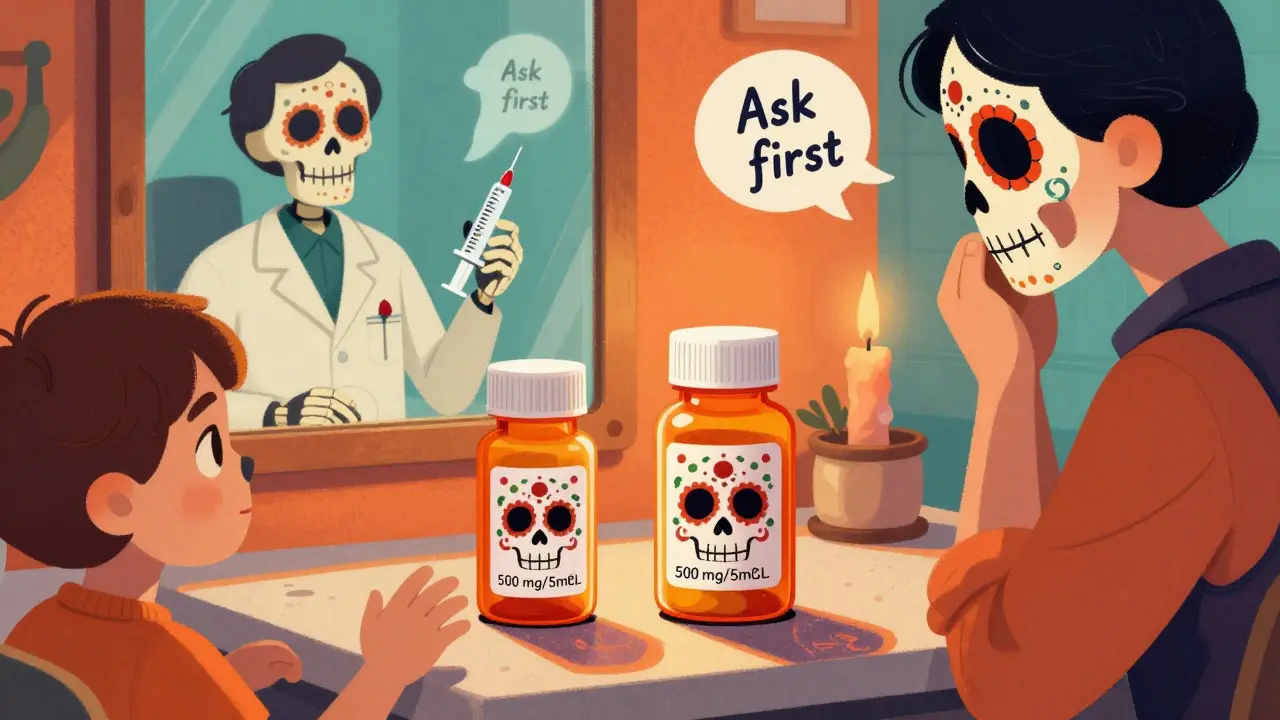
And then there’s concentration. Acetaminophen (Tylenol) comes in two common forms: 160 mg per 5 mL for children and 500 mg per 5 mL for adults. A parent might grab the adult version thinking "stronger is better," not realizing they’re giving over three times the intended dose. St. Louis Children’s Hospital reports that 65% of parental dosing errors come from mixing up these concentrations.

When Weight Isn’t Enough
For some drugs-especially chemotherapy agents like vincristine or certain anticonvulsants-body surface area (BSA) is used instead of weight. BSA accounts for both height and weight. The Mosteller formula is the standard: √(height in cm × weight in kg ÷ 3600). A child who is 97 cm tall and weighs 16.8 kg has a BSA of about 0.67 m². That number then gets plugged into the drug’s dosing formula.But even BSA has limits. Some medications, like buprenorphine for pain, cap the dose at a certain weight-say, 0.4 mg/kg/hour-even if the child weighs more. Giving more than that doesn’t help and can cause breathing problems. So, weight is the starting point, but clinical judgment always comes last.
Double-Check Protocols Are Non-Negotiable
Hospitals don’t let one nurse calculate a pediatric dose alone. Two licensed staff members must verify it. This isn’t bureaucracy-it’s a safety net. A 2023 JAMA Pediatrics study showed that electronic health records (EHRs) with built-in calculators cut dosing errors by 57%. Epic and Cerner now auto-convert pounds to kilograms and calculate the dose when you enter the weight. But even then, human review is required.The American Academy of Pediatrics updated its guidelines in March 2023 to require dual verification for all high-alert medications-drugs where a mistake can be deadly. This includes insulin, opioids, and chemotherapy agents. The Joint Commission, which accredits U.S. hospitals, lists improper pediatric dosing as a National Patient Safety Goal. If your hospital doesn’t have a double-check system, it’s not following the standard of care.
What Parents Need to Know
If you’re giving medicine at home, here’s what you must do:- Always weigh your child on a digital scale. Don’t guess.
- Convert pounds to kilograms: divide by 2.2.
- Check the concentration on the bottle. Is it 160 mg/5 mL or 250 mg/5 mL? They’re not the same.
- Use the syringe that came with the medicine. Never use a kitchen spoon.
- If the prescription says "mg/kg/day," ask: "How many times a day should I give it?"
- Never give Benadryl to children under 2 unless a doctor says so. Even if they weigh enough, their liver can’t handle it.
Many parents feel pressured to do the math themselves because they’re told to "follow the doctor’s instructions." But the truth is, pediatric dosing is complex. If you’re unsure, call the pharmacy. Call the doctor. Don’t guess.
The Future of Pediatric Dosing
New tools are emerging. Children’s Hospital of Philadelphia is testing AI systems that compare a calculated dose against thousands of past cases. If the system flags a dose as unusually high or low for that weight, it alerts the prescriber. In early trials, it caught 92% of potential errors.Also, the FDA now requires all new pediatric drugs to include weight-based dosing data in their labeling. And EHRs are starting to force users to enter weight in both pounds and kilograms, so there’s no room for confusion.
But no tool replaces clear communication. The most advanced calculator won’t fix a prescription that says "mg/kg/d"-a vague abbreviation that confuses even experienced nurses. The Institute for Safe Medication Practices now pushes for "mg/kg/day" or "mg/kg/dose" as the only acceptable formats.
Weight-based dosing isn’t going away. It’s the gold standard. And while technology helps, the real safety comes from slowing down, checking twice, and asking questions when something doesn’t feel right.
Why is weight in kilograms used instead of pounds for pediatric dosing?
Weight in kilograms is the international standard for medication dosing because it’s part of the metric system, which is used in all scientific and medical research. Dosing guidelines from drug manufacturers, medical journals, and hospitals are all based on mg/kg. Using pounds increases the chance of calculation errors, especially since the conversion factor (2.2) isn’t a whole number. Most hospitals in the U.S. require weight to be recorded in kilograms first, even if the scale shows pounds.
Can I use a kitchen spoon to give my child liquid medicine?
No. Kitchen spoons vary widely in size-a teaspoon can hold anywhere from 3 to 7 mL. Always use the syringe, dropper, or cup that came with the medicine. These are calibrated to deliver the exact amount prescribed. Using a spoon can lead to under- or overdosing by 50% or more.
What should I do if my child’s weight changes suddenly?
If your child gains or loses more than 10% of their weight-say, after an illness or rapid growth-you should contact their doctor before giving the next dose. A child who was 15 kg and now weighs 17 kg may need a higher dose. A child who lost weight due to illness may need a lower dose. Always update the weight with your provider before continuing medication.
Is it safe to give adult medicine to a child if I adjust the dose?
No. Adult medications often contain ingredients or concentrations that are unsafe for children. Even if you calculate the right weight-based dose, the formulation might include fillers, preservatives, or extended-release agents that aren’t approved for kids. Always use a pediatric-specific formulation. If one isn’t available, consult a pediatric pharmacist or doctor before proceeding.
Why are some medications capped at a certain weight?
Some drugs, like buprenorphine or certain chemotherapy agents, have a maximum safe dose regardless of weight. Giving more than the cap doesn’t improve effectiveness-it increases risk of side effects like respiratory depression or organ damage. These caps are based on clinical studies and are built into hospital protocols. Always follow the cap, even if the math says the child "should" get more.




13 Comments
Janelle Pearl March 10, 2026
I’ve seen so many parents panic because they think they have to be math geniuses to give their kid medicine. But honestly? You don’t. Just write down the weight in kg, read the label twice, and use the syringe. That’s it. No guesswork. No kitchen spoons. If you’re unsure? Call the pharmacy. They’re there to help, not judge.
And please, for the love of all that’s holy, don’t use adult Tylenol. I’ve had to explain this to three moms this month alone. It’s not a ‘stronger dose’-it’s a death sentence waiting to happen.
Dan Mayer March 12, 2026
lol i cant believe people still dont get this. i work in er and last week a kid came in with liver faileure cause mom gave him adult advil bc she thought 'it'll work faster' lol. 200mg/kg? nope. 500mg per 5ml? nope. you cant just wing it. its not cooking. its not a game. this is a child. ugh.
Neeti Rustagi March 12, 2026
While the article presents a technically accurate framework for pediatric dosing, I must emphasize that the underlying assumption-that weight alone is sufficient-is dangerously incomplete. In clinical practice, renal and hepatic maturity, developmental stage, and pharmacogenomic variability significantly modulate drug metabolism in children. A 15 kg child with cystic fibrosis may require 30% higher dosing than a neurotypical peer of the same weight. Weight is the starting point, not the endpoint. The omission of these factors in public-facing materials is a systemic failure in risk communication.
Ray Foret Jr. March 14, 2026
I love that they mentioned the AI system testing at CHOP! That’s next-level stuff. My cousin works there and said the AI flagged a dose that was 40% too high for a 5-year-old with asthma. They caught it before the nurse even drew it up. 🤯 Technology is finally catching up to how smart kids’ bodies are. We need this everywhere. 👏
Robert Bliss March 14, 2026
I just want to say thank you for writing this. My daughter had a bad reaction last year because we used a measuring spoon. We didn’t know. Now we have a whole drawer of syringes. I wish someone had told us earlier. Please keep sharing this stuff. Parents are scared and clueless. You’re helping.
Leon Hallal March 16, 2026
They say weight-based dosing is the gold standard but what about the fact that 70% of pediatric doses are prescribed by non-pediatricians? ER docs, family practitioners, even dentists are dosing kids with no training. The system is broken. No amount of syringes or calculators fixes that. We need mandatory pediatric pharmacology certification for anyone writing prescriptions for kids. Period.
APRIL HARRINGTON March 16, 2026
OMG I JUST REALIZED I DID THIS TO MY KID LAST MONTH 😭 I GAVE HER THE ADULT AMOXICILLIN BECAUSE THE KID ONE WAS OUT AND I THOUGHT 'SHE'S BIG ENOUGH' I DIDN'T EVEN THINK ABOUT THE CONCENTRATION I'M SO SORRY I'M CRYING RIGHT NOW
Peter Kovac March 17, 2026
The assertion that dual verification reduces errors by 57% is statistically misleading. The JAMA Pediatrics study had a sample size of 1,200 cases across 12 hospitals. The confidence interval for the reduction ranges from 41% to 68%. Moreover, the study did not control for prescriber experience level, making the causal claim untenable. This is not a safety protocol-it’s a performative compliance ritual.
Judith Manzano March 19, 2026
I’m a nurse and I’ve been doing this for 12 years. I still double-check every single time. Even when the EHR auto-calculates, I go back and do the math in my head. Why? Because I’ve seen too many near-misses. One time, a mom brought in a bottle labeled '250 mg/5 mL'-but it was actually 500 mg/5 mL. The label was smudged. If I hadn’t been skeptical, that baby wouldn’t have made it. Trust, but verify. Always.
rafeq khlo March 19, 2026
The real issue is not dosing-it's that we let parents do math at home. The entire system should be hospital controlled. No more prescriptions for home use. Every child should be given medication under supervision. If you're giving a child medicine without a nurse present you're a liability. End of story.
Morgan Dodgen March 21, 2026
Let’s be real-this whole weight-based system is a corporate shill. The metric system was pushed by Big Pharma because it makes dosing harder for laypeople, forcing dependency on hospitals and pharmacies. They profit from confusion. The FDA’s new labeling rules? A distraction. The real solution? Standardized pediatric doses-like 50mg, 100mg, 200mg pills-no math required. But that would cut their margins. So they keep us scared and calculating.
Philip Mattawashish March 22, 2026
You think this is about safety? It’s about control. The medical establishment doesn’t want parents empowered. They want you dependent. They want you calling, asking, doubting, second-guessing. That’s how they maintain power. The 'double-check' protocol? It’s not for safety-it’s to create liability shields for institutions. The real hero is the parent who refuses to play along. The one who says, 'I’ll do the math myself because I know my child best.'
Tom Sanders March 22, 2026
I read all this and just thought… why not just make one standard dose for kids under 50 lbs? Like a universal pediatric pill? Why do we need all these formulas? It’s overcomplicated. Just give them one safe dose. Problem solved.