

When your kidneys stop working, your body doesn’t just slow down-it starts poisoning itself. That’s uremia. It’s not a disease you can see in a mirror. It’s the quiet, creeping buildup of waste your kidneys used to flush out. And when it hits, you don’t just feel tired. You feel nausea that won’t quit. You itch so badly you scratch until your skin bleeds. And you start wondering: is this normal, or is it time for dialysis?
What Uremia Really Feels Like
Uremia isn’t a single symptom. It’s a whole system crashing. Your kidneys aren’t just filters-they’re your body’s detox crew. When they fail, toxins like urea, creatinine, and p-cresyl sulfate pile up. These aren’t just numbers on a lab report. They’re what make you feel like you’ve been poisoned.
Nausea is one of the most common signs. About 68% of people with stage 5 chronic kidney disease (CKD) report it. It’s not occasional morning sickness. It’s constant. You eat a bite of food and feel like you’re going to throw up. The taste of meat turns metallic. Coffee tastes like ash. You lose weight because eating feels like a chore you can’t handle. One patient on a kidney forum said he lost 18 pounds in two months because food tasted like sand.
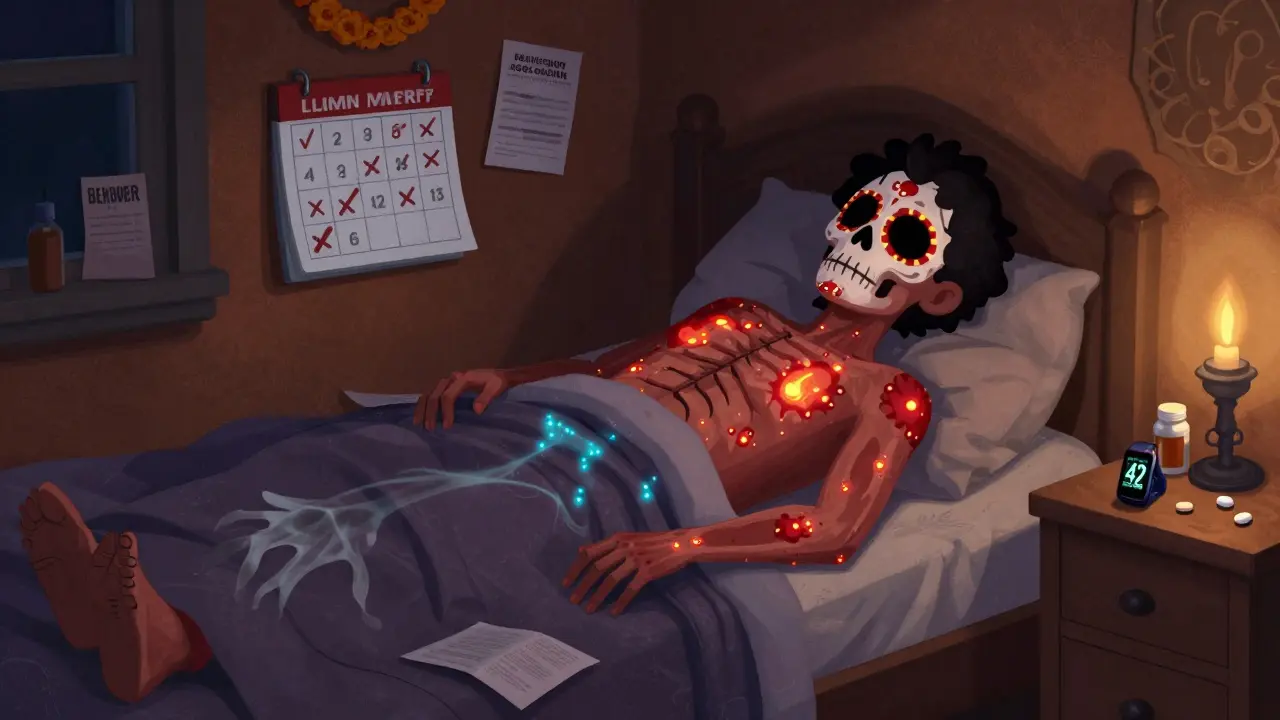
Then there’s the itch. Not a dry skin itch. Not a bug bite. This is deep, unrelenting, all-over itching called uremic pruritus. It hits 7 out of 10 people on dialysis. It doesn’t stay in one spot. It moves. Your back itches. Your legs itch. Your scalp itches. And it gets worse at night. You wake up scratching. You bleed. You stop sleeping. Your Fitbit shows your sleep score drops from 85 to 42. You start avoiding people because you’re embarrassed. You change jobs because you can’t focus. One Reddit user described it as scratching until you bleed-then still itching.
Why These Symptoms Happen
It’s not just urea. That’s the old myth. Modern research shows it’s a mix of toxins, inflammation, and nerve changes. The itching? It’s tied to high levels of CRP, a marker of inflammation. People with severe itch have CRP levels nearly triple those without it. The nausea? It’s caused by p-cresyl sulfate and indoxyl sulfate-waste products that directly trigger the brain’s vomiting center.
And here’s the catch: your skin looks fine. No rash. No bumps. No hives. That’s why so many people get misdiagnosed. They go to dermatologists, allergists, even psychiatrists. A 2022 University of Michigan poll found 41% of patients saw three or more doctors before someone said, “This is your kidneys.” The average delay? Nearly nine months.
Doctors use the 5-D Itch Scale to measure it: Duration, Degree, Direction, Disability, Distribution. A score over 12 means severe. Over 15? That’s a red flag. It’s not just uncomfortable-it’s disabling.
When Does Dialysis Become Necessary?
The old rule was: wait until your creatinine hits 10 or your eGFR drops below 5. That’s outdated. The 2023 KDOQI guidelines say: start dialysis when symptoms control your life-not when a number hits a threshold.
Here’s what triggers it:
- Weight loss of 5% or more in 3 months from nausea and loss of appetite
- Itch so bad you can’t sleep or function (5-D score >15)
- Fluid overload that doesn’t respond to diuretics
- Pericarditis (inflammation around the heart) confirmed by ultrasound
- Confusion, seizures, or bleeding from platelet dysfunction
The IDEAL trial showed no survival benefit for starting dialysis early (eGFR 10-14) versus late (eGFR 5-7). But here’s the twist: the late group had better quality of life-if their symptoms were managed well. That means: don’t rush dialysis just because your eGFR is 8. But don’t wait until you’re vomiting all day and can’t sleep.
Doctors now look at your life, not just your lab results. If you’re losing weight, skipping meals, avoiding showers because itching is unbearable, or canceling plans because you’re too tired-those are signs. Your kidneys are failing. Your body is drowning in waste. Dialysis isn’t a failure. It’s a rescue.
What Happens Before Dialysis Starts?
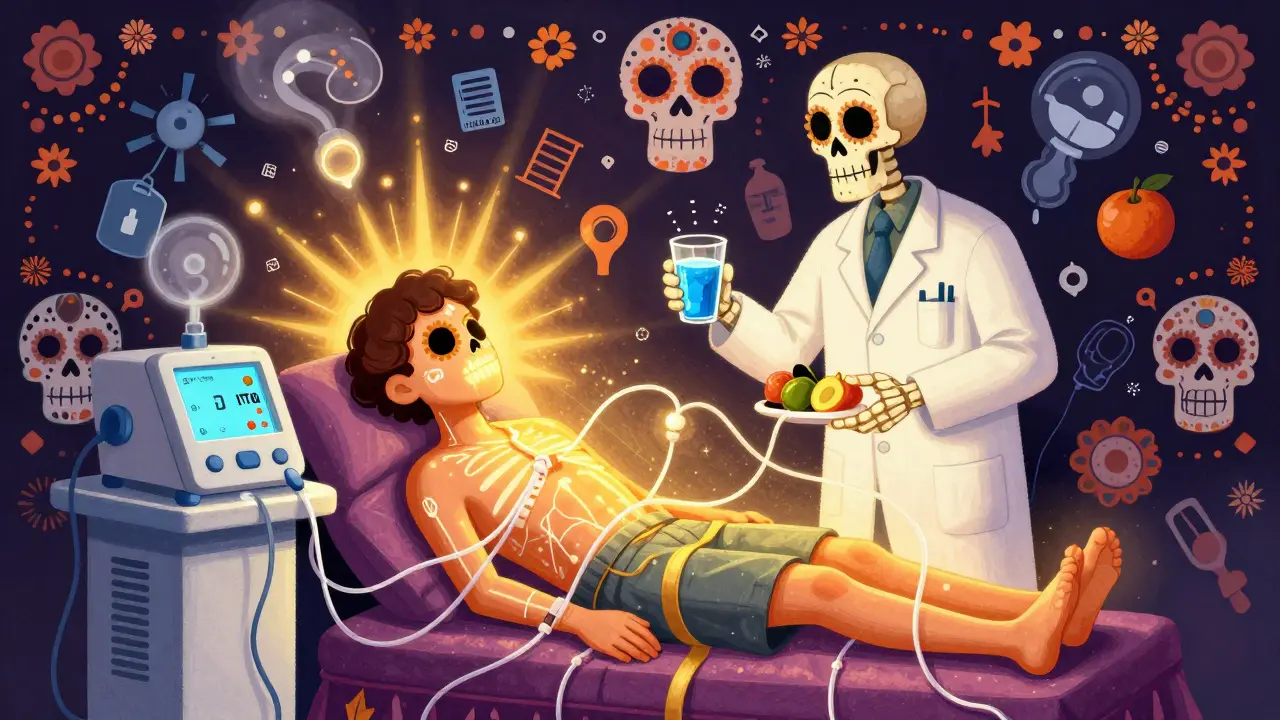
You don’t just wait. You fight. First, optimize dialysis if you’re already on it. Target a Kt/V of at least 1.4-that means your sessions are removing enough toxins. If you’re not on dialysis yet, your doctor might start you on:
- For nausea: Ondansetron (Zofran) 4mg up to three times a day. If that doesn’t work, domperidone (Motilium)-but watch for heart rhythm risks.
- For itch: Gabapentin (Neurontin), starting at 100mg at night, slowly increased. It doesn’t cure it, but it dulls the nerve signals. Difelikefalin (Korsuva), an IV drug approved in 2021, reduces itch by over 30% in weeks. Nalfurafine, a newer oral option, is showing even better results in trials.
- For phosphate: Binders like sevelamer or lanthanum to lower phosphate levels. High phosphate makes itching worse. Target: under 5.5 mg/dL.
- For inflammation: Diet changes, avoiding processed foods, reducing sodium and phosphorus.
Many patients get relief with just these steps. But if you’re still itching, still nauseated, still losing weight after 4-6 weeks? Dialysis is next.
The Cost of Waiting
Delaying dialysis isn’t brave. It’s dangerous. People with severe uremic itching spend $8,400 more per year on healthcare. Why? More ER visits. More hospital stays. More infections. One study found they’re hospitalized twice as often as those without itching.
And there’s a racial gap. Black patients wait 3.2 months longer than white patients before starting dialysis-even when symptoms are identical. That delay leads to 18% higher hospitalization rates. It’s not just medical. It’s systemic.
That’s why the NIH just funded $47 million for uremic symptom research. We’re finally starting to treat the symptoms-not just the numbers.
What to Do If You’re Feeling This
If you have kidney disease and you’re experiencing:
- Constant nausea that makes you skip meals
- Itching that keeps you awake at night
- Unexplained weight loss
- Confusion, fatigue, or shortness of breath
Don’t wait. Don’t assume it’s “just aging.” Don’t go to a dermatologist first. Go to your nephrologist. Bring a symptom log: when the nausea hits, how bad the itch is, how many hours you slept, what you ate. Use the 5-D Itch Scale if you can. Write it down.
Ask: “Is this uremia? Is it time for dialysis?” Don’t let them say, “Your numbers aren’t bad enough.” Your life matters more than a number.
Dialysis isn’t the end. It’s the start of regaining control. One patient said after starting: “I slept through the night for the first time in three years. I tasted food again.” That’s not a miracle. That’s medicine working.
What’s Coming Next
Future guidelines may not even use eGFR as the main trigger. The 2024 KDIGO conference is pushing for patient-reported outcomes. If your itch score hits 15 on the new PROMIS-Itch scale, you qualify for dialysis-even if your eGFR is 12.
New drugs are coming. Nemifitide, a kappa-opioid agonist, reduced itch by 45% in trials. Non-opioid options are being prioritized because gabapentin is often overused in kidney patients, leading to dangerous side effects.
The goal isn’t just to keep you alive. It’s to let you live.
Is nausea always a sign of kidney failure?
No, nausea has many causes-gastroenteritis, pregnancy, migraines, medications. But if you have chronic kidney disease (CKD) and nausea is new, persistent, and paired with fatigue, itching, or loss of appetite, it’s likely uremic. A BUN level above 80 mg/dL and creatinine above 8 mg/dL strongly suggest uremia. Always check with your nephrologist.
Why does kidney failure cause itching?
It’s not dry skin. It’s toxins like indoxyl sulfate and p-cresyl sulfate building up in your blood. These trigger inflammation and irritate nerve endings in your skin. High levels of CRP (a marker of inflammation) are common in itchy kidney patients. Your skin may look normal, but your nerves are screaming. That’s why antihistamines don’t help-this isn’t an allergy.
Can you manage uremic itching without dialysis?
Yes, but only temporarily. First-line treatments include gabapentin, phosphate binders, and optimizing dialysis if you’re already on it. Difelikefalin (Korsuva) is an FDA-approved IV drug that reduces itch by over 30% in weeks. Nalfurafine, a newer oral option, is showing even better results. But if these don’t work after 4-6 weeks, and symptoms are severe, dialysis is the only long-term solution.
How do I know if I’m ready for dialysis?
Don’t wait for a number. Ask yourself: Are you losing weight? Can you sleep? Do you avoid food because it makes you sick? Does itching stop you from working or spending time with family? If yes, it’s time to talk to your nephrologist. The 2023 KDOQI guidelines say dialysis should start when symptoms become unmanageable-not when eGFR hits 5 or 10. Your quality of life matters more than a lab result.
Is dialysis the only treatment for uremic symptoms?
No, but it’s the most effective. Before dialysis, you can manage symptoms with medications like ondansetron for nausea and gabapentin or difelikefalin for itching. Diet changes, phosphate control, and avoiding triggers like processed foods help. But if symptoms persist despite treatment, dialysis is the only way to remove the toxins causing them. A kidney transplant is the only cure-but dialysis keeps you alive while you wait.





10 Comments
Isaac Jules January 5, 2026
Uremia isn't some fancy medical buzzword-it's your body screaming for help while doctors stare at eGFR numbers like they're tarot cards. 68% nausea? 70% itching? That's not 'bad lab results,' that's a fucking emergency. I've seen patients die waiting for 'the right number.' Stop playing god with kidney function charts and start listening to the patient who can't sleep because their skin is on fire.
Lily Lilyy January 7, 2026
Thank you for writing this with such care. If you or someone you love is suffering like this, please know you are not alone. There is hope. Dialysis is not the end-it is a bridge back to life. Many people go on to travel, hug their grandchildren, taste coffee again. You deserve to live without pain. Reach out. Ask for help. You are worthy of relief.
Susan Arlene January 7, 2026
itch so bad you bleed then still itch?? yep. that’s uremia. no rash. no reason. just your nerves going full alarm mode. i lost 20lbs in 3 months cause food tasted like dirt. docs kept giving me antihistamines. like bro its not allergies its my kidneys throwing a riot inside me
Joann Absi January 8, 2026
AMERICA IS FAILING ITS KIDNEY PATIENTS!!! 🇺🇸🔥 Why are black patients waiting 3 MONTHS LONGER?! This isn't medicine-it's systemic neglect! The NIH funding $47M? Too little too late! We need national dialysis NOW policy! Stop letting Big Pharma and lazy docs decide who lives and who suffers! #DialysisIsAHumanRight
Jeane Hendrix January 8, 2026
Can someone clarify the difference between Kt/V and eGFR in this context? I'm trying to understand why Kt/V >1.4 matters more than creatinine levels when managing symptoms. Also, is there data on how often difelikefalin is prescribed off-label before dialysis initiation? I'm curious about real-world access barriers.
Rachel Wermager January 8, 2026
Uremic pruritus is mediated by kappa-opioid receptor dysregulation secondary to elevated endogenous opioid peptides and inflammatory cytokines like IL-6 and TNF-alpha. Gabapentin is a GABA analog that modulates calcium channels, but its efficacy plateaus due to renal clearance issues. Difelikefalin is a peripherally restricted kappa-opioid agonist with a half-life of 12 hours-ideal for nocturnal pruritus. Nalfurafine’s oral bioavailability is 89% in CKD patients, per phase 3 trials. You're welcome.
Leonard Shit January 8, 2026
my aunt started dialysis after 4 years of itching. she said the first night she slept without scratching? she cried. not from pain. from peace. i wish more docs understood that numbers don't feel the itch. they just count it.
Katelyn Slack January 9, 2026
thank you for this. i’ve been too scared to tell my nephrologist how bad the itching is. i thought it was ‘in my head.’ now i know it’s not. i’m making an appointment tomorrow. i’m bringing my symptom log. i deserve to feel better.
Matt Beck January 11, 2026
Life isn’t about surviving numbers… it’s about tasting coffee again 🤍
One day you’ll look back and realize dialysis didn’t steal your life-it gave it back. You’re not broken. You’re adapting. And that’s brave.
Ryan Barr January 11, 2026
Stop delaying. Start dialysis. Numbers lie. Suffering doesn’t.