

Most people assume that a generic pill is just a cheaper version of the brand-name drug-and for the most part, they’re right. The FDA says generics must have the same active ingredient, strength, and dosage as the original. But if you’ve ever switched from brand-name levothyroxine to a generic and suddenly felt more tired, anxious, or off-balance, you’re not imagining it. Thousands of patients report real changes after a switch. And while science says generics are equivalent, biology doesn’t always agree.
What ‘Bioequivalent’ Really Means
The FDA requires generic drugs to deliver between 80% and 125% of the active ingredient in the bloodstream compared to the brand-name version. That’s a huge range. Two different generic versions of the same drug can be 45% apart in how fast they’re absorbed-and still both be considered “bioequivalent.” Think of it like two cars that both get 25 miles per gallon on average, but one sputters in cold weather and the other hesitates on hills. Same label, different behavior. This gap matters most for drugs with a narrow therapeutic index (NTI). These are medications where the difference between a helpful dose and a dangerous one is tiny. Levothyroxine, warfarin, phenytoin, carbamazepine, and digoxin fall into this category. For levothyroxine, even a 10% change in blood levels can throw thyroid hormone balance out of whack. A 2019 JAMA Internal Medicine study found that nearly 24% of patients switching from Synthroid to generic levothyroxine had thyroid-stimulating hormone (TSH) levels that went outside the safe range within six months. That’s more than one in five people.It’s Not Just the Active Ingredient
The pill you swallow is 80-99% inactive ingredients. Fillers, dyes, binders, coatings, and preservatives make up most of the tablet. These don’t treat your condition-but they can change how your body handles the drug. One generic version might use cornstarch as a filler; another might use lactose. For people with sensitivities, that’s enough to trigger reactions. Asthmatics, for example, can have severe breathing issues from bisulfites, a preservative used in some generic formulations. The Merck Manual notes that 5-10% of asthmatics react to these chemicals. Even small differences in coating can affect absorption. A tablet that dissolves too slowly might not release enough drug early on. One that dissolves too fast might spike blood levels and cause side effects. For medications like bupropion (used for depression and smoking cessation), patients on Reddit and Drugs.com report headaches, anxiety, and mood swings after switching to certain generics. One analysis of 472 comments found 63% of complaints centered on generic bupropion, with over 30% describing severe headaches.When Switching Makes a Difference
Not all drugs behave the same when switched. For metformin, used for type 2 diabetes, multiple studies show no meaningful difference in blood sugar control between brand and generic. But for antiepileptic drugs, the story is different. A 2018 study in Epilepsia followed 1,250 patients and found 17% had breakthrough seizures after switching from brand-name lamotrigine to generics-nearly double the rate of those who stayed on the original. The same pattern shows up with warfarin, a blood thinner. A slight change in how quickly the drug enters the bloodstream can mean the difference between a clot and a bleed. That’s why the American College of Chest Physicians now recommends checking INR levels within 3-5 days after any switch. Pharmacists at CVS and Walgreens have started blocking automatic substitutions for NTI drugs unless the doctor approves it. That’s happening in about 2.3% of all generic fills-but those are the cases that matter most.
What Patients Are Saying
Patient experiences don’t always match clinical data. On Drugs.com, 38% of people taking generic levothyroxine reported worse symptom control than with Synthroid. Nearly 28% said they felt more fatigued. Almost 20% noticed mood swings or brain fog. ThyroidChange, a patient advocacy group, surveyed nearly 5,000 thyroid patients in 2023. Over 72% said their symptoms got worse after switching to generic. More than half needed a dose adjustment just to feel normal again. These aren’t outliers. A 2022 survey of 3,215 community pharmacists found that 68% had seen patients have adverse reactions after switching between different generic brands of the same drug. Over 40% said it happened “frequently”-more than five cases a month. When patients go back to the original brand, symptoms often improve. That’s not placebo. That’s physiology.Why the System Allows This
The FDA’s 80-125% bioequivalence standard was designed to balance cost and access. Generic drugs save the U.S. healthcare system over $370 billion a year. If every generic had to match the brand exactly, prices would stay high. But the system assumes everyone reacts the same. It doesn’t account for individual biology. The European Medicines Agency uses a tighter range-90-111%-for NTI drugs. That’s why fewer generics are approved there. But they also have fewer reported issues. The U.S. prioritizes volume; Europe prioritizes consistency. Neither is wrong. But the U.S. system leaves patients to figure out the consequences.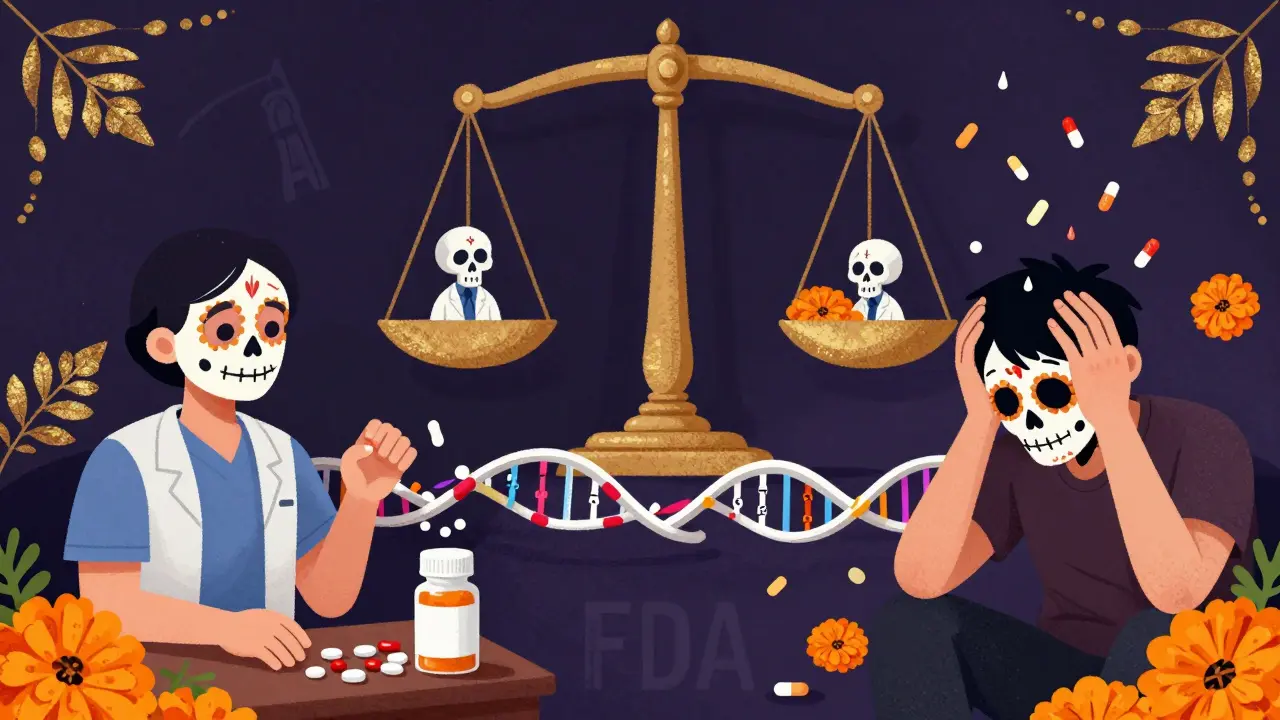




15 Comments
Kiran Plaha January 6, 2026
I switched to generic levothyroxine last year and felt like a zombie for three weeks. My doctor said it was all in my head. Turns out, my TSH shot up. Now I ask for the same brand every time. No more guessing games.
Simple stuff, really.
Matt Beck January 6, 2026
So… the FDA says 80–125% is ‘equivalent’?? 😳 That’s like saying two pizzas are the same if one has 80% cheese and the other has 125%… and then you eat both and throw up from the second one. 🍕🤮
Our system is built on spreadsheets, not human bodies. We’re not widgets. We’re messy, biological snowflakes. 🌧️🧬
Beth Templeton January 6, 2026
People are shocked generics cause issues? Wow. Groundbreaking. Next you’ll tell me water can be wet.
Tiffany Adjei - Opong January 6, 2026
Let’s be real - if you’re one of those people who ‘feel different’ on generics, you probably also think your phone is spying on you because it autocorrects ‘coffee’ to ‘tea.’
Also, the FDA isn’t out to get you. They’re just trying to keep pills affordable for the 90% of people who don’t magically turn into vampires after a pill change.
Also also - your ‘mood swings’ are probably just caffeine withdrawal.
Ryan Barr January 8, 2026
The FDA’s bioequivalence standard is a product of utilitarian economics. To demand perfection is to ignore the cost-benefit calculus that underpins modern pharmaceutical access.
Also, your ‘body doesn’t care’ is a poetic lie. Bodies care about dosage. Not branding.
Cam Jane January 9, 2026
Hey - if you’ve noticed a change after switching generics, don’t brush it off. Track it. Write down how you feel. Energy. Sleep. Mood. Brain fog. Bring it to your doctor. Don’t let them dismiss you. You’re not crazy. Your body’s giving you data.
And if your pharmacist switches your med without telling you? Ask why. Demand the same manufacturer. It’s your right. You’re not being difficult - you’re being smart.
Also - check the inactive ingredients. Lactose? Sulfites? Dyes? Those can wreck your day. Use the FDA’s database. It’s free. You’ve got this.
And if you’re on warfarin or levothyroxine? Never let a generic switch happen without a follow-up blood test. Seriously. Don’t wait. Your life depends on those numbers.
Dana Termini January 10, 2026
I get why this is frustrating. I’ve been on levothyroxine for 12 years. Switched generics twice. Felt awful both times. Went back to Synthroid - and boom, normal again.
I don’t blame the system. I blame the lack of transparency. Pharmacies should have to say which manufacturer it is. Simple.
Patients deserve to know what’s in their pills. Not just the active ingredient - the whole thing.
Let’s make that happen.
Amy Le January 11, 2026
Europe is better? Of course they are. They’re all about ‘safety’ and ‘consistency’ - like they’re raising children, not treating adults.
We have freedom here. Freedom to save money. Freedom to choose. If you can’t handle a little variability, maybe you shouldn’t be on a drug with a narrow therapeutic index.
Also - if your thyroid is that sensitive, why aren’t you on brand name from the start? Stop being a victim. Take responsibility.
Stuart Shield January 12, 2026
Man, I’ve been a pharmacist for 22 years. I’ve seen people cry because their generic made them feel like they were stuck in slow motion.
One woman came in sobbing - said she couldn’t hold her baby because she was too dizzy. Switched back to Synthroid? She hugged me. Said she felt like herself again.
It’s not about money. It’s about dignity. People deserve to feel like themselves. Not like a lab experiment.
Lily Lilyy January 12, 2026
Dear friends, I want to remind you that your health is sacred. Every pill you take is a promise. And when that promise changes without warning, it shakes your trust. That’s okay. It’s human.
Speak up. Write to your representative. Ask for transparency. You are not alone. And you are worthy of consistency.
Keep going. You are strong. 💪❤️
Katelyn Slack January 14, 2026
i switched to generic and got a rash?? i thought it was the laundry but nope. checked the ingredients. lactose. i’m lactose intolerant. my doc didn’t even ask. oops.
now i always check the fda thing. thanks for the heads up.
Jeane Hendrix January 14, 2026
From a clinical pharmacology perspective, the intra-individual variability in Cmax and AUC for NTI drugs like levothyroxine often exceeds the FDA’s 80–125% bioequivalence threshold, especially when switching between different generic manufacturers. The therapeutic window is narrow, and excipient-induced alterations in gastric pH or motility can significantly impact dissolution kinetics - particularly with enteric-coated formulations.
Moreover, pharmacogenomic polymorphisms in UGT1A1 and DIO1 genes modulate thyroid hormone metabolism, meaning two patients with identical TSH levels may have divergent intracellular T3 availability. This is why patient-reported outcomes often diverge from population-level bioequivalence data.
It’s not placebo. It’s pharmacokinetic heterogeneity.
Melanie Clark January 16, 2026
Big Pharma is running this. Synthroid is owned by a company that makes the generic too. They’re making double the profit. They don’t care if you feel like crap. They care about the stock price.
They even let the same company make the brand AND the generic. That’s not a coincidence. That’s a scam.
And they’re hiding the inactive ingredients because if you knew what was really in there, you’d never take it.
They’re poisoning us slowly. Wake up.
Harshit Kansal January 17, 2026
bro i switched to generic bupropion and i cried for 3 days straight. i didn’t even know i was crying. just… tears. everywhere.
my dog stared at me like i was a ghost.
switched back to brand. i’m human again.
why does this happen??
Brian Anaz January 17, 2026
Look. If you’re complaining about generics, you’re part of the problem. We spend billions on healthcare because people want the ‘best’ even when the ‘good enough’ works for 95% of the population.
Stop whining. Get over it. The system works. You just don’t like it.