
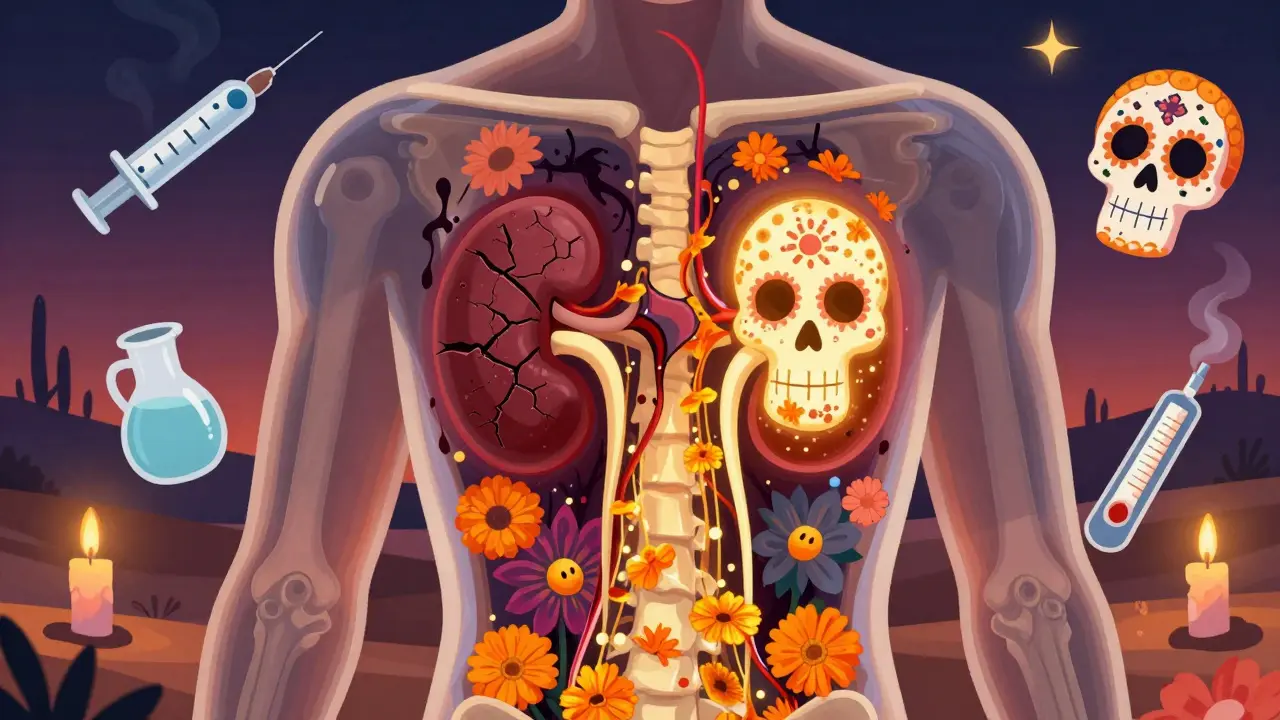
When your kidneys suddenly stop working like they should, it’s not just a lab result-it’s a medical emergency. Acute Kidney Injury (AKI) doesn’t wait for a warning sign. It can hit in hours, especially if you’re sick, dehydrated, or on certain medications. Unlike chronic kidney disease, which creeps in over years, AKI is sudden, often reversible, but deadly if ignored. About 13 million people worldwide experience it every year, and for those in the hospital, especially in intensive care, the risk jumps to 20-30%. The good news? If caught early, many people recover full kidney function. The bad news? Too often, it’s missed until it’s too late.
What Happens When Your Kidneys Shut Down
Your kidneys don’t just make urine. They filter waste, balance fluids, regulate electrolytes, and control blood pressure. When they’re injured, toxins build up, fluids pile up in your lungs and legs, and your body’s chemistry goes haywire. The most common sign? Less urine. Most people with AKI produce less than 400 mL a day-sometimes as little as 100 mL. But here’s the twist: about 22% of cases show normal urine output. You can feel fine and still be in kidney danger. That’s why doctors rely on blood tests, not just symptoms.High creatinine levels tell the story. Normal levels? Around 0.6 to 1.2 mg/dL for women, 0.7 to 1.4 mg/dL for men. In AKI, creatinine jumps by at least 0.3 mg/dL in 48 hours-or more than 50% above your baseline. If your creatinine was 0.9 and now it’s 1.2, that’s a red flag. And it’s not just creatinine. Blood urea nitrogen (BUN) climbs too, often above 20 mg/dL. These numbers don’t lie. But they don’t always show up fast enough.
Why Your Kidneys Stop Working
AKI isn’t one disease. It’s three different problems with different causes-and different treatments.Prerenal AKI (60-70% of cases) means your kidneys aren’t getting enough blood. It’s not a kidney problem-it’s a circulation problem. Think severe dehydration from vomiting or diarrhea, major blood loss after trauma, or heart failure. Your kidneys sense low pressure and shut down to conserve fluid. Give them blood flow back, and they usually wake up. A 500-1000 mL IV fluid bolus can turn things around in hours. Many patients recover fully if treated within 24-48 hours.
Intrarenal AKI (25-35% of cases) means real damage inside the kidney. The most common cause? Acute tubular necrosis (ATN). This happens when kidney cells die from toxins or lack of oxygen. Aminoglycoside antibiotics, contrast dye used in CT scans, or even prolonged low blood pressure can trigger it. Glomerulonephritis-where the kidney’s filtering units get inflamed-also falls here. Lupus or infections can cause this. Treatment? Stop the poison. Use steroids for inflammation. Sometimes, you need plasma exchange. Recovery takes weeks, and not everyone gets back to 100%.
Postrenal AKI (5-10% of cases) is all about blockage. Your kidneys are fine, but urine can’t get out. In men over 60, enlarged prostate causes 65% of these cases. In others, it’s kidney stones, tumors, or blood clots. If the blockage is bilateral, pressure backs up and damages the kidneys. Relief is fast: a stent or catheter can restore flow in minutes. But if it’s ignored for days, permanent damage can set in.
The Warning Signs You Can’t Ignore
Symptoms vary wildly. Some people feel fine. Others are in crisis.- Swelling in legs, ankles, or feet (68% of cases)
- Shortness of breath (42% of hospitalized patients)
- Extreme fatigue (75% of cases)
- Confusion or trouble thinking (33% of older adults)
- Nausea or vomiting (58% of cases)
- Flank pain (27% of intrarenal cases)
- Chest pain (15% of severe cases, from heart lining inflammation)
And don’t forget: many cases are silent. Routine blood work during a hospital stay catches AKI before symptoms appear. That’s why labs are your first line of defense.
Complications Can Kill
Left untreated, AKI doesn’t just hurt-it can kill.- Fluid overload can flood your lungs, causing pulmonary edema (30-40% of severe cases)
- Potassium spikes above 5.5 mEq/L (hyperkalemia) can stop your heart-25% of patients need emergency treatment
- Acid buildup in the blood (metabolic acidosis) affects 35% of cases
- Pericarditis from toxin buildup causes chest pain in 15% of untreated patients
And even if you survive, your kidneys may never fully recover. One in five AKI survivors develops chronic kidney disease within a year. Each episode raises your long-term risk of needing dialysis by over eight times. That’s why follow-up isn’t optional-it’s essential.
How Doctors Diagnose It
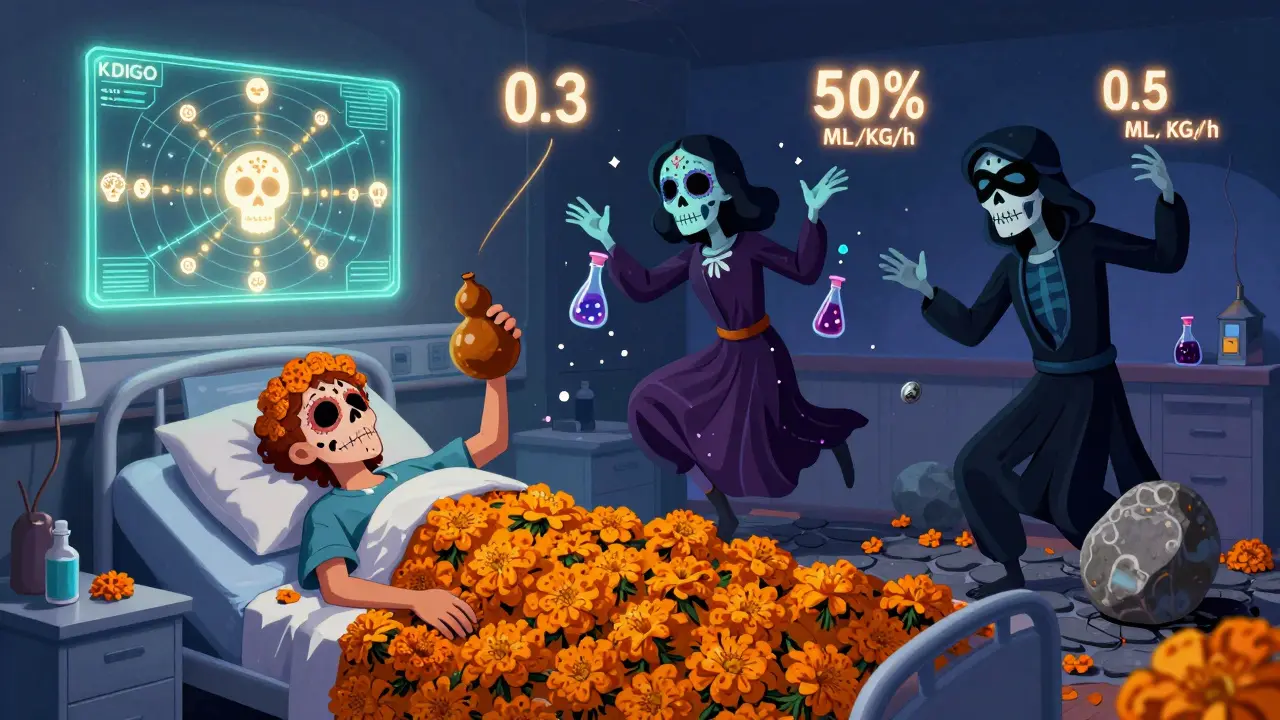
The KDIGO guidelines (2012) are the global standard. They define AKI by three simple criteria:- Creatinine rises by ≥0.3 mg/dL in 48 hours
- Creatinine increases by ≥50% from baseline in 7 days
- Urine output is less than 0.5 mL per kg of body weight per hour for 6 hours
Stages range from mild (Stage 1) to life-threatening (Stage 3). Stage 3 means creatinine is tripled, over 4.0 mg/dL, or urine output drops below 0.3 mL/kg/h for 24 hours. That’s dialysis territory.
Imaging helps too. Ultrasound checks kidney size and looks for blockages. It’s used in 85% of cases. A CT urogram finds stones with 95% accuracy. But sometimes, the real clue is in the urine-not the blood. Fractional excretion of sodium (FeNa) tells you if it’s prerenal (FeNa <1%) or intrinsic (FeNa >2%).
Treatment: Speed Is Everything
There’s no one-size-fits-all fix. It’s all about the cause.- For prerenal: Fluids. Fast. A liter of saline can reverse it in hours.
- For intrarenal: Stop the toxin. Treat the inflammation. Sometimes, immunosuppressants or plasmapheresis are needed.
- For postrenal: Remove the blockage. A stent or catheter often fixes it immediately.
If your kidneys are barely working, you might need dialysis. About 5-10% of hospitalized patients need intermittent hemodialysis. In the ICU, 15-20% get continuous renal replacement therapy (CRRT). Peritoneal dialysis is rare-only 2-5% of cases.
And here’s something new: biomarkers. Tests for NGAL (neutrophil gelatinase-associated lipocalin) can predict AKI 24-48 hours before creatinine rises. Early trials show this cuts delays in treatment by 30%. In 2021, NICE started recommending these tests in high-risk patients. AI tools are also being tested-algorithms that scan your medical records and flag AKI risk 12-24 hours before it shows up. Early data says this could reduce AKI by 20-30%.
Recovery: Not Everyone Gets Back to Normal
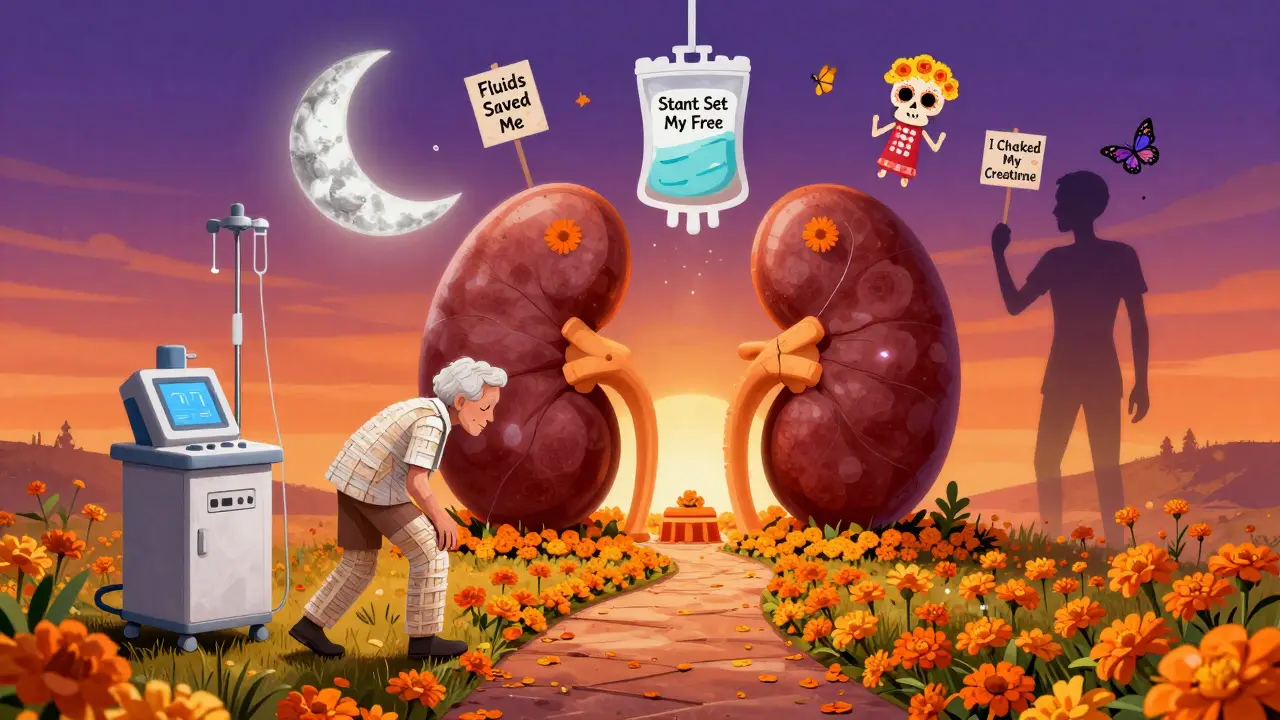
The good news? Most prerenal cases recover fully in 7-10 days. Intrarenal cases? 40-60% improve over weeks. But if you had prolonged oliguria (no urine for over two weeks), only 20-30% fully recover.Age matters. If you’re over 65, your chance of full recovery drops by 35%. If your kidneys were already weak before (eGFR under 60), recovery is half as likely. And if you needed dialysis? Only 25% get back to full kidney function within three months.
Long-term, 23% of survivors develop chronic kidney disease within a year. That’s why every AKI patient needs follow-up. A nephrology visit within six months is standard. Blood pressure control, avoiding NSAIDs, and monitoring creatinine are non-negotiable.
Real Stories, Real Risks
One patient, a 72-year-old man, had a UTI. He didn’t drink much. His creatinine jumped from 1.0 to 2.9 in three days. He was hospitalized, put on fluids, and recovered fully in a week. No dialysis. No long-term damage.Another, a 58-year-old woman, had sepsis. Her kidneys shut down. She was on CRRT for 17 days. Her creatinine normalized, but she spent three months too tired to walk more than 50 feet. She still checks her urine output every day. “I’m scared it’ll come back,” she says.
On forums, people say the same thing: the mental toll is worse than the physical. Anxiety about kidney health, fear of dialysis, fatigue that won’t go away-these are real. Recovery isn’t just about numbers. It’s about rebuilding trust in your body.
What You Can Do
If you’re at risk-diabetic, older, on blood pressure meds, or recently hospitalized-know the signs. Drink water. Avoid NSAIDs like ibuprofen if you’re sick. Tell your doctor if you’re producing less urine. Ask for a creatinine check if you’re feeling off. Don’t wait for swelling or pain. By then, it might be too late.AKI is not a death sentence. It’s a wake-up call. The sooner you act, the better your kidneys recover. And in many cases, they come back stronger than ever.



10 Comments
Steve DESTIVELLE February 11, 2026
AKI is just the body's way of saying you've been pushing too hard for too long
Its not about kidneys failing its about the entire system screaming for balance
Modern medicine treats symptoms not root causes
We fix creatinine levels but ignore why they rose in the first place
Dehydration isn't just lack of water its a symptom of disconnection from our physical needs
Look at the stats 13 million cases a year and we still treat it like an accident not a pattern
Our culture glorifies exhaustion as productivity
We medicate fatigue instead of resting
Our hospitals are machines designed to patch leaks not prevent floods
Maybe the real AKI isnt in the kidneys its in the way we live
Recovery isn't just about fluids and dialysis its about changing how we relate to our bodies
When you stop seeing your body as a machine you start listening to its whispers before they become screams
Stephon Devereux February 12, 2026
Love this breakdown. Seriously one of the clearest explanations of AKI I've ever read.
Just want to add that NGAL biomarkers are already being used in some major US trauma centers and they're game changers.
One study showed a 40% reduction in missed AKI cases when NGAL was added to routine labs.
Also-CRRT isn't just for ICU patients anymore. We're starting to use it in step-down units for high-risk folks with sepsis.
Biggest win? Early detection. If you're on nephrotoxic meds like vancomycin or contrast dye? Get your creatinine checked at 24 hours not 48.
And yes-AI tools are coming. I've seen algorithms that flag risk before the patient even feels weird.
We're moving from reactive to predictive medicine. This is huge.
athmaja biju February 12, 2026
India has the highest rise in AKI cases due to unregulated NSAID use and water pollution
People take ibuprofen like candy and drink dirty water and wonder why their kidneys fail
Western medicine talks about biomarkers but we need public health education not lab tests
Our government must ban over-the-counter NSAIDs without prescription
Every pharmacy in Delhi sells diclofenac like candy
AKI is not a medical issue its a societal failure
Stop blaming patients and start fixing systems
Education in schools about kidney health should be mandatory
Until then millions will die quietly while doctors chase numbers
Robert Petersen February 14, 2026
You guys are killing it with this thread.
Just wanted to say-this isn't just about hospitals or labs.
It's about YOU.
If you're over 50, diabetic, or on blood pressure meds-drink water like it's your job.
Don't wait for swelling. Don't wait for fatigue.
Ask your doctor for a basic kidney panel every 6 months.
It takes 5 minutes. Costs $20. Could save your life.
And if you're caring for an elderly parent? Learn the signs.
Confusion? Less pee? Nausea? Call the doctor. Don't wait.
You don't need to be a genius to prevent AKI.
You just need to care enough to act.
Small steps. Big impact.
You got this.
Craig Staszak February 14, 2026
Prerenal AKI is the silent killer because it looks like nothing
Dehydration isn't just 'not drinking enough'
Its stress its heat its meds its aging its ignoring thirst
I've seen patients with perfect labs one day and dialysis the next
Because no one checked
Urine output is the most underused vital sign
Not BP not temp not pulse
Urine
Track it
Measure it
Report it
Even if you feel fine
And if you're on diuretics? Your doc should be checking you weekly
Simple
Free
Life saving
alex clo February 15, 2026
The KDIGO criteria are widely adopted but still underutilized in community hospitals.
Many clinicians rely on clinical impression rather than objective thresholds.
Studies show that when AKI is defined strictly by creatinine rise rather than oliguria alone, diagnosis improves by 37%.
Additionally, baseline creatinine is often missing from electronic records, leading to underdiagnosis.
Recommendation: Always document pre-admission creatinine values and use eGFR trends, not single values.
Also, avoid automatic ordering of contrast without pre-screening in high-risk patients.
Systemic changes are needed, not just individual vigilance.
Ernie Simsek February 17, 2026
bro i had AKI after a 3-day binge of Advil + coffee + no water
creatinine hit 3.1
thought i was fine until i passed out in the shower
woke up in the hospital with a catheter
they said if i waited another 12 hours i'd have needed dialysis
now i drink 3L of water a day and never touch NSAIDs again
also i got a smart water bottle that vibrates if i forget to drink
lmao i sound like a robot but my kidneys thank me
if you're reading this right now-go drink some water
you're probably dehydrated
and stop being a hero
your kidneys don't care how hard you work
they just want you to hydrate
🫠💧
Joanne Tan February 17, 2026
i just want to say thank you for writing this
i had ak1 last year after a bad flu
they said i was lucky i got caught early
but i still feel tired every day
and i panic every time i get sick
its not just the body that gets damaged
its your mind too
you start checking your pee like its a test
you stop trusting yourself
and no one talks about that part
so thank you for saying it
you're not alone
we're all still healing
Stacie Willhite February 17, 2026
This is so important. I work in geriatric care and see AKI all the time.
Older adults often don't feel thirsty. They don't report feeling weak. They just seem 'off'.
That's the red flag.
Don't dismiss it as 'just aging'.
Check creatinine. Check urine output. Ask about meds.
One pill. One missed dose. One day without water.
That's all it takes.
Be the person who notices.
It might save someone's life.
You don't need to be a doctor.
You just need to care enough to ask.
Rob Turner February 19, 2026
From the UK-we're seeing a rise in AKI linked to over-the-counter painkillers and post-pandemic dehydration
Our NHS has great protocols but community awareness is low
People think kidneys are 'back there' and don't matter until you're in crisis
But they regulate your blood pressure, your electrolytes, your sleep
They're not filters-they're conductors
And we treat them like spare parts
Maybe we need a public health campaign
Not with stats
But with stories
Like the 72-year-old who drank water and walked away
Or the 58-year-old who still checks her output every day
Because recovery isn't just numbers
Its trust
Its habit
Its choosing to listen
🫶