

For decades, taking a daily aspirin was a simple, cheap way to protect your heart. If your parent had a heart attack, your doctor likely told you to pop a baby aspirin every morning. But that advice has changed - dramatically. As of 2025, aspirin therapy is no longer a one-size-fits-all solution for preventing heart disease. In fact, for most healthy adults, it’s no longer recommended at all.
Why the Big Change?
Aspirin works by thinning your blood. It stops platelets from clumping together, which can block arteries and cause heart attacks or strokes. That sounds great - until you realize it also increases your risk of dangerous bleeding. For years, doctors assumed the benefits outweighed the risks. But large, modern studies from 2018 onward changed everything.The ASPREE, ASCEND, and ARRIVE trials followed over 100,000 people for years. The results were clear: in people without existing heart disease, aspirin reduced heart attacks by only about 10-15%. But it increased the risk of serious bleeding - like stomach bleeds or brain hemorrhages - by nearly 43%. For many, the harm was greater than the help.
Modern medicine has also gotten better at preventing heart disease. Statins lower cholesterol more effectively. Blood pressure meds control hypertension. Lifestyle changes like quitting smoking and eating better reduce risk more than aspirin ever did. So the bar for adding aspirin has gotten much higher.
Who Might Still Benefit?
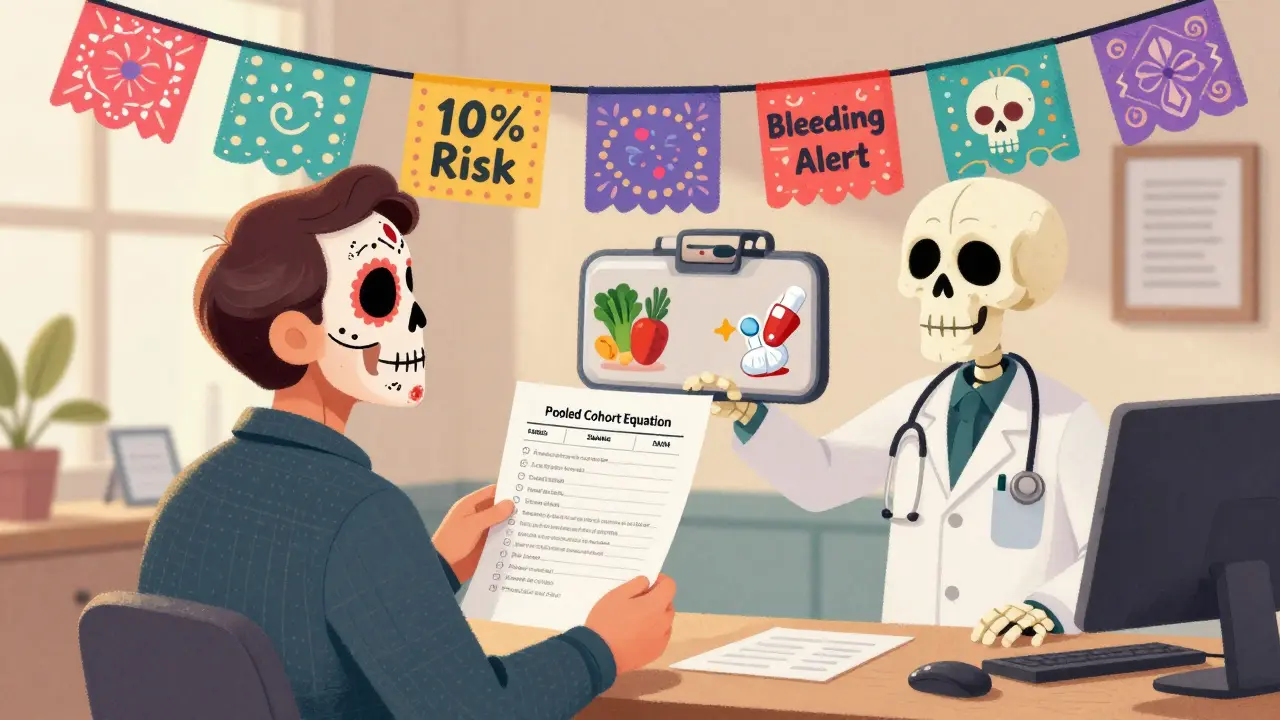
The latest guidelines from the U.S. Preventive Services Task Force (USPSTF) and the American College of Cardiology say aspirin might still make sense for a small group: adults aged 40 to 59 with a high risk of heart disease and low risk of bleeding.How do you know if you’re in that group? Your doctor calculates your 10-year cardiovascular disease risk using something called the Pooled Cohort Equation. It looks at:
- Your age and sex
- Your race
- Total and HDL cholesterol
- Systolic blood pressure (even if you’re on meds)
- Whether you have diabetes
- Whether you smoke
If your calculated risk is 10% or higher, and you don’t have bleeding risk factors, your doctor might suggest trying low-dose aspirin (75-100 mg daily). But even then, it’s not automatic. It’s a conversation.
Who Should Avoid Aspirin Completely?
If you’re 60 or older, the USPSTF says do not start aspirin for heart disease prevention. The bleeding risk rises sharply with age, and the heart benefits don’t keep up. A 65-year-old with no heart history gains almost no protection from aspirin - but their chance of a major bleed goes up.Also avoid aspirin if you have:
- A history of stomach ulcers or GI bleeding
- Active liver or kidney disease
- Been on blood thinners like warfarin or apixaban
- Drink more than 3 alcoholic drinks a day
- A bleeding disorder like hemophilia
- A HAS-BLED score of 3 or higher (a tool doctors use to measure bleeding risk)
Even if you’re young and healthy, if you’re on NSAIDs like ibuprofen regularly, aspirin can irritate your stomach lining and increase bleeding risk. Talk to your doctor before combining them.
What About Diabetes?
People with diabetes have a higher risk of heart disease. The American Diabetes Association still says aspirin can be considered for those over 40 with additional risk factors - like high blood pressure or smoking. But even here, it’s not automatic. A 2022 study in the Journal of the American College of Cardiology found that for many diabetic patients without prior heart events, the bleeding risk still outweighed the benefit.Some experts now recommend checking coronary artery calcium (CAC) scores in diabetic patients. If the score is high (above 100), aspirin might make sense. If it’s zero, skip it. This personalized approach is becoming the new standard.
What About Family History?
A lot of people keep taking aspirin because their parent had a heart attack young. But genetics alone aren’t enough to justify it. If you’re 62, have normal cholesterol, no high blood pressure, and don’t smoke - your family history doesn’t change the math. The risk of bleeding still outweighs the benefit.One 2021 study found that 68% of people over 60 who took aspirin for prevention did so because of family history. But their actual risk profile didn’t match the guidelines. That’s why shared decision-making matters. Your doctor shouldn’t just say, “Your dad had a heart attack, so take aspirin.” They should say, “Here’s your actual risk. Here’s your bleeding risk. Here’s what the data says.”
What If You’re Already Taking It?
If you’re over 60 and have never had a heart attack, stroke, stent, or bypass, the current advice is to stop. Don’t quit cold turkey without talking to your doctor - but don’t keep taking it just because “it’s been years.”Many people who stop report feeling anxious at first. But in follow-ups, most feel better knowing they’re not risking a bleed for no benefit. One woman in Seattle, 67, stopped her daily aspirin after her doctor ran her risk numbers. She’d been taking it since 55 because her dad died of a heart attack. Her 10-year risk? 6%. Bleeding risk? High due to occasional NSAID use. She stopped. No heart issues since. No nosebleeds either.
If you’ve had a heart attack, stent, or bypass, keep taking aspirin. It’s proven to save lives in secondary prevention. For those patients, aspirin reduces the chance of another event by about 21%. The bleeding risk is real, but the benefit is clear.

What Are the Alternatives?
Aspirin isn’t the only tool. Statins are now the cornerstone of prevention. Atorvastatin (Lipitor) and rosuvastatin (Crestor) reduce LDL cholesterol by 30-50% and lower heart attack risk by 25-37%. That’s better than aspirin - and without the bleeding risk.For people with high blood pressure, ACE inhibitors or ARBs are first-line. For high cholesterol, PCSK9 inhibitors (like Repatha) are powerful options. Lifestyle changes - a Mediterranean diet, 150 minutes of exercise a week, no smoking - are more effective than any pill for most people.
Aspirin’s only real advantage is cost. A 3-month supply of generic aspirin costs $4-$6. But when you factor in ER visits for bleeding, hospital stays, and lost workdays, the real cost of unnecessary aspirin use is much higher.
How to Talk to Your Doctor
If you’re unsure whether aspirin is right for you, ask these questions:- What’s my 10-year risk of heart disease using the Pooled Cohort Equation?
- What’s my bleeding risk? Do I have any risk factors like ulcers, NSAID use, or heavy drinking?
- Am I on statins or other heart meds? Are they enough?
- Has my risk changed since I started aspirin?
- What happens if I stop? What happens if I keep going?
Bring your latest blood work, blood pressure readings, and a list of all meds and supplements. Many doctors still default to prescribing aspirin out of habit. Be prepared to ask for the data.
The Bottom Line
Aspirin isn’t a magic bullet. It’s a tool - and like any tool, it’s only useful in the right hands. For most people in 2025, it’s not the right tool for heart disease prevention. The era of blanket aspirin prescriptions is over.If you’re under 60, have high heart risk, and low bleeding risk - talk to your doctor. If you’re over 60 and have never had a heart event - talk to your doctor about stopping. If you’ve had a heart attack or stent - keep taking it. And for everyone else: focus on statins, blood pressure control, and lifestyle. Those are what actually move the needle now.
Should I take aspirin every day to prevent a heart attack?
Only if you’re between 40 and 59, have a 10% or higher 10-year risk of heart disease, and have no bleeding risks. For most people - especially those over 60 - the risks of bleeding outweigh the benefits. Don’t start without talking to your doctor.
Is baby aspirin safe for long-term use?
Low-dose aspirin (75-100 mg) is generally safe for people who need it - like those with prior heart events. But for healthy people without heart disease, long-term use increases the risk of stomach bleeds, brain hemorrhages, and other serious bleeding. The longer you take it unnecessarily, the higher the risk.
Can I stop taking aspirin suddenly?
If you’re taking aspirin for secondary prevention (after a heart attack or stent), never stop without your doctor’s guidance - it can trigger a clot. If you’re taking it for primary prevention and your doctor agrees you should stop, you can usually stop safely. But always confirm with your provider first.
Does aspirin help prevent stroke?
Aspirin can slightly reduce the risk of ischemic stroke (caused by clots) - but it increases the risk of hemorrhagic stroke (caused by bleeding in the brain). For most healthy people, the net effect is neutral or negative. It’s not recommended for stroke prevention alone.
What’s better than aspirin for heart health?
Statins (like Lipitor or Crestor) are far more effective for lowering heart attack risk in most people. Controlling blood pressure, quitting smoking, exercising regularly, and eating a heart-healthy diet are also more impactful than aspirin. For people with diabetes or high cholesterol, these interventions should come first.
Why do some doctors still prescribe aspirin for prevention?
Many doctors still follow old habits, especially if they’ve been prescribing it for years. Some patients insist on it because they believe it helped their parents. Others don’t have time to calculate risk scores. But guidelines have changed. The evidence now strongly supports a more selective approach. Ask your doctor if they’re using the latest 2022 USPSTF or 2019 ACC/AHA guidelines.






11 Comments
Anu radha December 17, 2025
I used to take aspirin every day after my mom had her heart attack. I stopped last year after my doctor showed me my risk score. I was terrified at first, but no more stomach pain and no more weird bruises. Feels good to listen to the data, not just the fear.
Victoria Rogers December 17, 2025
lol so now we’re trusting some gov study over grandma’s wisdom? In my day, aspirin was for headaches AND heart attacks. Now we got apps that tell us not to breathe without a risk assessment. Next they’ll ban breathing if your lungs are 0.3% too moist.
CAROL MUTISO December 18, 2025
It’s funny how medicine keeps evolving like a really stubborn teenager. We used to think aspirin was a miracle cure, then we thought it was poison, now we think it’s… a tool? Like a hammer? You don’t hand out hammers to everyone who walks into Home Depot. You ask: ‘What are you building?’
Turns out, most of us are just trying to fix a squeaky door - and we’ve been hitting our thumbs with the hammer for 20 years. Statins? Diet? Exercise? Those are the real blueprints. Aspirin’s just the duct tape someone forgot to throw away.
Erik J December 19, 2025
Just curious - what’s the bleeding risk percentage increase for someone in their 50s with no risk factors? I saw the 43% number but that’s relative to what baseline? Just wondering if the absolute risk is still low enough to be negligible.
BETH VON KAUFFMANN December 21, 2025
Let’s be real - the USPSTF guidelines are just a corporate compromise. Statin manufacturers funded the trials. The real reason aspirin got de-platformed is because it’s generic and unpatentable. Meanwhile, we’re pushing $1,200/month PCSK9 inhibitors like they’re holy water. The system doesn’t want cheap solutions. It wants recurring revenue.
Martin Spedding December 22, 2025
my doc still prescribes it. i told him i stopped. he said ‘oh ok’ and gave me a new script. i’m 62. no heart issues. i’m not taking it. he’s not listening. again.
Jessica Salgado December 24, 2025
I cried when I stopped. Not because I was scared - because I felt guilty. Like I was betraying my dad. He died at 58. I took aspirin for 15 years thinking I was honoring him. Turns out, I was just following a ghost. My doctor said, ‘Your dad’s story doesn’t write your health plan.’ I needed to hear that.
amanda s December 25, 2025
THIS IS WHY AMERICA IS FALLING APART. You let some nerds with spreadsheets tell you not to take aspirin? My uncle took it for 40 years, never had a problem. Now you want us to be scared of our own blood? Pathetic. We need more aspirin, not less. This is woke medicine.
Peter Ronai December 26, 2025
Everyone’s missing the point. Aspirin isn’t about heart disease. It’s about control. People take it because they want to feel like they’re doing *something*. The real problem isn’t aspirin - it’s that we’ve outsourced our health to pills and algorithms. You want to prevent heart disease? Stop eating Twinkies. Move your body. Sleep. That’s the real pill. Aspirin’s just a placebo for people too lazy to change.
Steven Lavoie December 26, 2025
I’m from Canada, but I’ve lived in the U.S. for 12 years. I’ve seen how differently doctors here treat prevention vs. back home. In Ontario, we don’t even *offer* aspirin for primary prevention unless you’re in a very specific high-risk group. Here? It’s like it’s in the water. Cultural inertia is powerful. But I’m glad the science is catching up. It’s not about distrust - it’s about better tools.
Brooks Beveridge December 26, 2025
Hey everyone - if you’re thinking about stopping aspirin, please don’t just quit. Talk to your doc. But also - if you’ve been taking it for years because of your parent’s heart attack, I get it. I’ve been there. You’re not being irrational. You’re being human. But now? You get to choose differently. Not out of fear. Not out of guilt. Out of knowledge. And that’s powerful. 💪❤️