
When a pharmaceutical company makes even a small change to how a drug is made-like swapping out a mixer, moving a step to a different building, or using a new supplier for an ingredient-it’s not just an internal decision. It’s a regulatory event. The FDA, EMA, Health Canada, and other agencies require strict notification and approval processes because manufacturing changes can directly impact whether a medicine is safe, effective, and consistent from batch to batch.
Why Manufacturing Changes Are Heavily Regulated
A drug isn’t just a chemical formula. It’s a product shaped by how it’s made. Change the temperature during mixing, switch the tablet press, or alter the cleaning procedure for a tank, and you might unknowingly change how the active ingredient dissolves in the body. That could mean the medicine doesn’t work as well-or worse, causes unexpected side effects. Regulators don’t trust companies to self-police these changes. That’s why they’ve built a system that forces manufacturers to prove, before or after making a change, that the product hasn’t been compromised. The goal isn’t to slow innovation. It’s to protect patients from unintended consequences.The Three-Tier System: FDA’s Approach
In the U.S., the FDA classifies manufacturing changes into three categories under 21 CFR 314.70. Each has different rules for when you can implement the change and how much data you need to submit.- Prior Approval Supplement (PAS) - Required for major changes. These are changes with a high risk of affecting the drug’s quality, safety, or effectiveness. Examples: switching the chemical synthesis route for the active ingredient, moving production to a new factory, or changing equipment that controls critical process parameters like pressure or mixing time. You cannot ship the product until the FDA approves your submission. This can take 6 to 12 months.
- Changes Being Effected in 30 Days (CBE-30) - For moderate changes. You can implement the change after submitting the notification, but you must wait 30 days before distributing the product. Examples: replacing a tablet press with an identical model from the same manufacturer, changing a filter in a purification step, or updating software on a packaging line. You must include data showing the change doesn’t affect critical quality attributes (CQAs) like dissolution rate or impurity levels.
- Annual Report - For minor changes. These are low-risk, well-understood adjustments. Examples: changing the location of a non-critical step within the same facility, updating labeling on a container, or switching to a different brand of the same-grade solvent. You don’t need approval or even a pre-notification. Just document it and include it in your next annual report.
How Other Regulators Compare
The FDA’s system isn’t the only one. Other regions use similar but different frameworks.- European Medicines Agency (EMA) uses Type IA (minor, notify within 12 months), Type IB (moderate, must be approved before implementation), and Type II (major, full review before change). Unlike the FDA’s CBE-30, EMA doesn’t let you start the change before approval for Type IB-no "do-and-tell." This creates longer delays but reduces risk.
- Health Canada mirrors the FDA closely with Level I (prior approval), Level II (notify and wait), and Level III (annual report). Their guidance is very detailed on what counts as "equivalent equipment," which helps reduce confusion.
- WHO Prequalification requires a Comparability Protocol for any significant change. This means you must design a study upfront-collecting stability data, bioequivalence results, and process performance metrics-to prove the product is unchanged after the modification.
Companies selling globally often have to manage multiple systems at once. A change that’s a CBE-30 in the U.S. might be a Type II in Europe, requiring a full review. That’s why large pharma companies build global change control systems that map each change to all applicable regulations.
What Counts as a Major Change?
Not all equipment swaps are equal. The FDA says equipment is "equivalent" only if it has:- The same principle of operation
- The same critical dimensions
- The same material of construction
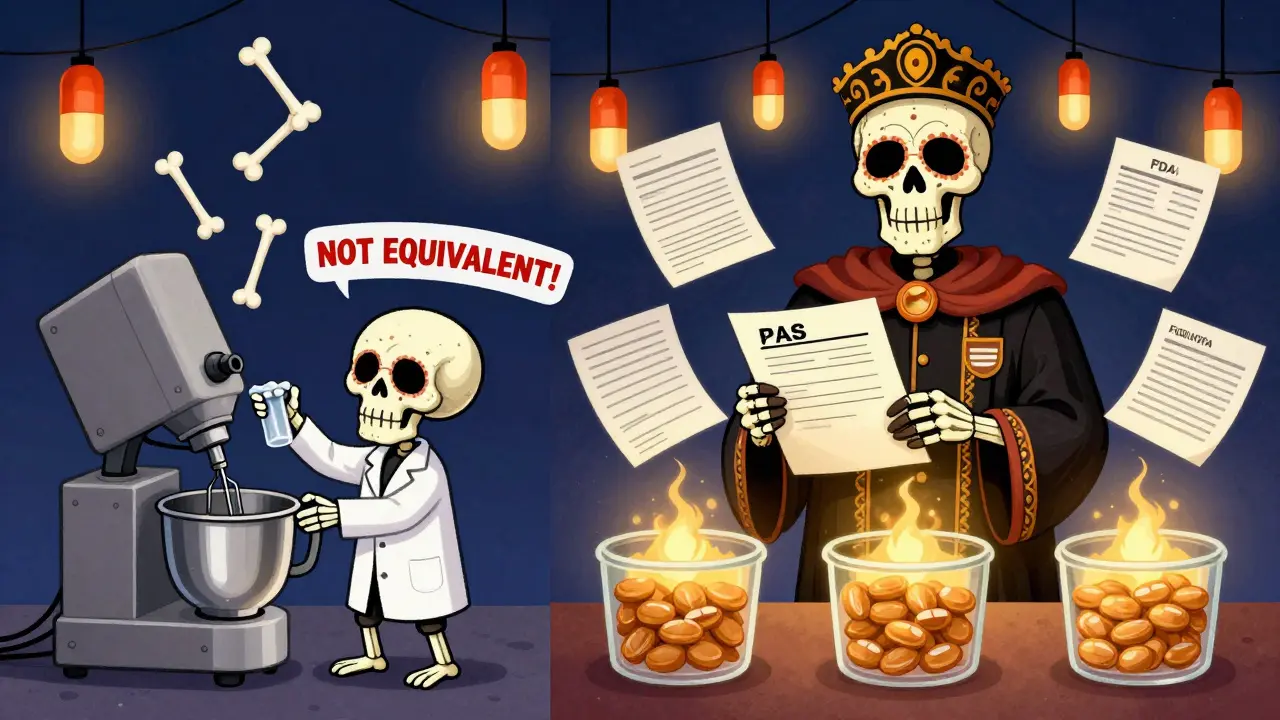
So if you replace a stainless steel mixer with a plastic one-even if it’s the same size and speed-that’s not equivalent. You need a PAS.
Another common trap: changing a supplier of an excipient (inactive ingredient). If the new supplier’s material has different particle size, moisture content, or flow properties, it could alter tablet hardness or dissolution. Even if the ingredient name is the same, the change may require a PAS or CBE-30. Companies often run comparative batch testing to prove equivalence.
Real-World Challenges
In practice, classifying changes isn’t always clear-cut. A senior regulatory affairs specialist on Reddit shared that classifying a tablet press replacement took their team 37 hours of meetings. Why? Because the API’s particle size distribution was borderline, and the validation data wasn’t strong enough to confidently call it a CBE-30.Another issue: companies sometimes misclassify changes to save time. In 2023, the FDA issued four warning letters specifically for misclassified equipment changes. One company replaced a lyophilizer (freeze-dryer) without submitting a PAS-despite the new machine having different drying profiles. The FDA shut down the batch. The company lost $2.3 million in product and faced a public warning.
Small and mid-sized manufacturers struggle the most. They don’t have teams of regulatory specialists. One 2022 FDA inspection report found only 63% of small companies were compliant with change control requirements, compared to 98% of large pharma firms.

How to Get It Right
There’s no shortcut, but there are best practices:- Start with risk assessment. Use FMEA (Failure Modes and Effects Analysis) to score how a change could impact product quality. This isn’t optional-it’s expected by regulators.
- Document everything. Keep facility diagrams, equipment specs, process validation reports, and batch comparison data. The FDA can ask for this at any time.
- Involve the right people. Change control isn’t just a regulatory task. You need input from manufacturing, quality control, validation, and even R&D. One team meeting can prevent months of delays.
- When in doubt, ask the FDA. The 2021 guidance explicitly encourages early consultation. Submitting a pre-submission meeting request can save you from a costly misclassification.
- Train your team. ASQ data shows regulatory professionals need 18 months of hands-on experience to consistently classify changes correctly. Don’t assume your new hire knows the rules.
The Future: Harmonization and Real-Time Data
The industry is moving toward more harmonized rules. The ICH Q12 guideline, adopted in 2020, aims to create global consistency in managing post-approval changes. The FDA’s 2023 draft guidance on quality risk management pushes companies to use data-driven decisions-not just checklists.One of the biggest shifts is the use of real-time monitoring. Six major companies are piloting systems that track temperature, pressure, and moisture during production and feed that data directly into change assessments. If a process stays within proven limits, regulators may allow more flexibility in the future.
For now, though, the rules are strict. Every change, no matter how small it seems, has to be treated like a potential threat to patient safety. The cost of getting it wrong isn’t just financial-it’s reputational, and sometimes, life-threatening.
What happens if I make a manufacturing change without approval?
If you implement a change that requires FDA approval without submitting the proper supplement, you’re distributing an unapproved drug. The FDA can issue a warning letter, seize your product, or order you to stop distribution. In severe cases, your facility may be barred from producing drugs. Companies have lost millions in recalls and legal fees after misclassifying a change as minor when it was actually major.
Can I change equipment without submitting anything?
Only if it’s a true minor change under the annual report category. That means the new equipment must be identical in design, material, and function to the old one, and it must not affect any critical process parameters. Even then, you still need to document it internally and include it in your next annual report. Never assume a swap is "just a replacement"-always validate.
How long does a Prior Approval Supplement (PAS) take?
The FDA’s standard review time for a PAS is 180 days, but complex changes-especially for biologics or new manufacturing sites-can take 6 to 12 months. You can request a priority review if the change is needed to prevent a drug shortage, but that’s rare. Plan ahead: start your submission at least 9 months before you intend to make the change.
Do I need to re-validate the entire process after a change?
Not always, but you must prove the change didn’t break anything. For a CBE-30, you typically run three consecutive batches with full testing of critical quality attributes. If those batches meet all specs and stability data looks good, you’ve demonstrated comparability. Full re-validation is only required for major changes that alter the core process-like switching from batch to continuous manufacturing.
Are there tools to help classify manufacturing changes?
Yes. Many companies use internal risk assessment tools with scoring systems based on FDA and ICH guidelines. Some use software platforms that map your change to regulatory categories and auto-generate submission templates. The Parenteral Drug Association’s Technical Report No. 60 and the FDA’s 2021 biologics guidance include decision trees that can help. But no tool replaces expert judgment-always involve your regulatory team early.





12 Comments
Kelly McRainey Moore January 21, 2026
Man, I remember when my buddy’s company swapped out a mixer and thought it was ‘just a replacement.’ Turns out the new one was stainless steel vs. the old plastic-lined one. Took them 10 months to get FDA approval. Lost a whole quarter’s revenue. Don’t assume ‘same size = same thing.’
Amber Lane January 22, 2026
Small changes, big consequences. It’s why I trust my meds.
Ashok Sakra January 23, 2026
THEY JUST WANT TO CONTROL US!! WHY CAN’T WE JUST CHANGE THINGS?! I’M SICK OF BIG PHARMA AND BIG GOVERNMENT TELLING US WHAT TO DO!!
michelle Brownsea January 24, 2026
Let’s be perfectly clear: the regulatory framework isn’t ‘red tape’-it’s a moral imperative. Every unapproved change is, by definition, an act of negligence toward human life. The FDA doesn’t ‘slow innovation’-it prevents catastrophe. And anyone who calls it bureaucracy hasn’t lost a loved one to a contaminated batch.
Furthermore, the notion that ‘minor’ changes are harmless is statistically indefensible. Particle size variance? Moisture content drift? These aren’t ‘details’-they’re existential variables in pharmacokinetics.
And yet, companies still cut corners. The 2023 warning letters? They’re not anomalies. They’re symptoms of a culture that prioritizes speed over safety-and that culture must be dismantled.
Let’s not romanticize ‘agility’ when it’s just arrogance in a lab coat.
lokesh prasanth January 25, 2026
why do they even care? its just a pill right? lol
Yuri Hyuga January 26, 2026
👏 This is exactly why I have such deep respect for regulatory professionals. They’re the unsung heroes keeping our medicines safe. 🌍💡 Every PAS, every CBE-30, every annual report-it’s not paperwork, it’s protection. Let’s celebrate the quiet rigor behind every bottle on the shelf. #PharmaSafety #QualityFirst
Coral Bosley January 27, 2026
I’ve seen a plant get shut down over a filter change. Not because it was dangerous-but because the paperwork didn’t match the SOP. The bureaucracy isn’t just slow-it’s brutal. And the people who pay the price? The ones who need the drug the most.
Kevin Narvaes January 28, 2026
bro i just want my pills to work why is this so hard??
Dee Monroe January 29, 2026
You know what’s wild? This whole system was built on decades of tragedy-Thalidomide, contaminated heparin, the insulin crisis in the 70s. Every regulation here? Someone died because it didn’t exist. So when people say ‘it’s too much,’ I hear ‘I don’t want to think about the people who died so we could have rules.’
It’s not about slowing innovation-it’s about making sure innovation doesn’t kill. The fact that we can even talk about ‘minor’ changes means we’ve already survived the worst. But we’re still not safe. Not yet.
And that’s why training matters. That’s why documentation matters. That’s why asking the FDA before you act matters. Because the next batch that fails? It might be yours. Or your mom’s. Or your kid’s.
So yeah, it’s tedious. But it’s sacred.
And if you think otherwise? You haven’t held someone’s hand while they wait for a drug that should’ve been there.
Alex Carletti Gouvea January 30, 2026
Why does the FDA get to dictate how we make medicine? We’re the best in the world. Let us innovate without this red tape. Other countries are catching up-we don’t need to be held back by bureaucrats.
Philip Williams January 30, 2026
Interesting. How do companies handle discrepancies between FDA and EMA classifications? For example, a CBE-30 in the U.S. being a Type II in Europe. Is there a standardized mapping tool used across global teams?
Ben McKibbin February 1, 2026
There’s a quiet genius in how this system balances flexibility with rigor. It’s not about preventing change-it’s about making change *intentional*. The real innovation isn’t in the mixer or the solvent-it’s in the culture that says: ‘We won’t ship until we’re sure.’ That’s not compliance. That’s courage.
And honestly? The fact that small manufacturers are at 63% compliance? That’s the real crisis. We need more support-not more punishment. Mentorship programs. Shared regulatory labs. Subsidized risk assessments. This isn’t just about rules-it’s about equity.