
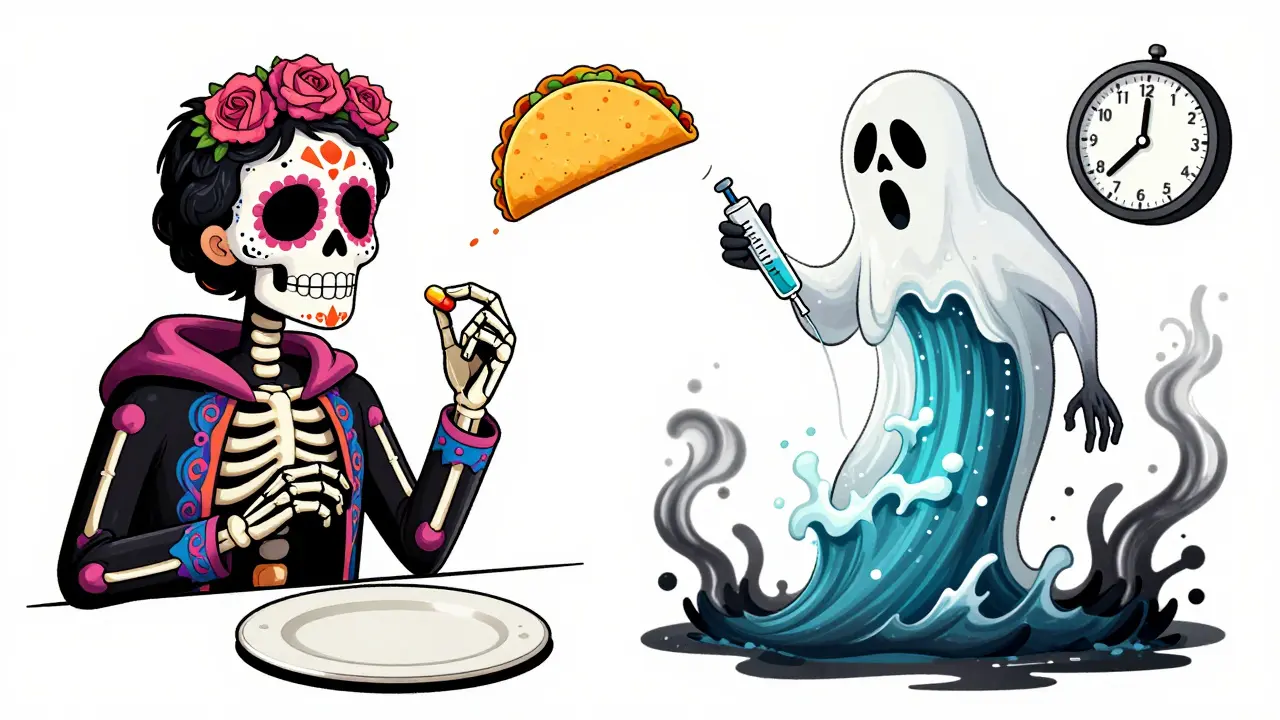
When you have type 2 diabetes, managing your blood sugar isn’t just about taking pills-it’s about syncing those pills with your meals. For some people, that means taking a medication like repaglinide or nateglinide-two drugs in the meglitinide class-right before eating. But if you skip that meal, or delay it by even 30 minutes, your blood sugar can crash. This isn’t a rare side effect. It’s built into how these drugs work.
How Meglitinides Work (and Why They’re So Fast)
Meglitinides are designed for one thing: lowering blood sugar right after you eat. They act faster than most other diabetes pills. Repaglinide hits your bloodstream in 15 to 30 minutes, peaks within an hour, and is mostly gone in 4 hours. Nateglinide is even quicker-its effects start in under a minute. Both trigger your pancreas to release insulin, but only when you take them. That’s the whole point.
Unlike sulfonylureas (like glipizide), which keep pumping out insulin for 12 to 24 hours no matter what you eat, meglitinides are like a light switch. Flip it on when you eat. Flip it off when you don’t. Sounds smart, right? But here’s the catch: if you flip the switch and then don’t eat, your body still gets a flood of insulin with no glucose to use. That’s when your blood sugar drops below 70 mg/dL-and that’s hypoglycemia.
The Meal-Skipping Trap
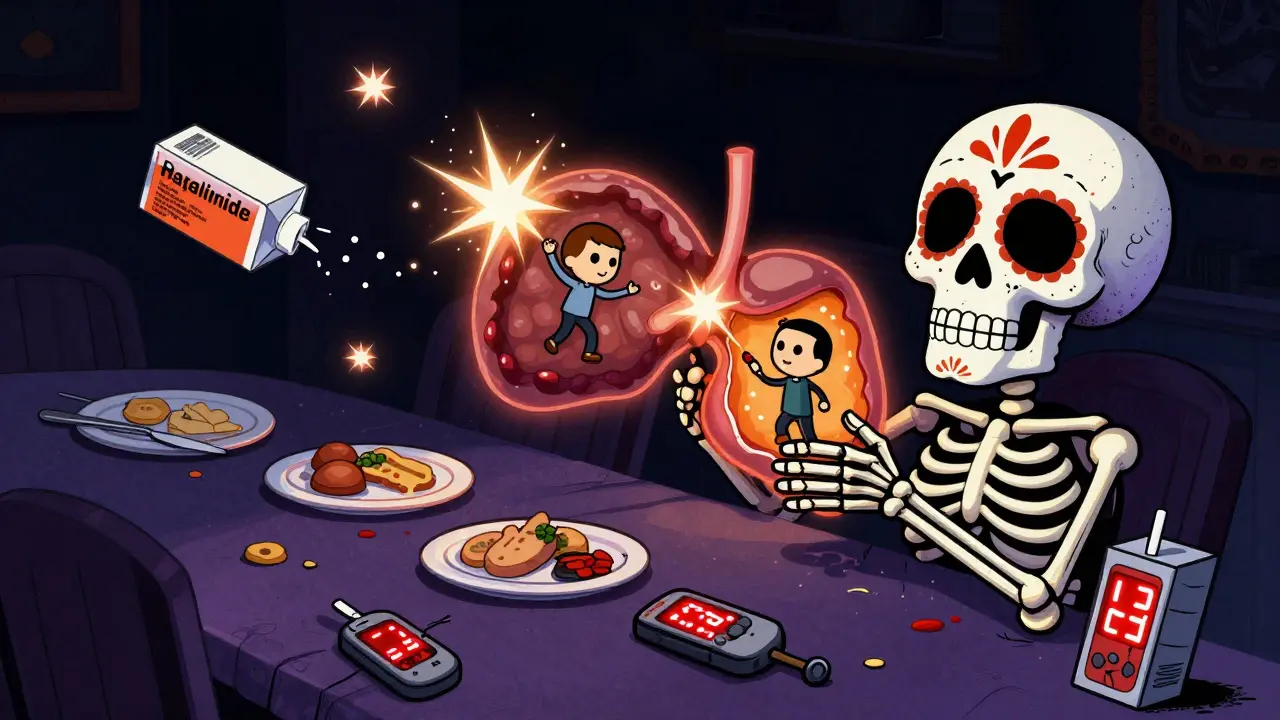
Studies show that skipping just one meal after taking a meglitinide increases your risk of hypoglycemia by more than 3.7 times. For some patients, that drop happens within 90 minutes of dosing. Imagine taking your pill at 11 a.m., thinking you’ll eat lunch at noon, but then getting called into a meeting. You don’t eat until 1 p.m. By then, your insulin levels are peaking, and your blood sugar is plummeting. You feel shaky, sweaty, dizzy. You might even pass out.
That’s not hypothetical. In real-world data, 41% of all hypoglycemia episodes in meglitinide users occur between 2 and 4 hours after taking the dose-the exact window when the drug is most active and meals are most likely to be delayed. The American Diabetes Association’s 2025 Standards of Care warn that older adults, especially those with cognitive decline or irregular routines, are at the highest risk. It’s not just about forgetting lunch. It’s about not remembering whether you ate.
Who Gets Prescribed Meglitinides?
You won’t see these drugs on every diabetes patient’s list. They’re not first-line. Metformin still leads the pack, prescribed to over half of all U.S. patients with type 2 diabetes. SGLT2 inhibitors and GLP-1 agonists are growing fast. But meglitinides still have a niche: people with unpredictable schedules.
Think shift workers. Caregivers who eat when they can. People with dementia or mental health conditions that disrupt eating habits. Patients with kidney disease, too-because repaglinide is mostly cleared by the liver, not the kidneys. That makes it safer than sulfonylureas for those with advanced kidney damage. The National Kidney Foundation recommends reduced doses (60 mg instead of 120 mg) for patients with an eGFR below 30.
Still, only about 4.2% of U.S. type 2 diabetes patients are on meglitinides today. That’s small, but it’s not trivial. For those 4.2%, the trade-off is real: flexibility in timing, but zero room for error in eating.
What Happens When You Combine Them
Meglitinides become even more dangerous when stacked with other drugs. Taking them with insulin? That combination spikes hypoglycemia risk by a statistically significant amount (p=0.018). Pair them with a sulfonylurea? You’re doubling down on insulin secretion. No meal? No buffer. Just a double dose of insulin with nothing to balance it.
One 2004 study found repaglinide lowered HbA1c better than nateglinide-but also caused 28% more low blood sugar events. That’s not a flaw in the drug. It’s a reflection of its power. Repaglinide pushes insulin harder and faster. That’s why it works better for some, but also why it’s riskier.
How to Stay Safe
If you’re on a meglitinide, here’s what you need to do:
- Take it 15 minutes before every meal. Not 30 minutes before. Not after you start eating. Fifteen minutes before.
- Never skip a meal after taking it. If you’re not sure you’ll eat, don’t take it.
- Carry fast-acting carbs. Glucose tablets, juice, or candy. Keep them in your bag, car, and pocket.
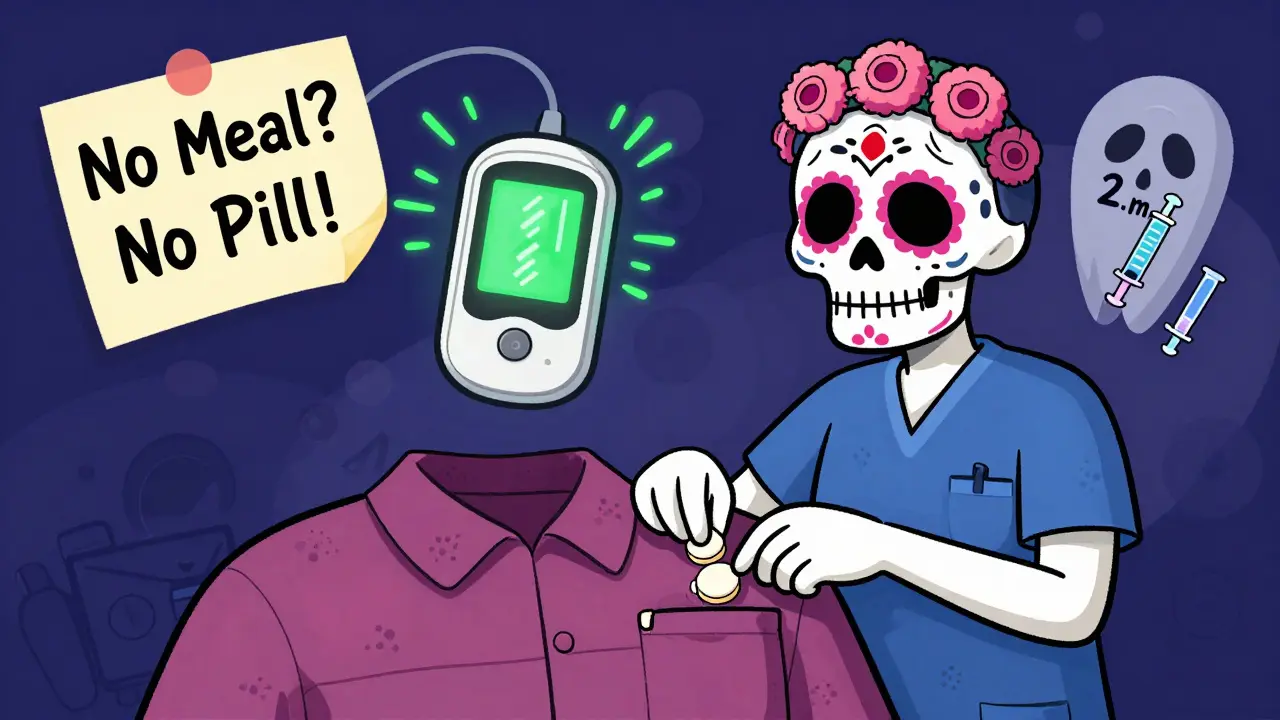
- Use a CGM if you can. Continuous glucose monitors cut hypoglycemia episodes by 57% in people with irregular eating patterns. They give you real-time alerts before your blood sugar drops too far.
- Set phone reminders. A 2023 trial showed that simple text or app alerts before meals reduced hypoglycemia by 39% in patients with erratic schedules.
Some doctors now recommend a "dose-to-eat" approach: only take the pill when you’re about to eat. No meal? No pill. That’s safer than trying to stick to a fixed schedule when life doesn’t cooperate.
The Future: Can We Fix This?
Researchers are trying. There’s a Phase II trial right now for an extended-release version of repaglinide-called repaglinide XR. Early results show it reduces hypoglycemia episodes by 28% in people with unpredictable meals. It’s not a cure, but it’s progress. The goal isn’t to eliminate meglitinides. It’s to make them safer for the people who need them most.
For now, though, the rule stays the same: food and meglitinides must go hand in hand. No food, no pill. No exceptions. This isn’t just advice. It’s a matter of life and death.
Can I skip my meglitinide if I don’t eat?
Yes, you should skip it. Meglitinides are designed to be taken right before meals. If you don’t plan to eat, don’t take the dose. Taking it without food raises your risk of dangerous hypoglycemia. Always follow your doctor’s instructions on when to skip the medication.
Why are meglitinides riskier than metformin?
Metformin works by reducing how much sugar your liver releases and improving how your body uses insulin. It doesn’t force your pancreas to make more insulin. That’s why it rarely causes low blood sugar. Meglitinides, on the other hand, trigger your pancreas to pump out insulin immediately-no matter what. If you don’t eat, that insulin has nothing to act on, and your blood sugar crashes.
Are meglitinides safe for older adults?
They can be, but with caution. Older adults are more likely to skip meals due to appetite changes, memory issues, or mobility problems. The American Diabetes Association warns that irregular eating patterns increase hypoglycemia risk in this group. If an older adult is prescribed a meglitinide, caregivers should help ensure meals are eaten on time, and a CGM is strongly recommended.
Is repaglinide better than nateglinide?
It depends. Repaglinide lowers HbA1c slightly more than nateglinide, but it also causes more hypoglycemia. Nateglinide acts faster but is less potent. For someone who eats very inconsistently, nateglinide’s shorter action might be safer. For someone who needs stronger post-meal control, repaglinide may be preferred. The choice should be personalized, based on meal habits and risk tolerance.
Can I take meglitinides if I have kidney problems?
Repaglinide is often preferred over sulfonylureas in people with kidney disease because it’s cleared mostly by the liver. The National Kidney Foundation recommends reducing the dose to 60 mg with meals if your eGFR is below 30. Nateglinide is also considered safer than older drugs in kidney impairment, but close monitoring is still needed. Always talk to your doctor before adjusting your dose.




12 Comments
Alex Arcilla March 23, 2026
lol so i took repaglinide at 11am thinking i’d eat lunch at noon… then got stuck in a 2 hour meeting and by 1pm i was sweating like i just ran a marathon in a sauna. almost passed out in the parking lot. now i carry glucose gummies like they’re my damn security blanket. this drug is basically a gamble with your brain cells.
winnipeg whitegloves March 25, 2026
man i love how meglitinides are like the punk rockers of diabetes meds-fast, loud, and if you don’t feed ‘em right, they’ll blow up your whole damn system. no chill, no mercy. but for shift workers like me? it’s the only thing that lets me eat at 3am or 7pm and still not turn into a zombie. i’d rather be shaky than diabetic.
Korn Deno March 26, 2026
The body doesn’t care about your schedule. It only cares about glucose and insulin. When you force insulin into a system with no fuel, you’re not managing diabetes-you’re playing Russian roulette with your pancreas. The drug isn’t broken. The assumption that meals are predictable is.
Aaron Sims March 27, 2026
Wait… so you’re telling me the pharmaceutical industry designed a drug that ONLY works if you eat on time… and then marketed it to people who CAN’T eat on time? That’s not a medical breakthrough. That’s a trap. Someone’s getting paid to keep people on this stuff. I’m 100% sure the FDA got bribed. Or it’s a CIA mind-control experiment. Either way-don’t trust this.
Stephen Alabi March 28, 2026
I must express my profound disapproval of the casual dismissal of pharmacological risk in this article. The statistical correlation between meal irregularity and hypoglycemic events is not merely anecdotal-it is empirically validated, peer-reviewed, and documented in multiple longitudinal studies. To suggest that ‘just don’t skip meals’ is sufficient is dangerously reductive.
Agbogla Bischof March 29, 2026
I’ve been on repaglinide for 7 years. My wife sets phone alarms for me. I don’t take it unless I’m sitting at the table with food in front of me. No exceptions. I also use a CGM. It saved my life last year when I forgot I’d eaten. The alarm went off at 68. I ate 3 glucose tabs. I’m still here. This isn’t complicated. It’s discipline.
Pat Fur March 30, 2026
I’m 68. I forget if I ate. Sometimes I eat breakfast twice. My doctor switched me to metformin after I passed out at the grocery store. No drama. No panic. Just… steady. Sometimes the safest choice is the boring one.
Natasha Rodríguez Lara April 1, 2026
I love how the article mentions CGMs. They’re not perfect, but they’ve turned my life from ‘constant fear of fainting’ to ‘mild inconvenience.’ I used to panic every time my stomach growled. Now I just check my graph. If it’s dropping, I eat. If not, I wait. It’s like having a personal glucose bodyguard.
Chris Crosson April 3, 2026
You people act like this is some new problem. I’ve been on meglitinides since 2012. I’ve skipped meals. I’ve passed out. I’ve had seizures. I still take them because they work better than anything else for my post-meal spikes. You don’t get to have perfect safety. You get to have control. And control means being ready for the crash.
Linda Foster April 4, 2026
The clinical guidelines are clear: meglitinides should be reserved for patients with predictable meal patterns or those who have demonstrated adherence to structured eating regimens. Prescribing them to individuals with cognitive impairment without caregiver support constitutes a breach of standard of care.
Rama Rish April 5, 2026
I work 3 shifts. Some days i eat at 2am. Some days i dont eat till 8pm. Meglitinide was a nightmare. Now i take nateglinide 10 mins before i start eating. Even if its ramen at 3am. Its not perfect but its better. And i always have candy in my pocket. Always.
Chris Farley April 6, 2026
This whole thing is a socialist plot. Real Americans eat when they’re hungry, not when some algorithm says so. They want you to depend on alarms, glucose tabs, and CGMs… so they can sell you more gadgets. The real solution? Stop eating carbs. Go keto. Then you don’t need pills at all. This is just Big Pharma keeping you weak.