
Most people think pharmacies make big money on prescription drugs. But if you ask an independent pharmacist in Ohio or a small-town pharmacy owner in rural Washington, they’ll tell you a different story. They’re not getting rich off pills. In fact, many are barely breaking even - and the reason has everything to do with generic drugs.
Generics Are the Real Profit Engine - Even Though They Cost Less
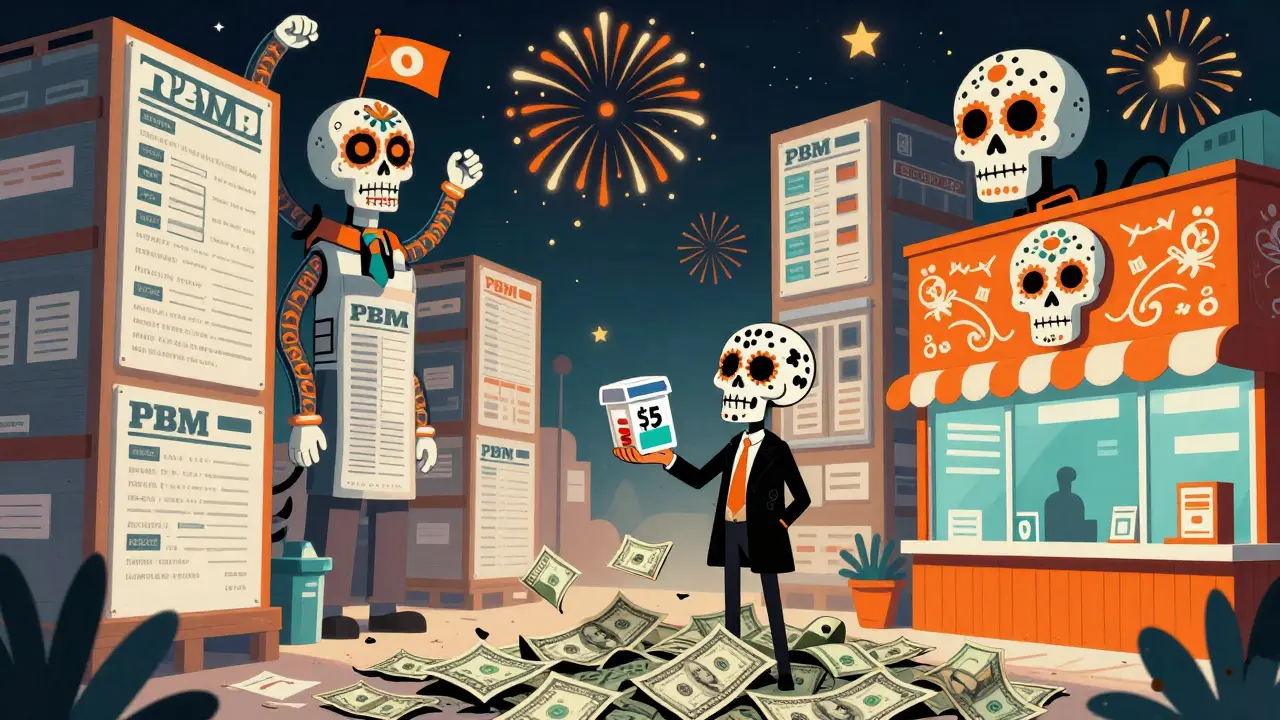
Here’s the twist: generic drugs make up 90% of all prescriptions filled in the U.S. But they only account for about 25% of total drug spending. Why? Because brand-name drugs cost 10 to 100 times more. A $500 insulin pen or a $1,200 cancer pill drives the numbers. But here’s what no one talks about: pharmacies make most of their actual profit from the $5 generic antibiotics or $10 blood pressure pills.
According to the Schaeffer Center’s 2022 analysis, pharmacies earn an average gross margin of 42.7% on generic drugs. That’s more than 12 times the margin they make on brand-name drugs, which hover around 3.5%. So even though brand drugs bring in more total revenue, the bulk of pharmacy profits come from low-cost generics.
Think of it this way: for every $100 spent on a generic drug, the pharmacy keeps about $32 before paying rent, staff, and utilities. For a brand drug, they might only keep $3. That’s why pharmacies rely on volume. They fill hundreds of generic prescriptions a day just to stay afloat.
The Hidden Game: How PBMs Control What Pharmacies Actually Get Paid
But here’s the catch - that $32 isn’t what ends up in the pharmacy’s bank account. It’s what’s listed on the receipt. What the pharmacy actually gets paid? That’s controlled by pharmacy benefit managers, or PBMs.
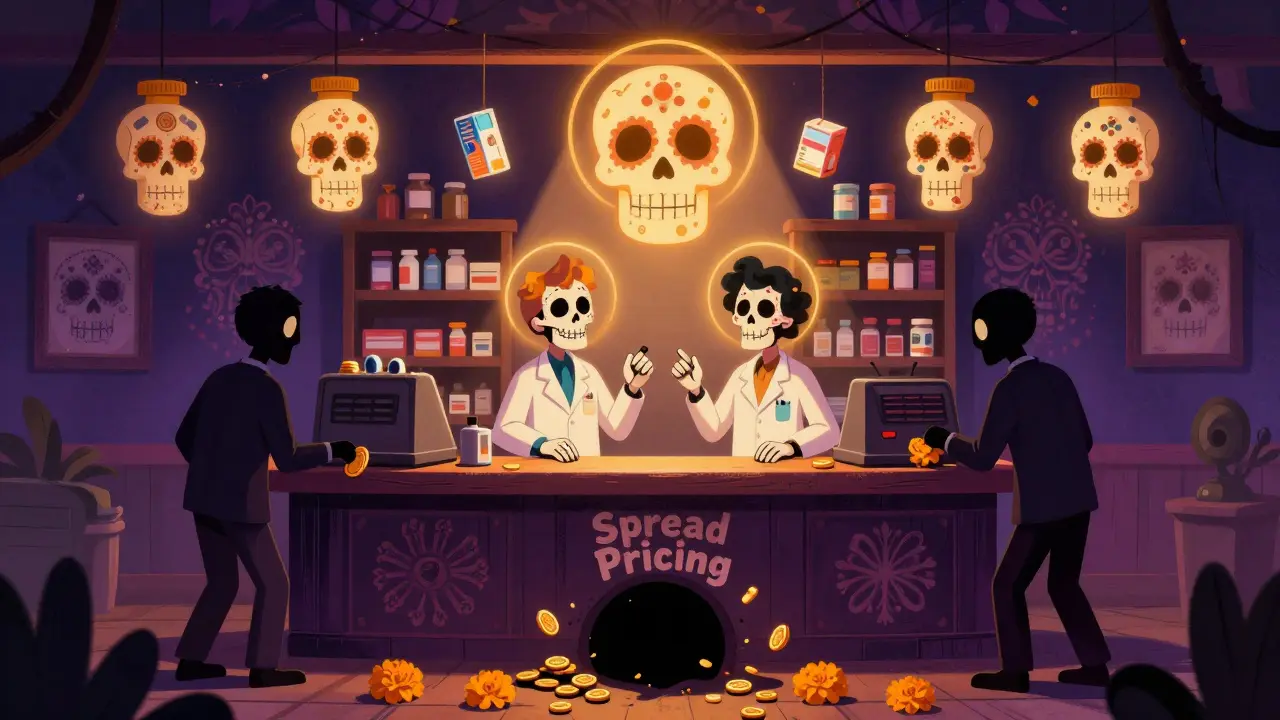
Three companies - CVS Caremark, Express Scripts, and OptumRx - control 80% of the market. They negotiate prices between drug manufacturers and insurers. But they don’t tell pharmacies what they’re being paid. Instead, they use something called “spread pricing.”
Here’s how it works: A PBM tells your insurance plan, “This generic drug costs $12.” Then they tell the pharmacy, “We’ll reimburse you $8.” The PBM pockets the $4 difference. That’s spread pricing. And it’s legal.
On top of that, PBMs sometimes do “clawbacks.” If you dispense a generic and the patient pays $10 at the counter, but the PBM later decides the drug’s true cost is $12, they demand you pay back $2. That’s right - you’ve already given the patient the pills, and now you owe money.
Independent pharmacies report losing 8-10% net profit on generics five years ago. Now, it’s down to 2% or less. Meanwhile, rent, wages, and insurance premiums keep rising. One Ohio pharmacy owner told Pharmacy Times, “My overhead went up 35%. My profit didn’t.”
Why Generic Prices Are Rising - Even When Competition Should Lower Them
You’d think more generic manufacturers would mean lower prices. And that’s usually true. The FDA says when three or more companies make the same generic, prices drop by about 20% within three years.
But that’s not happening anymore. Between 2014 and 2016, nearly 100 generic drug makers merged or were bought out. Now, the top five companies control 45% of the market - up from 32% in 2015.
Result? Some generics have only one manufacturer left. No competition. No price pressure. And in some cases, the price of the generic is now higher than the brand-name version.
SureCost’s 2024 white paper found cases where a single-source generic for a common antibiotic cost more than the brand. Why? Because the manufacturer has no rivals. And PBMs have no leverage to push the price down.
That’s why pharmacists are seeing more patients walk out because they can’t afford the $40 generic that’s now more expensive than the $30 brand. It’s not just bad economics - it’s bad medicine.
Mail-Order Pharmacies Are Winning - And Retail Pharmacies Are Losing
While your local pharmacy struggles, mail-order pharmacies are thriving. Why? Because they’re not bound by the same rules.
3Axis Advisors found that mail-order pharmacies make over four times the margin on generics compared to grocery store pharmacies. For brand drugs? They make more than 35 times the margin.
And in some cases, when pricing is opaque - like with specialty drugs or those without clear list prices - mail-order pharmacies can make up to 1,000 times more profit on a generic than a small retail pharmacy. How? They buy in bulk, negotiate directly with PBMs, and don’t have the overhead of storefronts.
That’s why independent pharmacies are closing. Between 2018 and 2023, over 3,000 closed. The National Community Pharmacists Association says 68% of independent owners rank declining generic reimbursement as their top threat.
Meanwhile, big chains like Walgreens and CVS are buying up independents. They’re also building their own PBMs. That’s not charity - it’s survival.

What Pharmacies Are Doing to Survive
Some pharmacies are fighting back. Not by hoping for better reimbursement, but by changing their business model.
- Many now offer Medication Therapy Management (MTM) services - one-on-one consultations with patients about their drugs. Medicare pays for this. It’s not about pills anymore - it’s about advice.
- Some have become specialty pharmacies, handling complex drugs for conditions like MS or rheumatoid arthritis. These drugs come with higher reimbursements and fewer clawbacks.
- A growing number are going cash-only for generics. Mark Cuban’s Cost Plus Drug Company charges $20 for a generic plus a $3 dispensing fee. Amazon Pharmacy does something similar: $5 for common generics, with full cost breakdowns.
- Others are cutting ties with PBMs entirely and contracting directly with employers or unions. One pharmacy in Minnesota reported a 4% net margin increase after switching.
The NCPA’s Rebuttal Academy has trained over 8,500 pharmacy staff to challenge unfair PBM payments. It’s not easy. It takes 15-20 hours a week just to fight for fair reimbursement.
What’s Next? Regulation, Disruption, and the Future of Pharmacy
The government is starting to pay attention. The FTC has launched investigations into PBM practices. States like California, Texas, and Illinois passed laws in 2022-2023 requiring PBMs to disclose how they set reimbursement rates.
The Inflation Reduction Act, which starts drug price negotiations for Medicare in 2026, could indirectly help. If brand-name drug prices drop, PBMs might have less room to inflate spreads.
But the real change might come from outside the system. Companies like Cost Plus Drug Company and Amazon Pharmacy are proving that transparent pricing works. Patients like knowing exactly what they’re paying. Pharmacies that adopt this model report higher customer loyalty and less pressure from PBMs.
Will independent pharmacies survive? Goldman Sachs predicts 20-25% more closures by 2027 unless reimbursement rules change. But Leerink Partners says pharmacies that shift to services - not just pills - can hit 4-6% net margins.
The truth? Pharmacy economics isn’t broken. It’s working exactly as designed - for PBMs and big chains. For the local pharmacist? It’s a daily battle to stay open. And the only way out is to stop playing the old game - and build a new one.



12 Comments
Michael Burgess January 3, 2026
Bro, I never realized how wild this system is. Pharmacies are basically running on fumes while PBMs laugh all the way to the bank. I got my blood pressure med for $3 last week - thought I was getting a deal. Turns out the pharmacy probably lost money on it. 😅
Brittany Wallace January 3, 2026
It’s heartbreaking. I grew up in a town where the pharmacy was the heart of the block - people came for meds, yes, but also for a chat, for advice, for comfort. Now? It’s just a kiosk with a PBM screen. We’re losing more than pharmacies… we’re losing care.
Philip Leth January 3, 2026
My grandma’s local pharmacy shut down last year. The owner cried when he told her they couldn’t afford to keep the lights on. He wasn’t making money on the pills - he was making it on the human connection. And now? That’s gone.
Kerry Howarth January 3, 2026
This is why we need transparent pricing laws - and fast. The current system rewards opacity and punishes community. It’s not just unfair, it’s unsustainable.
Tiffany Channell January 4, 2026
Of course this is happening. Capitalism doesn’t care about your small town pharmacy. If you’re not a corporate drone with a corporate PBM, you’re dead weight. Wake up.
Angela Goree January 5, 2026
Wait - so PBMs are literally stealing from pharmacies?! And the government lets them?! This is worse than I thought. Who’s paying for this? Who’s profiting? Who’s in charge?! Someone needs to burn this whole system down!
Palesa Makuru January 5, 2026
Actually, I’m from Johannesburg, and our pharmacy model is way more rational - generics are regulated, margins are capped, and pharmacists are trained as clinical partners. But here? It’s like the Wild West with insulin. I mean, really? A $40 generic is more expensive than the brand? That’s not capitalism - that’s a cartel with a pharmacy coat.
JUNE OHM January 7, 2026
MARK CUBAN IS A HERO. Amazon is just another Big Pharma puppet. But Cost Plus? That’s the future. They’re not playing the game - they’re rewriting the rules. The elites HATE this. That’s why they’re trying to shut them down. TRUST THE DATA.
Joy F January 8, 2026
Let’s be real - this isn’t about generics or PBMs. It’s about the collapse of the American social contract. The pharmacy is the last vestige of community medicine, and now it’s being commodified by algorithm-driven profit machines. The PBM is the new feudal lord, and the pharmacist? Just a serf with a scanner. We’re in the post-capitalist dystopia, folks. And it’s already here.
It’s not just economics. It’s epistemology. The loss of trust in local institutions. The erosion of embodied care. The algorithmic alienation of healing. We’re not just losing pharmacies - we’re losing the soul of medicine.
And don’t get me started on how Medicaid fraud is being used to justify clawbacks. It’s a narrative engineered to distract from the real theft - the systematic extraction of value from the most vulnerable.
Someone needs to write a thesis on this. I’ll fund it.
Liam Tanner January 8, 2026
My cousin runs a pharmacy in Iowa. She started offering free blood pressure checks and diabetes coaching. Now she gets reimbursed through Medicare for MTM. It’s not glamorous, but it keeps the doors open. Small shifts matter.
Shanahan Crowell January 10, 2026
Don’t give up hope! Pharmacies that pivot to services are thriving. I know one in Nebraska that now does telehealth consults, vaccine clinics, and even sells CBD gummies legally. They’re not just selling pills - they’re building a health hub. The future isn’t dead. It’s just waiting for someone to show up.
Ian Ring January 11, 2026
Interesting… and terrifying. I’m British - here, generics are priced by the NHS, and pharmacists are salaried. We don’t have PBMs. We don’t have clawbacks. We don’t have $40 generics more expensive than brands. The system isn’t perfect - but it’s not designed to bleed the pharmacist dry.
Maybe… just maybe… we need to stop pretending this is ‘free market’ and admit it’s a rigged game.