
Have you ever picked up your prescription and thought, "This isn’t the same pill I got last month"? Maybe it’s a different color, shape, or size. You’re not imagining things. And you’re not alone. Millions of people in the U.S. experience this every year. The truth? It’s not a mistake. It’s the law.
It’s Not About Quality - It’s About Trademarks
Generic drugs are just as safe and effective as brand-name ones. The FDA requires them to have the exact same active ingredient, strength, dosage form, and route of administration. But here’s the catch: generic drugs can’t look identical to the brand-name version. Why? Because of U.S. trademark laws.Trademark laws protect the visual identity of brand-name drugs. If a generic version looked exactly like the original - same color, same shape, same markings - it could confuse consumers and violate the brand’s intellectual property rights. So, the FDA enforces a simple rule: generics must be different in appearance.
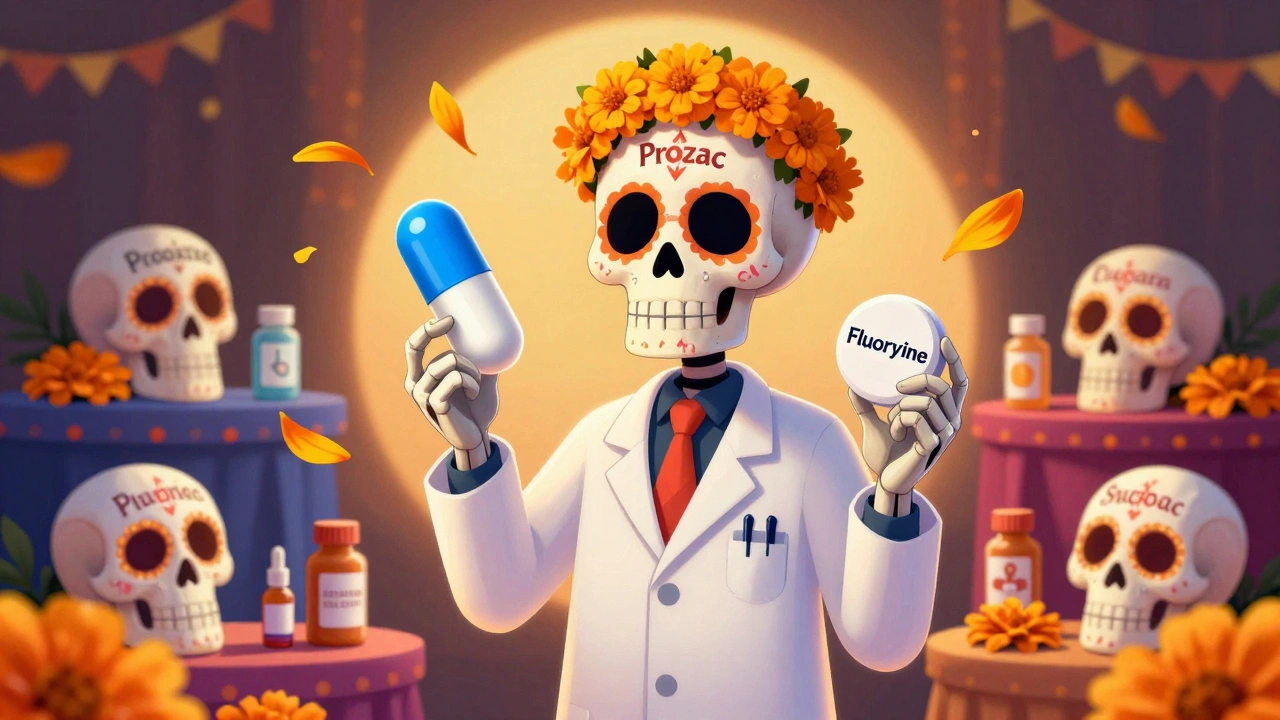
This isn’t about making generics less trustworthy. It’s about making sure the original manufacturer’s product stands out. That’s why Prozac (brand) is a blue capsule, but generic fluoxetine might be a white tablet, a yellow capsule, or even a pink pill - depending on who made it. Same drug. Same effect. Different look.
What Exactly Changes? (And What Doesn’t)
The only thing that changes between brand and generic is the inactive ingredients. These are the stuff that doesn’t treat your condition - but helps the pill work, look, or taste better. Think of them like the packaging of a product. The inside is the same; the box is different.Here’s what can vary:
- Color: Dyes like FD&C Blue No. 1 or iron oxide are added for visual distinction.
- Shape and size: Tablets might be oval instead of round, or smaller/larger to avoid copying the brand.
- Flavoring: In liquid or chewable forms, flavorings like mint or cherry can differ.
- Coatings and binders: Ingredients like lactose, cellulose, or starch help hold the pill together - and can change between manufacturers.
What stays the same? The active ingredient. The dose. The way your body absorbs it. The FDA requires generics to be bioequivalent - meaning they deliver the same amount of medicine into your bloodstream within 80% to 125% of the brand-name version. That’s a wide enough range to account for natural variation in manufacturing, but tight enough to ensure the same effect.
A 2008 study in the Journal of the American Medical Association looked at 38 clinical trials comparing generics and brand drugs. The average difference in absorption? Just 3.5%. That’s less than the natural fluctuation you’d see if you took the same brand-name pill on two different days.
Why This Confuses Patients - And Why It Matters
People don’t think of pills as products. They think of them as medicine. When your blood pressure pill suddenly turns from green to white, your brain says: "Is this the right one?"It’s not paranoia. It’s psychology. A 2021 study in JAMA Internal Medicine found that 14.2% of patients stop taking their medication after switching to a generic - not because it doesn’t work, but because they’re unsure if it’s the same. That’s dangerous.
There are real consequences. A case reported by Brown University Health involved a 72-year-old woman who stopped taking her amlodipine after her generic turned from blue to white. Eleven days later, her blood pressure spiked to 198/112. She ended up in the ER.
Pharmacies see this all the time. UMass Memorial Health Center found that appearance changes contribute to about 3% of all medication errors in community pharmacies - third behind similar-sounding drug names and handwriting issues.
How Pharmacies Are Fighting the Confusion
Pharmacists know this problem. And they’re trying to fix it.In 2022, CVS and Walgreens started using software that flags when a patient gets a generic with a new appearance. When that happens, the pharmacist is prompted to explain the change - right at the counter.
Eighty-nine percent of independent pharmacies now use something called medication synchronization. That means they try to refill all your prescriptions at the same time - so you get the same generic version every time. No surprises.
Many pharmacies also now hand out pictures of your pills with your prescription. Humana’s patient education campaign showed that when patients see a photo of what their pill should look like, they’re 22% less likely to stop taking it.
It’s simple: See it. Know it. Trust it.
The Big Picture: Cost vs. Confusion
Generic drugs save the U.S. healthcare system over $300 billion every year. In 2022, 90% of all prescriptions filled were for generics. That’s over 6 billion pills.But here’s the irony: the very rule that lets generics exist - the trademark law forcing visual differences - is costing the system money. Medicare Part D estimates that appearance-related confusion leads to 4.8% higher discontinuation rates for generics. That adds up to $1.2 billion in avoidable hospital visits and emergency care annually.
Generic manufacturers spend an average of $2.1 million per drug to develop a formulation that meets bioequivalence standards while still looking different. That’s money that could go toward lowering prices - but instead goes into making pills look unique.
Is There a Better Way?
The FDA is starting to ask that question.In September 2023, they released draft guidance suggesting generic manufacturers should match the brand’s appearance when possible - not because they have to, but because it helps patients. Some companies like Teva and Mylan are already doing it voluntarily for common drugs like atorvastatin and lisinopril. Their results? A 17.3% improvement in patient adherence.
The 2023 Lower Drug Costs Now Act even includes a mandate for the Department of Health and Human Services to create standards for reducing appearance-related errors by June 2025.
It’s not about removing trademark protection. It’s about smart design. If a generic can look just like the brand without copying it - and that helps people take their medicine - why not do it?
What You Should Do
If your pill looks different:- Don’t panic. It’s probably still the right drug.
- Check the label. The active ingredient and dose should match your old pill.
- Ask your pharmacist. Show them your old and new pills. They’ll tell you if it’s the same medicine.
- Keep a photo. Take a picture of your pill when you first get it. That way, next time it changes, you’ll know it’s normal.
Remember: color doesn’t cure. Chemistry does. The pill that looks different? It’s doing the same job.
Generic drugs aren’t cheaper because they’re worse. They’re cheaper because they don’t need to pay for advertising, branding, or patent lawsuits. And they work just as well.
The real question isn’t whether the pill looks right. It’s whether you’re taking it - and that’s what matters most.
Why do generic drugs look different from brand-name ones?
Generic drugs look different because U.S. trademark laws prevent them from copying the exact color, shape, or markings of brand-name drugs. This is to avoid confusion and protect the original manufacturer’s intellectual property. The active ingredient, dosage, and effectiveness are identical - only the inactive ingredients that affect appearance (like dyes or coatings) are changed.
Are generic drugs as effective as brand-name drugs?
Yes. The FDA requires generic drugs to be bioequivalent to their brand-name counterparts, meaning they deliver the same amount of active ingredient into your bloodstream within a very narrow range (80%-125%). Studies show the average difference in absorption is only 3.5%, which is clinically insignificant for most medications.
Can changing the appearance of a generic drug affect how it works?
No, the appearance change doesn’t affect how the drug works. The active ingredient is the same. Changes in color, shape, or flavor come from inactive ingredients like dyes or binders, which don’t impact therapeutic effect. However, confusion over appearance can lead some patients to stop taking their medication - which can be dangerous.
Why do some people stop taking their generic medication?
Many people stop because they believe a different-looking pill means it’s not the same drug. A 2021 study found 14.2% of patients discontinue their medication after switching to a generic - not because it doesn’t work, but because they’re unsure or anxious. This confusion can lead to missed doses, worsening health, and even emergency care.
What should I do if my generic pill looks different?
First, check the label for the active ingredient and dose - they should match your previous prescription. Then, ask your pharmacist to confirm it’s the same medicine. Many pharmacies now offer pill photos or alerts when appearance changes. Taking a picture of your pill when you first get it can help you recognize future changes.
Are there any exceptions where generic appearance matters more?
Yes. For drugs with a narrow therapeutic index - like warfarin, levothyroxine, or phenytoin - even small changes in absorption can matter. The FDA has stricter guidelines for these, but even then, the law still requires visual differences between manufacturers. That’s why it’s especially important to stick with the same generic brand if possible, and always check with your pharmacist when switching.


8 Comments
Jane Quitain December 7, 2025
i just thought my blood pressure pill was going bad or something 😅 guess it’s just the law being weird. never knew generics had to look different-now i take pics of every new pill i get. saved my sanity.
David Brooks December 8, 2025
THIS. THIS RIGHT HERE. 🙌 I had a friend who stopped her thyroid med because it went from white to orange-ended up in the hospital. The system is literally designed to confuse people who are already stressed about being sick. Why are we punishing patients for trademark lawyers’ ego trips??
Olivia Hand December 8, 2025
It’s fascinating how a legal loophole rooted in 19th-century branding doctrine is now a public health hazard. The FDA’s bioequivalence standards are rock-solid, yet we force manufacturers to reinvent the aesthetic wheel every time-dyes, coatings, shapes-all just to avoid trademark infringement. Meanwhile, the real cost isn’t in pill production, it’s in ER visits, non-adherence, and the psychological toll of wondering if your medicine is ‘fake.’ The 17.3% adherence boost from matching appearances? That’s not a coincidence. It’s a moral imperative.
And let’s be real: if you gave someone a blue pill and a white pill and told them one was ‘premium’ and one was ‘discount,’ they’d pick the blue one every time. It’s not about science-it’s about perception. And perception, in healthcare, can kill.
Why not let generics match the brand’s look unless there’s a documented risk of confusion? The brand didn’t invent the molecule. They just trademarked the packaging. We’re not protecting innovation-we’re protecting corporate vanity.
Also, the fact that 3% of pharmacy errors come from this? That’s not a footnote. That’s a systemic failure dressed up as ‘trademark protection.’
And yes, I’ve had my own ‘is this the same pill?’ panic. Took me 20 minutes to confirm it was fluoxetine. I’m a pharmacist’s kid. Imagine how bad it is for someone who doesn’t know the difference between lisinopril and losartan.
Someone should make a TikTok series: ‘Pill ID Bingo.’
Desmond Khoo December 9, 2025
bro i just took a pic of my pill every time i got a refill 😂 now my phone gallery is just 87 photos of little white ovals and blue capsules. but hey-at least i know i’m not going crazy. also, pharmacies should just send you a little sticker with the pill’s face on it. like a pokemon card. ‘Fluoxetine: Rare variant, 20mg, blue cap, 2024 edition.’ 🎴💊
Louis Llaine December 10, 2025
so let me get this straight-our entire healthcare system is held hostage by trademark law because someone in 1982 thought Prozac should be blue? 🤦♂️ next they’ll make us pay extra to keep the same color pill. i bet the brand-name company charges more for the ‘original aesthetic experience.’
also, 3% of pharmacy errors? that’s like saying ‘we’re not sure if this is medicine or a Skittles bag.’
Sam Mathew Cheriyan December 11, 2025
you guys are missing the point. the government is hiding the real truth. the pills are different because they’re not the same drug. the active ingredient is just a placebo. the real medicine is the color and shape. that’s why the brand-name ones work better. they’ve got secret nano-chips inside. the fda is in on it. they don’t want you to know you’re being manipulated by big pharma with dye-based mind control.
also, my cousin in india says generics there look exactly the same. weird right?
Nancy Carlsen December 11, 2025
thank you for writing this. 🙏 i’m a nurse and i see this every single day. old folks staring at their pill bottles like it’s a magic trick. i started printing little pill cards with photos and names-now my patients actually take their meds. one lady hugged me because she finally stopped skipping her pills. that’s worth more than any trademark.
ps: if your pill changes color, just ask. we’re here to help. no judgment. just medicine. 💙
Ted Rosenwasser December 11, 2025
As a former biochemistry PhD candidate who spent three years studying pharmacokinetics, I can tell you that the FDA’s 80–125% bioequivalence window is statistically absurd. The 3.5% average difference cited is a misleading average-it masks significant inter-individual variability, especially in CYP450 polymorphic populations. Furthermore, the assertion that ‘color doesn’t cure’ is a gross oversimplification of psychopharmacology. The placebo effect is not a myth-it’s a measurable neurochemical phenomenon. When a patient perceives a change in pill appearance, cortisol levels rise, dopamine release drops, and therapeutic efficacy plummets-regardless of active ingredient equivalence. This isn’t about trademarks. It’s about neurobiology. And the fact that the FDA hasn’t mandated visual standardization for high-risk drugs like warfarin is a dereliction of duty. The 2023 guidance? Too little, too late. We need a mandatory pill ID registry. And someone needs to sue the American Pharmaceutical Manufacturers Association for emotional distress.