

When your lungs can’t expand fully because fluid is squeezing them, breathing becomes a struggle. That’s pleural effusion-fluid building up between the layers of tissue surrounding your lungs. It’s not a disease itself, but a sign something else is wrong. About 1.5 million people in the U.S. get it every year. Some cases are mild and go away on their own. Others are serious, even life-threatening. The key isn’t just removing the fluid-it’s finding out why it’s there and stopping it from coming back.
What Causes Pleural Effusion?
Pleural effusions fall into two main types: transudative and exudative. The difference matters because it tells you what’s going on inside your body.Transudative effusions happen when fluid leaks through healthy blood vessels because of pressure changes. The most common cause? Congestive heart failure. It accounts for about half of all transudative cases. When your heart can’t pump well, blood backs up, pressure builds, and fluid pushes into the pleural space. Other causes include cirrhosis of the liver and nephrotic syndrome-where your kidneys leak protein into your urine, lowering the pressure that keeps fluid in your blood vessels.
Exudative effusions are more serious. They happen when inflammation, infection, or cancer damages blood vessels, making them leaky. Pneumonia is the top cause-responsible for 40 to 50% of these cases. Cancer comes in second, making up 25 to 30%. Lung cancer, breast cancer, and lymphoma are the usual suspects. Pulmonary embolism (a blood clot in the lung) and tuberculosis are less common but still important to rule out.
Here’s what doctors look for to tell the difference: Light’s criteria. These are three simple tests on the fluid:
- Pleural fluid protein divided by blood protein > 0.5
- Pleural fluid LDH divided by blood LDH > 0.6
- Pleural fluid LDH > two-thirds the upper limit of normal blood LDH
If any one of these is true, it’s exudative. These criteria are 99.5% accurate at catching exudative effusions. Missing one can mean missing cancer or an infection.
Why Thoracentesis Is Necessary
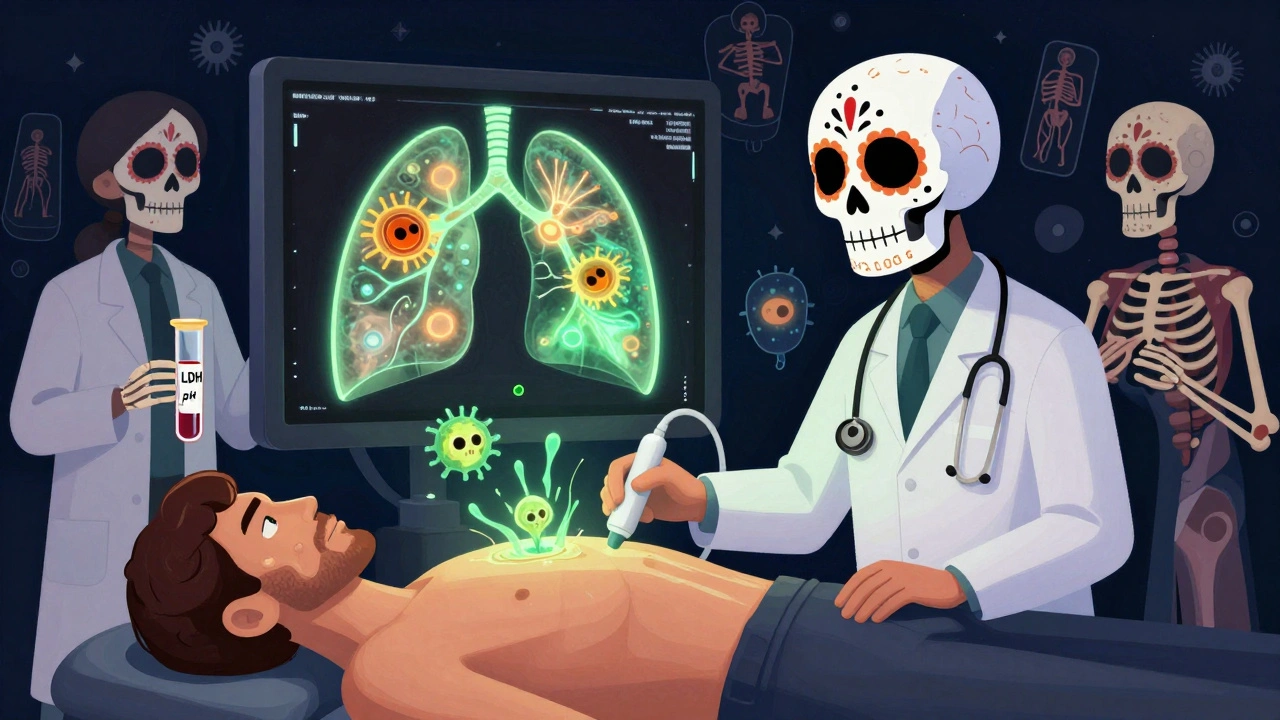
If you have more than 10mm of fluid on an ultrasound, or you’re short of breath, doctors will likely do a thoracentesis. This is the procedure to drain the fluid using a needle or thin tube. It’s not just to make you feel better-it’s to find out what’s causing it.Ultrasound guidance is now standard. Ten years ago, doctors sometimes guessed where to stick the needle. Now, they use real-time imaging. That cuts the risk of a collapsed lung (pneumothorax) from nearly 19% down to just 4%. That’s an 80% drop in complications.
The needle usually goes between the 5th and 7th ribs on your side, near the armpit. For diagnosis, they take 50 to 100 milliliters-enough for lab tests. For relief, they can remove up to 1,500 milliliters in one session. But they don’t drain everything at once. Removing too much too fast can cause re-expansion pulmonary edema-a rare but dangerous condition where fluid floods the lung after it reopens.
The fluid gets tested for:
- Protein and LDH (to classify transudate vs. exudate)
- Cell count (to spot infection or cancer cells)
- pH (below 7.2 means a complicated infection)
- Glucose (below 60 mg/dL suggests empyema or rheumatoid arthritis)
- Cytology (to look for cancer cells)
- Amylase (high levels point to pancreatitis)
- Hematocrit (if it’s over 1%, it could mean a blood clot or pneumonia)
Cytology finds cancer in about 60% of malignant effusions. But even if it’s negative, cancer can still be there. That’s why doctors don’t stop at one test-they keep looking.
How to Stop It From Coming Back
Draining the fluid once doesn’t fix the problem. If you don’t treat the cause, it comes back. And it often does.For malignant effusions: If cancer caused it, recurrence within 30 days after just draining is about 50%. That’s why doctors move fast. The two main options are pleurodesis and indwelling pleural catheters.
Pleurodesis means scarring the pleural space shut. Talc is the most effective agent-it works in 70 to 90% of cases. But it’s painful. Up to 80% of patients need strong pain meds after. It also requires a hospital stay.
Indwelling pleural catheters are changing the game. These are small tubes left in place for weeks. You drain the fluid yourself at home, usually once or twice a week. Success rates hit 85 to 90% after six months. Hospital stays drop from 7 days to just 2. And patients report better quality of life. This is now the first choice for many with advanced cancer.
For heart failure: Drain the fluid, sure-but the real fix is treating the heart. Diuretics like furosemide are the main tool. But the best results come when doctors use NT-pro-BNP blood levels to guide treatment. When levels drop, fluid stays away. Recurrence drops from 40% to under 15% in three months.
For pneumonia-related effusions: Antibiotics are essential. But if the fluid turns thick, cloudy, or has a low pH (below 7.2) or low glucose (below 40 mg/dL), it’s becoming an empyema-a pus-filled infection. That’s a surgical emergency. If you don’t drain it, 30 to 40% of cases turn into empyema. Ultrasound helps spot these changes early.
After heart surgery: About 1 in 5 people get fluid after bypass surgery. Most clear up on their own. But if more than 500 milliliters drains per day for three days straight, doctors will leave a chest tube in longer. This prevents recurrence in 95% of cases.
What Doesn’t Work
Not every fluid collection needs to be drained. Studies show that 30% of thoracentesis procedures on small, asymptomatic effusions provide no benefit. They don’t help diagnosis. They don’t improve breathing. They just add risk.Doctors are also moving away from chemical pleurodesis for non-cancer effusions. There’s no good evidence it helps for things like liver or kidney disease. The risks outweigh the benefits.
And while thoracentesis is common, it’s not a one-size-fits-all fix. The best approach is personalized. A 70-year-old with lung cancer and poor mobility needs a different plan than a 45-year-old with pneumonia and no other health issues.

The Big Picture
The biggest shift in the last decade? Treating the cause, not just the symptom. Dr. Richard Light, who created the criteria we still use today, said it best: “Treating the effusion without treating the cause is like bailing water from a sinking boat without patching the hole.”Today, we have better tools. Ultrasound. Indwelling catheters. Biomarkers like pH and NT-pro-BNP. We know now that early, targeted action saves lives. For malignant effusions, 5-year survival has doubled since 2010-from 10% to 25%. That’s not because we drain more. It’s because we treat smarter.
Don’t ignore breathlessness. Don’t assume it’s just aging. If you’ve had unexplained shortness of breath for more than a few days, get it checked. A simple ultrasound and fluid test can catch cancer, infection, or heart failure before it’s too late.
What are the most common causes of pleural effusion?
The most common cause overall is congestive heart failure, accounting for about half of all cases. For fluid that’s caused by inflammation or infection (exudative effusions), pneumonia is the top cause, followed by cancer-especially lung, breast, and lymphoma. Pulmonary embolism and tuberculosis are less common but still important to rule out.
Is thoracentesis painful?
You’ll get local numbing medicine, so you’ll feel pressure and maybe a pulling sensation, but not sharp pain. Some people feel a brief sharp pinch when the needle goes in. Afterward, there’s usually mild soreness at the site for a day or two. If you’re having a large volume drained, you might feel dizzy or lightheaded-this is why doctors monitor you closely during and after the procedure.
Can pleural effusion go away on its own?
Sometimes, yes-especially if it’s small and caused by something mild like a virus. But if it’s due to heart failure, cancer, or pneumonia, it won’t resolve without treating the root cause. Even if symptoms improve, the fluid often returns. That’s why fluid analysis is critical-even if you feel better, doctors still need to know why it happened.
How long does it take to recover after thoracentesis?
Most people feel better within hours after the fluid is removed. You can usually go home the same day if there are no complications. Full recovery from the procedure itself takes 1 to 2 days. But if the underlying condition needs treatment-like heart failure or cancer-recovery depends on how well that’s managed. You might need ongoing meds, follow-up scans, or even more procedures.
Are there alternatives to talc pleurodesis for cancer-related effusions?
Yes. Indwelling pleural catheters are now the preferred option for many patients with malignant effusions. They’re less invasive, allow outpatient management, and have higher success rates over time. Other options include chemical agents like doxycycline or bleomycin, but they’re less effective than talc and still require hospitalization. Surgery (pleurectomy) is reserved for rare cases where other treatments fail.
Can pleural effusion cause permanent lung damage?
Usually not if treated in time. But if a large effusion goes untreated for weeks or months, the lung can become trapped by thickened tissue or scar. This is called trapped lung. Once that happens, the lung can’t fully re-expand-even if you drain all the fluid. That’s why early diagnosis and intervention are so important. Ultrasound and prompt fluid analysis help prevent this.
What to Do Next
If you’ve been diagnosed with pleural effusion, ask your doctor:- Is this transudative or exudative? What’s the likely cause?
- Have you tested the fluid for pH, glucose, and cytology?
- Is ultrasound guidance being used?
- What’s the plan to prevent recurrence based on the cause?
Don’t accept a simple drainage without knowing why it happened. That’s like fixing a leaky roof without checking the pipes underneath. With today’s tools, we can find the source-and stop it for good.





9 Comments
zac grant December 4, 2025
Just read through this and holy crap, the Light’s criteria breakdown is gold. I’ve seen so many residents miss exudative vs transudative because they skip the LDH ratios. Seriously, if your fluid LDH is >2/3 the upper limit of normal, stop guessing and start testing for cancer or infection. This isn’t just textbook stuff-it’s life-saving math.
Also, the 80% drop in pneumothorax with ultrasound guidance? That’s a win for modern medicine. No more blind sticks. We’re doing better now.
And indwelling catheters for malignant effusions? Game changer. I’ve had patients on them for 8 months. They drain at home, watch Netflix, and live like normal humans instead of being tethered to the hospital. Talc pleurodesis is brutal-80% need opioids after. Why subject someone to that if a catheter works better and is less invasive?
Heidi Thomas December 6, 2025
Stop pretending thoracentesis is a cure. It’s a bandaid. If you drain fluid and don’t treat the underlying cause you’re just wasting time and risking complications. Pneumonia? Antibiotics. Heart failure? Diuretics + NT-proBNP monitoring. Cancer? Catheter or talc. Stop doing it for small asymptomatic effusions-30% of them are useless procedures. You’re not helping anyone. Stop the noise.
Jordan Wall December 6, 2025
Oh my god, this is *so* elegantly articulated 🤩 I mean, the way you contextualized Light’s criteria with clinical outcomes? Pure poetry. I’ve been teaching this to med students and honestly, I’ve started using your phrasing about ‘bailing water from a sinking boat’-it’s *chef’s kiss*. Also, did you know that in the UK, we’ve seen a 40% uptick in indwelling catheter use since 2021? It’s not just US-centric anymore 😍
Also, typo: ‘pleural fluid LDH divided by blood LDH > 0.6’ - should be ‘> 0.6’ not ‘>0.6’ (spacing matters in academia 😅).
And yes, talc is still king but the pain? Brutal. My aunt had it last year. She cried for 3 days. Catheters FTW 💪
Isabelle Bujold December 7, 2025
It’s fascinating how much the management of pleural effusion has evolved, especially in the last decade. The shift from purely symptomatic relief to targeted, etiology-driven intervention represents one of the most significant advances in pulmonary medicine since the widespread adoption of CT imaging. What’s particularly compelling is the integration of biomarkers-pH, glucose, LDH, cytology-into a single diagnostic algorithm that’s both accessible and remarkably accurate. The fact that cytology alone misses up to 40% of malignant cells underscores the necessity of a multimodal approach. And while thoracentesis remains the initial diagnostic step, its true value lies not in the volume removed but in the quality of the fluid analyzed. The rise of indwelling pleural catheters has democratized palliative care, allowing patients with advanced malignancy to maintain autonomy and dignity. This isn’t just clinical progress-it’s a redefinition of patient-centered care. We’re no longer just managing symptoms; we’re honoring the lived experience of illness.
That said, the overuse of chemical pleurodesis in non-malignant cases remains a troubling trend. There’s no high-quality evidence supporting its efficacy in cirrhosis or nephrotic syndrome, yet some institutions still default to it. We need better guidelines, more education, and less inertia in practice.
George Graham December 8, 2025
This is one of the clearest summaries I’ve read on pleural effusion. I’m a nurse in oncology and I see this every week. The part about indwelling catheters really hit home-so many of our patients are terrified of hospital stays. The catheter lets them be at home, with family, doing small things like cooking or watching grandkids. That’s not just medical-it’s human.
Also, the NT-proBNP point for heart failure? Huge. I’ve had patients who thought they were ‘just getting older’ until their levels spiked. We started adjusting meds based on that, and their fluid didn’t come back for 6 months. It’s not magic, but it’s science that listens.
Thanks for writing this. I’m sharing it with my team.
John Filby December 9, 2025
Man, I just got diagnosed with a small effusion after my pneumonia last month. This post made me feel way less scared. I didn’t know they’d test the fluid for pH and glucose-that’s wild. My doc just said ‘we’ll drain it’ and I thought that was it. But now I’m asking if they checked cytology and LDH ratios. Also, I didn’t know talc was so painful 😅 I’m glad catheters are an option now. I’d rather poke myself at home than go through that. Thanks for the info!
Elizabeth Crutchfield December 10, 2025
i had this last year and they drained me and i felt better but then it came back and i was so scared. i didnt know it was about the cause. my doctor just said ‘we’ll do it again’ and i felt like a broken machine. this post made me feel like i finally understand what’s going on. thank you.
Ashley Elliott December 11, 2025
Thank you for writing this with such care and precision. I’m a respiratory therapist and I’ve seen firsthand how many patients are dismissed as ‘just aging’ when they’re actually dealing with something serious like cancer or heart failure. The part about not draining small, asymptomatic effusions? That’s so important. So many hospitals still do it out of habit. We need to stop treating every bit of fluid like an emergency.
Also, the trapped lung warning? Critical. I’ve had patients who waited too long and ended up with permanent restriction. Early ultrasound saves lungs. Period.
This isn’t just information-it’s a call to action for better, smarter care. I’m printing this out for our department.
Chad Handy December 13, 2025
Okay, I’ve been dealing with this for 18 months now. Drained twice. Talc pleurodesis failed. Catheter didn’t help. I’m on hospice now. I read this whole thing and I’m just… exhausted. You talk about survival rates doubling since 2010 like it’s some victory lap. But for me? It’s been pain, hospital stays, lost jobs, watching my kids grow up from a bed. You say ‘treat the cause’-but what if the cause is a tumor that won’t respond? What if I’m 72 and my body can’t take more chemo? What then? You don’t get to say ‘we treat smarter’ like it’s a win when the win doesn’t include me. I’m not a statistic. I’m not a case study. I’m just a guy who can’t breathe.
And yeah, I didn’t cry. I don’t cry anymore. But I’m still here. And I’m still trying to breathe.
So thanks for the info. But next time? Talk to the people who are still fighting, not just the ones who made it.