
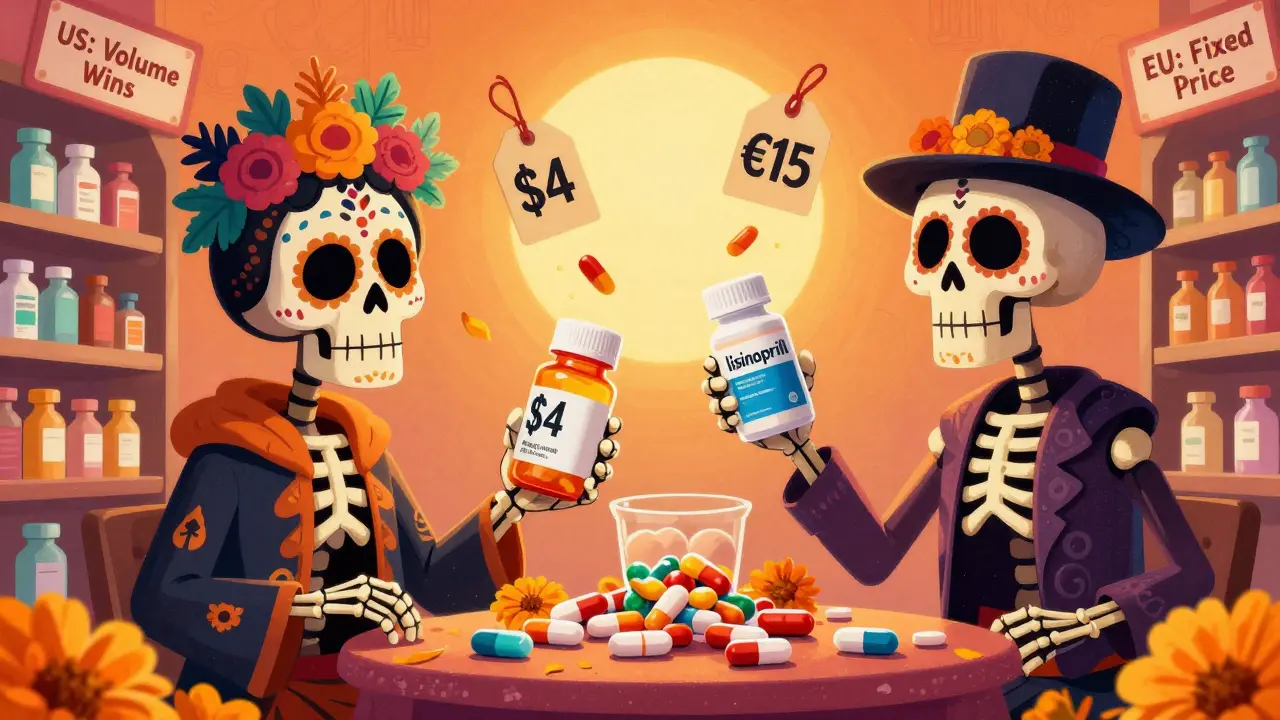
It’s one of those things that sounds backwards: Americans pay less for generic drugs than people in Europe. You’d expect the opposite. After all, the US is known for sky-high drug prices, and Europe has universal healthcare. But when it comes to off-patent medications, the US wins - and the reason has everything to do with how the market works, not just healthcare policy.
What’s the real price difference?
In 2023, the average price of a generic prescription in the US was $28.50. In European countries like Germany, France, and the UK, it was $42.10. That’s a 34% difference - and it’s not a fluke. A 2022 analysis from the U.S. Department of Health and Human Services found that Americans pay about one-third less for generics than residents of 33 other OECD countries. Meanwhile, brand-name drugs? The US pays over 3 times more. So the story isn’t about the whole system - it’s about the generics market specifically.
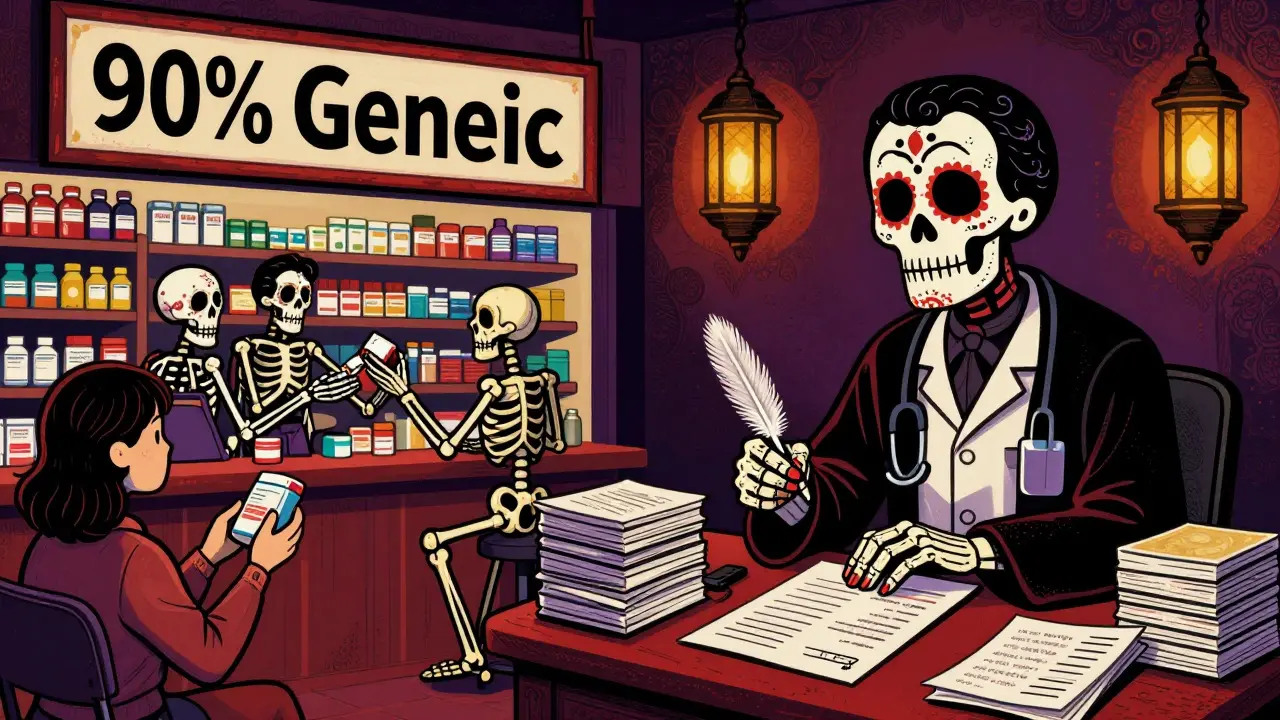
Why? Because the US has one of the most aggressive generic drug markets on the planet. Over 90% of prescriptions filled here are for generics. That kind of volume creates fierce competition. Manufacturers slash prices just to stay in the game. You’ve got companies like Teva, Mylan, and Sandoz fighting for shelf space. They know if they don’t offer the lowest price, someone else will. And pharmacies? They’re happy to switch patients to the cheapest version - 49 states allow automatic generic substitution without needing a doctor’s okay.
How Europe’s system is built differently
In Europe, only about 41% of prescriptions are for generics. That’s because their systems don’t push competition the same way. Many countries use centralized price negotiation. The government sits down with drugmakers and says, ‘This is what we’ll pay.’ No bidding war. No volume discounts based on market share. It’s more like a fixed contract.
Germany uses external reference pricing - they look at what neighboring countries pay and set their price around that average. France requires a doctor’s approval before switching from brand to generic. The UK uses NICE, a health technology assessment body that decides whether a drug is worth the cost based on clinical benefit. These systems protect manufacturers from price crashes but also keep generic prices higher.
And here’s the kicker: European pharmacies don’t always have the same incentive to switch. If the price difference between brand and generic is small, and the system doesn’t reward volume, there’s little reason to push the cheaper option. In the US, a pharmacy can save $20 per prescription by switching to a generic - and that adds up fast.
Rebates, PBMs, and the hidden system
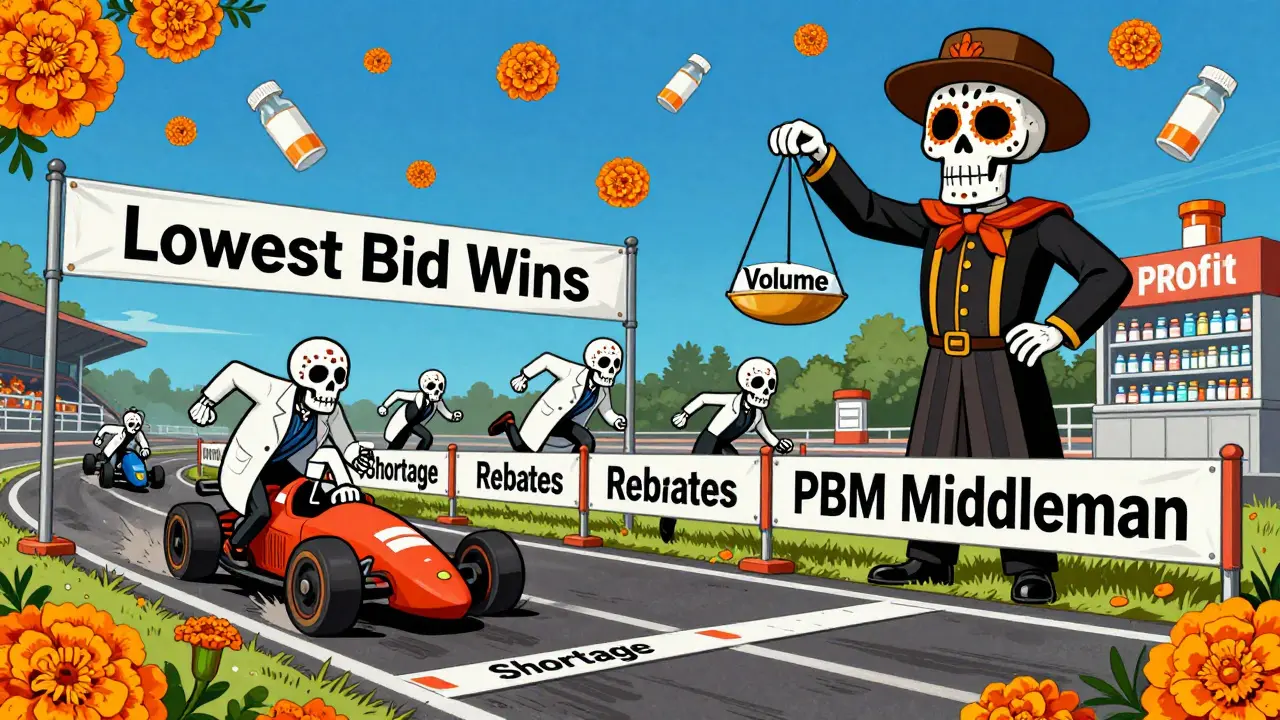
You might hear people say the US pays more because of Pharmacy Benefit Managers (PBMs). And that’s true - but mostly for brand-name drugs. PBMs negotiate rebates from drugmakers, often 35-40% off list price. But here’s the catch: those rebates don’t go to you. They go to your insurer or employer plan. You still see the full list price at the pharmacy counter.
For generics? It’s different. There’s almost no rebate system. The price you see is usually the net price. That’s why you can walk into Walmart or CVS and pay $4 for a 30-day supply of generic lisinopril. In Germany, the same thing might cost you €15 - even with insurance. One Reddit user in January 2025 posted: ‘I paid €15 for generic lisinopril in Berlin. At home, it’s $4.’ That’s not a typo. That’s the system.
The US generic market runs on volume and speed. Companies make money by selling huge quantities at razor-thin margins. Some even sell below manufacturing cost just to keep competitors out. That’s why shortages happen - when one company exits the market because it’s unprofitable, the next one can jack up prices. Dana Goldman from USC calls it a ‘race to the bottom’ - and sometimes, the bottom falls out.
Why brand-name drugs cost so much more in the US
It’s easy to blame the whole system for high drug prices, but the real story is more nuanced. The US pays more for brand-name drugs because it’s the primary funder of global pharmaceutical R&D. Companies recoup billions in development costs from American consumers. A 2024 Milbank Quarterly study found the US funds about two-thirds of all global drug innovation. Without those high prices here, many new drugs wouldn’t exist - or wouldn’t be developed at all.
Europe doesn’t pay that premium. Their pricing systems are designed to keep costs low, not to fund innovation. That’s why some experts say Europe is ‘free-riding’ on the US system. When Pfizer or Merck launch a new drug, they price it high in the US to cover costs, then offer it at a steep discount in Europe. That’s not a conspiracy - it’s business.
The Inflation Reduction Act is starting to change this. Medicare now negotiates prices for 10 high-cost brand-name drugs. For Jardiance, the negotiated price was $204 - compared to $52 in other countries. That’s still 4 times higher. But it’s a start. If more drugs get negotiated, the US price gap will shrink.
What’s changing - and what’s not
Policy is shifting. The Trump administration’s proposed ‘most favored nation’ rule would have forced the US to pay the same price as the lowest-paying OECD country. Experts like Alexander Natz of EUCOPE warned that this would force drugmakers to raise prices in Europe to make up the lost revenue. That could hurt access there.
Meanwhile, the European Commission is watching closely. Their 2025 review admits that strict price controls may be limiting access to new therapies. The US generic market, on the other hand, keeps humming. Even with shortages and occasional price spikes, it’s still the most efficient in the world.
Here’s what won’t change: the US will keep paying less for generics. Why? Because the market structure - the competition, the volume, the automatic substitution - is built for it. Europe’s system is built for control, not competition. One isn’t better. They’re just different.
What this means for you
If you’re in the US and take generics: you’re getting a deal. You’re benefiting from a market that works - even if the rest of the system feels broken. If you’re on Medicare Part D, your monthly generic copay is likely $0-$10. That’s not luck. That’s economics.
If you’re traveling to Europe and need a refill: expect to pay more. Don’t assume your US price applies. A generic that costs $5 here might be €12 there. Always check local prices.
And if you’re wondering why the US doesn’t just copy Europe’s system? It’s not that simple. Lowering brand-name prices might mean fewer new drugs. Lowering generic prices further could mean shortages. There’s no perfect model - just trade-offs.
Why do Americans pay less for generic drugs than Europeans?
The US has a highly competitive generic market with over 90% of prescriptions filled with generics. This drives manufacturers to slash prices to win volume. Pharmacies automatically substitute generics, and PBMs don’t interfere with generic pricing like they do with brand drugs. In Europe, centralized pricing, limited substitution, and lower competition keep generic prices higher.
Do US generic drug prices include rebates like brand-name drugs?
No. Rebates are mostly a feature of the brand-name drug market, negotiated between drugmakers and PBMs or insurers. Generic drugs are sold at net prices - what you pay at the pharmacy is typically the final price. That’s why you can get generic lisinopril for $4 at Walmart - there’s no hidden middleman markup.
Is it true that Europe pays less for all drugs?
No. Europe pays less for brand-name drugs because of government price controls, but pays more for generics. The US pays less for generics due to market competition and more for brand-name drugs because it funds global R&D. The total drug spending per capita is still higher in the US - but mostly because of brand-name prices.
Why do generic drug shortages happen in the US?
Because prices are pushed so low that some manufacturers can’t make a profit. When one company exits, others follow. Then, the few remaining suppliers gain monopoly power and raise prices. This happened with drugs like doxycycline and furosemide. It’s a side effect of a system that works too well - until it doesn’t.
Will Medicare drug negotiations lower generic prices?
No. Medicare negotiations only apply to brand-name drugs selected for price talks - not generics. The $28.50 average price for generics in the US won’t be affected by these deals. The generic market runs on its own rules: volume, competition, and low margins.
Can the US adopt Europe’s pricing system?
Technically, yes - but it would change the entire pharmaceutical ecosystem. If the US capped brand-name prices like Europe, drugmakers would lose revenue that funds global innovation. New drugs might stop being developed. And because the US generic market is so efficient, replacing it with a regulated system could actually raise generic prices - not lower them.

13 Comments
Aileen Nasywa Shabira March 18, 2026
Oh wow, so the US is "winning" by making drug companies go bankrupt to sell pills for $4? Brilliant. Let's just keep pushing manufacturers into oblivion until the only generic left is one made by a guy in a garage with a 3D printer and a dream. At least in Europe, people don't have to pray that their life-saving med doesn't vanish next month because some CEO decided "profit margin" was too low. #RaceToTheBottom 🤡
Kendrick Heyward March 19, 2026
THIS IS WHY AMERICA IS STILL THE GREATEST. WE DON'T LET GOVERNMENT TELL US WHAT TO PAY FOR MEDICINE. PEOPLE LIKE YOU WHO WANT EUROPEAN STYLE PRICES ARE JUST JEALOUS BECAUSE YOU CAN'T AFFORD YOUR OWN LUXURY CAR. 🤬
lawanna major March 19, 2026
There's something deeply human about how markets respond to volume. The US system isn't perfect-it's brutal, even-but it reveals a truth: when competition is real, prices fall. Not because someone decreed it, but because thousands of pharmacies, patients, and manufacturers all act in their own interest, and somehow, it aligns. The cost of this efficiency? Fragility. A single plant shutdown can leave thousands without medication. We trade stability for affordability. And that’s not just economics-it’s a moral calculus we all live with, daily.
Ryan Voeltner March 21, 2026
The structural differences between US and European generic markets reflect deeper philosophical approaches to health care. One prioritizes market dynamics, the other social equity. Neither is inherently superior. Both entail trade-offs. The challenge lies not in imitation but in understanding context.
Linda Olsson March 21, 2026
Let me guess-this was written by a PBM lobbyist. You know the real reason generics are cheap here? Because Big Pharma lets them be. They make all their money on brand drugs and use generics as a decoy. The FDA approves the same pills from the same factories-just repackaged. The $4 lisinopril? It's made in India. And yes, that's why there are shortages. They're not accidents. They're strategic. You think this is capitalism? It's a controlled collapse. Wake up.
Ayan Khan March 23, 2026
Interesting perspective. In India, we have generics priced even lower than the US-sometimes under $1 for a month’s supply. But we also have issues with quality control and distribution gaps. The US model works because of infrastructure, not just competition. Europe’s system protects access but loses speed. Maybe the future is hybrid: competition where it works, regulation where it’s needed. No system is pure.
Amadi Kenneth March 23, 2026
Wait, wait, wait-so you're saying the U.S. government doesn't control prices, but the pharmaceutical companies do? And they're just letting generics be cheap so they can charge more for brand names? That's a scam. I'm telling you, this is all part of the New World Order. The same people who run the Fed run the FDA. They want you dependent on cheap pills so you don't ask questions. They know if you get sick enough, you'll pay anything. And that's the plan. 🕵️♂️💣
Shameer Ahammad March 25, 2026
The European system is not about control-it is about sustainability. Price ceilings ensure long-term availability. The U.S. model is a Ponzi scheme disguised as efficiency. One day, there will be no manufacturers left, and then what? You will beg for regulation. And when that day comes, you will not have the infrastructure to implement it. You are burning the house to keep warm.
Alexander Pitt March 25, 2026
Key point missed: PBMs only matter for brand drugs. For generics, the price you see is the price paid. No middleman. No rebate shuffle. That’s why Walmart can offer $4. In Europe, even if the manufacturer sells cheap, the pharmacy or insurer adds layers. The system isn’t broken-it’s just different. And yes, shortages happen. But they’re rare, localized, and usually fixed within weeks. The trade-off is worth it.
Manish Singh March 26, 2026
It’s funny how we all think our system is the best. In India, we have generics that cost less than a cup of chai. But we also have people who can’t find them in rural clinics. The US has access but instability. Europe has stability but slower innovation. Maybe the answer isn’t copying one-it’s learning from both. We need competition, yes, but also safety nets. Not either/or. Both/and.
Nilesh Khedekar March 27, 2026
so like... uhhh the us is cheap because its a race to the bottom? but like... what if no one wants to make the pills anymore? like i get it its $4 but like what if the factory shuts down? then u just cant get ur meds? like thats kinda scary? 🤔
Robin Hall March 29, 2026
The assertion that the U.S. generic market is efficient is misleading. Efficiency implies sustainability. What we observe is a transient state of hyper-competition, deliberately engineered to extract maximum volume at minimal cost. The resulting supply-chain fragility is not a feature; it is a systemic vulnerability. The absence of regulatory oversight in pricing does not equate to market health. It equates to risk concentration.
Aileen Nasywa Shabira March 29, 2026
Wow. So now the "race to the bottom" is a feature? Not a bug? I guess if you’re okay with your insulin vanishing because the manufacturer went bankrupt last Tuesday, then sure. But I’ll take my €15 in Berlin any day. At least I know it’ll be there tomorrow.