
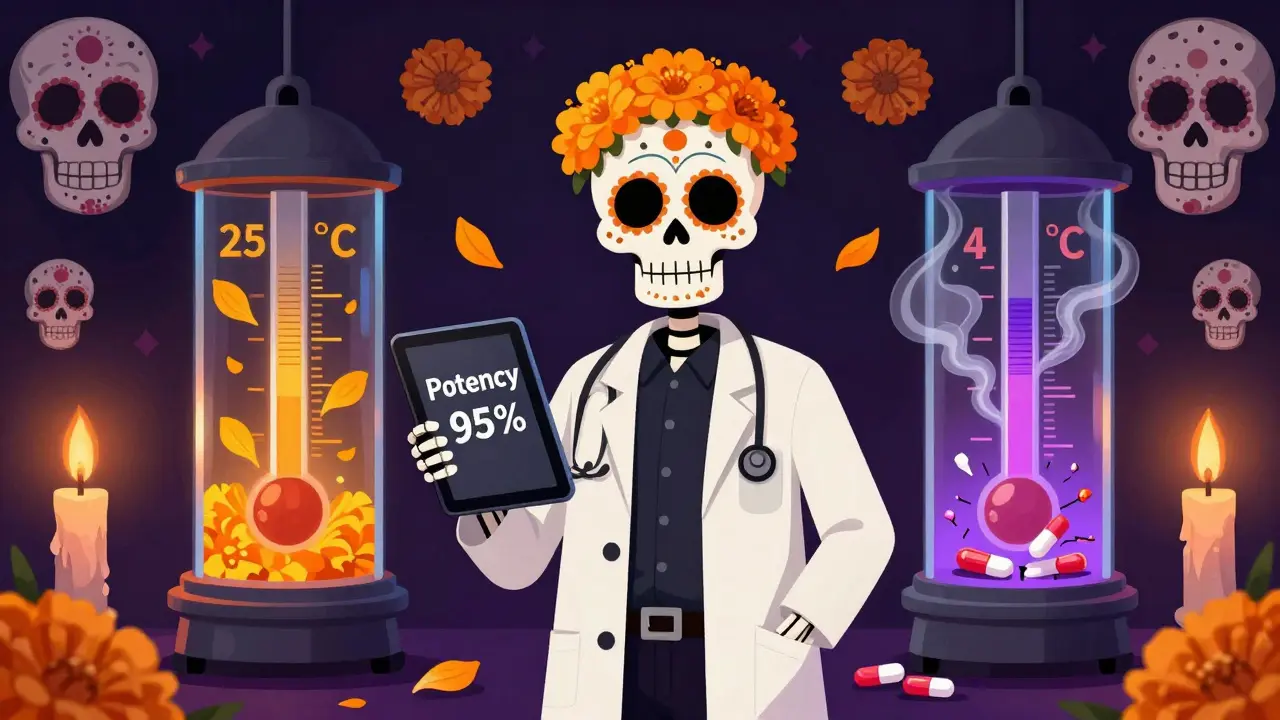
When a drug leaves the lab and enters the market, it must survive real-world conditions - heat, humidity, and time - without losing its power or safety. This isn’t guesswork. It’s a strict, science-backed process called stability testing, and it’s required by law in every major market. The rules are clear: if you can’t prove your medicine stays effective and safe under real storage conditions, it doesn’t get approved. And the core of that proof? Temperature and time.
Why Temperature and Time Matter
Drugs aren’t static. Over time, they break down. Active ingredients can degrade. Excipients can absorb moisture. Tablets can harden or crumble. Liquid formulations can separate. These changes don’t just affect how well the drug works - they can make it unsafe. A 10% drop in potency might mean a patient doesn’t get enough medicine. A toxic byproduct formed from heat exposure could cause serious harm. That’s why regulators demand proof. Stability testing shows exactly how a drug behaves over time under controlled environmental stress. It’s not about ideal lab conditions. It’s about what happens in a warehouse in Florida, a pharmacy shelf in India, or a patient’s medicine cabinet in Arizona. The goal is simple: set a shelf life that’s real, not theoretical.The Global Standard: ICH Q1A(R2)
There’s one rulebook that nearly every country follows: ICH Q1A(R2). Published in 2003 by the International Council for Harmonisation, it’s the foundation of stability testing for both active ingredients and finished products. It doesn’t matter if you’re in the U.S., Europe, Japan, or Canada - the temperature and time conditions are the same. This harmonization saves companies millions in redundant testing and keeps patients safe across borders. The standard defines three main testing conditions, each with a specific purpose:- Long-term testing - This is the real-time clock. It shows how the drug behaves under normal storage conditions over its intended shelf life.
- Accelerated testing - This is the stress test. It speeds up degradation to predict long-term behavior in a fraction of the time.
- Intermediate testing - This is the safety net. It’s used only if accelerated results show problems and long-term testing is done at a cooler temperature.
Temperature and Humidity Requirements
The numbers aren’t arbitrary. They’re based on decades of research and real-world climate data. For most solid oral drugs - tablets and capsules - the standard long-term condition is either:- 25°C ± 2°C and 60% RH ± 5% RH, or
- 30°C ± 2°C and 65% RH ± 5% RH
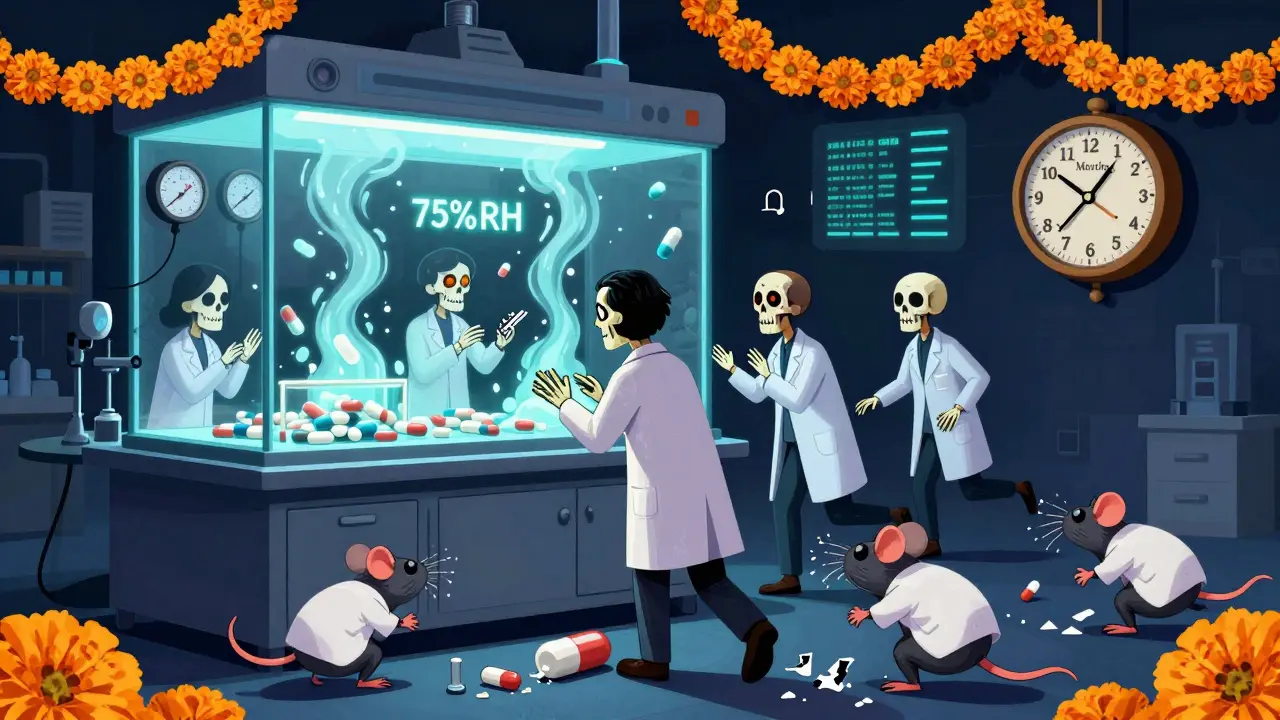
How Long Does Testing Take?
Time isn’t just a variable - it’s a requirement. For long-term testing, you need at least 12 months of data to submit a new drug application in the U.S. (FDA). In Europe (EMA), you can submit with 6 months, but you must commit to completing the full 12 months afterward. That difference can delay global approval by months. Testing isn’t done once. Samples are pulled at specific intervals: 0, 3, 6, 9, 12, 18, 24, and 36 months. Early time points (like 3 and 6 months) are critical because that’s when the most rapid changes usually occur. If a drug shows signs of degradation early, the study can be adjusted - or halted - before it’s too late. The chambers used for testing must hold temperature within ±0.5°C and humidity within ±2% RH. Even small drifts can invalidate results. One pharmaceutical company in Ohio lost an entire 12-month study because a chamber’s humidity control failed for 48 hours. The data was thrown out. The launch was delayed by 8 months.What Counts as a ‘Significant Change’?
This is where things get messy - and where many companies get caught. ICH Q1A(R2) says a product has failed if it shows a “significant change” in any of these areas:- Assay (potency) changes by more than 5%
- Any degradation product exceeds its specification limit
- Physical appearance changes (color, texture, clumping)
- Functionality fails (e.g., inhaler doesn’t deliver the dose)
Real-World Challenges
The rules are clear. The execution? Not so much. Temperature excursions happen. In a 2023 survey of 142 stability professionals, 78% reported at least one temperature deviation exceeding ±2°C during a long-term study. One incident can invalidate months - or years - of data. Humidity is another silent killer. In dry climates like Phoenix or Denver, maintaining 60-75% RH requires active humidification systems. Without them, tablets can dry out and crack. In humid places like Miami or Bangkok, moisture absorption can cause tablets to swell and disintegrate. And then there’s the time lag. A new drug might be ready to launch, but if the 12-month stability data isn’t complete, the launch gets delayed. One biotech in Seattle lost $15 million in projected revenue because their stability study ran 6 months longer than expected due to a chamber calibration issue.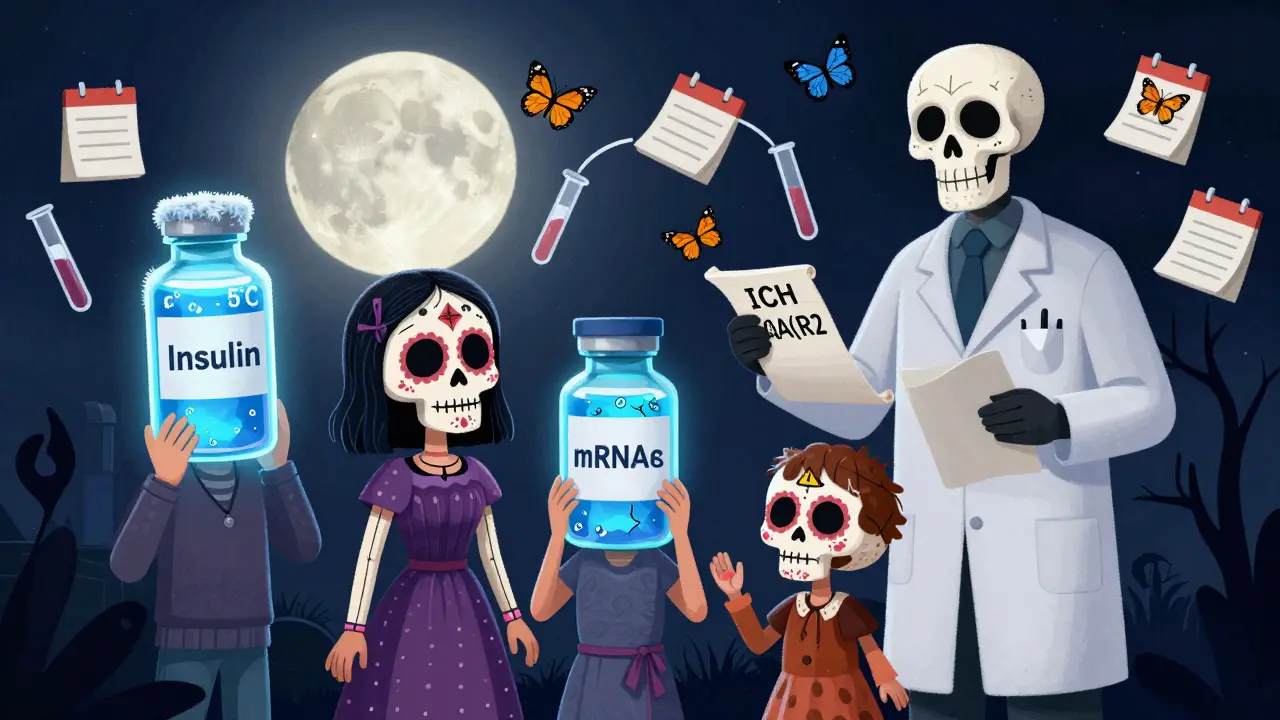
What’s Changing?
The ICH Q1A(R2) guidelines are 20 years old. The pharmaceutical world isn’t. New drug types - mRNA vaccines, antibody-drug conjugates, gene therapies - don’t behave like traditional pills. They’re sensitive to freeze-thaw cycles, light, and agitation. Standard 40°C testing doesn’t predict their failure modes. The FDA is testing real-time stability monitoring using Process Analytical Technology (PAT) for drugs made with continuous manufacturing. Early results show it could cut testing time by 30-50%. The ICH is working on a new update - Q1F - expected in late 2024, which will address stability for these advanced therapies. Some companies are now using predictive modeling. By running tests at 50°C, 60°C, even 80°C, they can model degradation curves and predict 2-year stability in just 3 months. But regulators are skeptical. The EMA rejected 8 model-based submissions in 2022 and 2023, insisting on real-time data.What You Need to Do
If you’re developing a drug, here’s what you must do:- Choose your target markets - that determines your long-term condition (25°C or 30°C).
- Run accelerated testing at 40°C/75% RH for 6 months - and document every result.
- Start long-term testing immediately - don’t wait.
- Use calibrated chambers with real-time monitoring - and log every temperature and humidity spike.
- Define your “significant change” criteria before you start - and stick to them.
- Plan for delays - stability testing is not fast.
Final Thought
Stability testing isn’t glamorous. It doesn’t make headlines. But it’s the quiet backbone of drug safety. Every pill you take, every injection you receive - its effectiveness and safety are guaranteed because someone ran the numbers, watched the clocks, and kept the temperature steady for a year or more. The rules haven’t changed in two decades - but the drugs have. The next generation of medicines demands smarter, faster, more flexible stability testing. Until then, the old standards still keep us safe. And that’s worth following - exactly as written.What are the standard temperature and humidity conditions for pharmaceutical stability testing?
For most solid oral drugs, the long-term stability condition is either 25°C ± 2°C with 60% RH ± 5% RH or 30°C ± 2°C with 65% RH ± 5% RH, depending on the target market. Accelerated testing is always 40°C ± 2°C and 75% RH ± 5% RH for 6 months. Refrigerated products use 5°C ± 3°C for long-term and 25°C ± 2°C with 60% RH for accelerated testing.
How long does stability testing take before a drug can be approved?
In the U.S., the FDA requires a minimum of 12 months of long-term stability data at the time of submission. In Europe, you can submit with 6 months but must complete the full 12 months after approval. Accelerated testing takes 6 months and is used to predict long-term behavior. Real-time data for a full shelf life (typically 24-36 months) continues after approval.
Why is accelerated testing done at 40°C and 75% RH?
The 40°C/75% RH condition was chosen because it accelerates chemical degradation without causing physical breakdowns like melting or evaporation of excipients. It simulates extreme environmental stress - such as a shipment left in a hot warehouse - and helps predict how the drug will behave over 2-3 years of real-time storage at 25°C/60% RH.
What happens if a drug fails stability testing?
If a drug shows a significant change - such as a potency drop over 5%, new degradation products, or physical changes - the product cannot be approved or must be withdrawn. The manufacturer must investigate the cause, reformulate if needed, and restart testing. Failure can lead to regulatory actions like warning letters, product recalls, or denial of marketing authorization.
Are stability testing requirements the same worldwide?
Yes, for most products, the ICH Q1A(R2) guidelines are harmonized across the U.S. (FDA), Europe (EMA), Canada (Health Canada), Japan, and other major markets. The temperature, humidity, and testing durations are identical. However, submission requirements vary slightly - for example, the FDA requires 12 months of data at submission, while the EMA allows 6 months with a commitment to complete the full 12 months later.
Do biologics and vaccines follow the same stability rules?
No. Traditional ICH Q1A(R2) guidelines were designed for small-molecule drugs. Biologics, mRNA vaccines, and cell therapies are sensitive to different stresses - like freeze-thaw cycles, agitation, or light exposure - that standard 40°C testing doesn’t capture. New guidelines under ICH Q1F (expected 2024) are being developed specifically for these complex products, and regulators are increasingly requiring custom stability protocols.






8 Comments
bhushan telavane December 18, 2025
Been there done that in Mumbai - our warehouse hit 42°C last monsoon and half the batch went south. No one noticed till the pharmacy called. 40°C testing? Yeah right, real world ain't that polite.
Mahammad Muradov December 20, 2025
Anyone who thinks 25°C is enough for India is either clueless or getting paid to lie. The ICH guidelines are outdated. We're not in Switzerland. If your drug melts in a Delhi summer it's not a failure of the product it's a failure of your ethics.
Connie Zehner December 21, 2025
OMG I JUST HAD A REVELATION 😭 I work in pharma and I never realized how much pressure those little chambers are under!! I cried reading about the Ohio study 😭😭😭 someone please hug me
holly Sinclair December 21, 2025
It's fascinating how we treat stability testing like a rigid mathematical law when in reality it's a cultural artifact of 20th century industrial medicine. We assume degradation is linear, time is uniform, and environment is controllable - but human bodies, climates, supply chains, and molecular structures are all nonlinear systems. The 5% potency threshold isn't science, it's a social contract we've agreed to pretend is absolute. What if the real failure isn't the drug degrading but our refusal to adapt our metrics to the complexity of life itself?
Monte Pareek December 23, 2025
Listen up everyone if you're developing a drug and you're not running real-time monitoring with PAT you're gambling with lives and your company's future. I've seen 12-month studies get tossed because a humidity sensor drifted 3% for 48 hours. That's not bad luck that's negligence. Calibrate your chambers daily log every spike and treat your stability data like it's your kid's medical record because it is. The FDA doesn't care about your budget they care about whether grandma gets her pills and they work. Stop cutting corners and start doing it right
Alex Curran December 24, 2025
Had a client in Perth lose a whole batch because they used a 25C protocol for a product going to Southeast Asia. The humidity turned the capsules into mush. Lesson learned the hard way. Always match your test condition to your market not your convenience
Edington Renwick December 26, 2025
Someone actually thinks 6 months of data is acceptable for approval? This is why the world is falling apart. No one takes responsibility anymore. Just submit half the data and hope for the best. Then when people die it's 'oh we didn't know' Well you should have known. You had the data. You just didn't want to wait.
Allison Pannabekcer December 26, 2025
I really appreciate how this post breaks down the human side of stability testing. It's easy to get lost in the numbers but behind every 5% potency drop or 40°C chamber is a team of people working late nights to keep people safe. I've worked with analysts who cried because their data was thrown out after a power outage. It's not just science it's heart. And yeah the guidelines are old but they're the best we've got until we can build something better that accounts for mRNA vaccines and climate change. Let's push for change but let's also honor the quiet heroes keeping the system running