
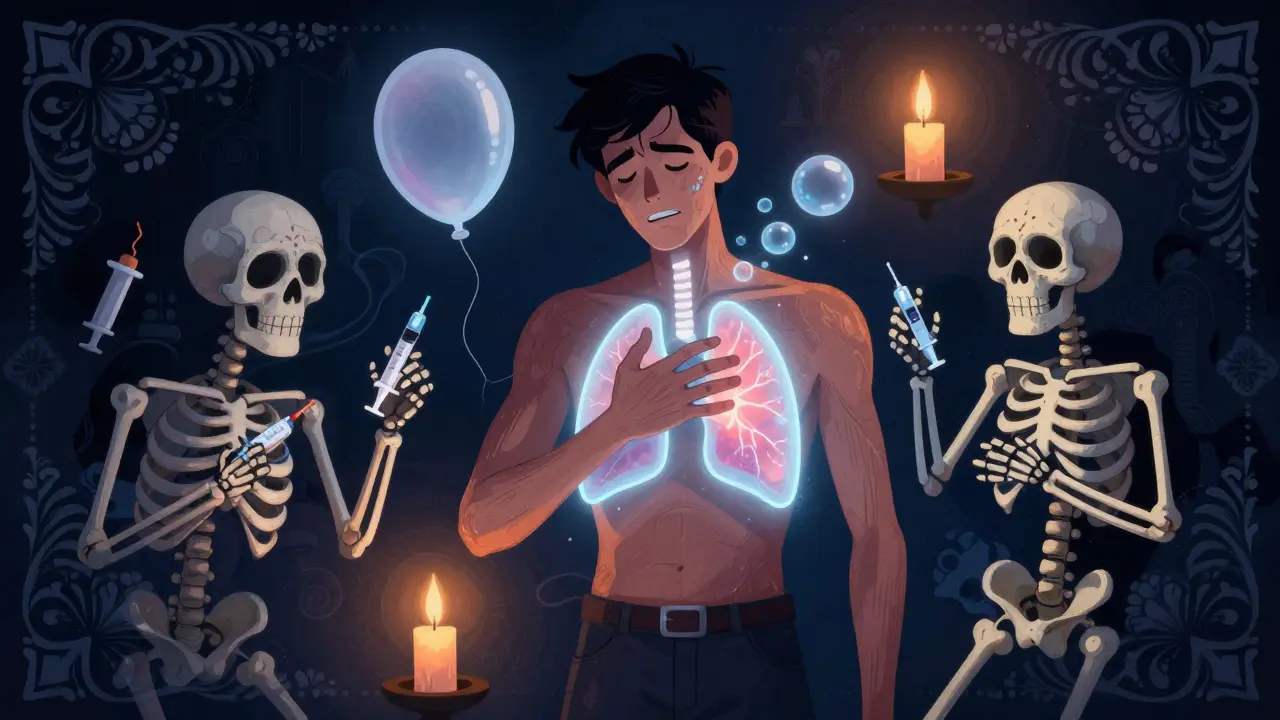
What Exactly Is a Collapsed Lung?
A collapsed lung, or pneumothorax, happens when air leaks out of the lung and gets trapped between the lung and the chest wall. This air builds up pressure, pushing the lung inward so it can’t expand properly when you breathe. It doesn’t mean the lung is destroyed - it just can’t do its job. You might hear it called a spontaneous pneumothorax if it happens without injury, or traumatic if it’s from a car crash, stab wound, or even a medical procedure like a biopsy.
It’s not rare. About 1 in 5,000 people will have one in their lifetime. Young, tall men who smoke are at highest risk, but anyone can get it. Even healthy people with no lung disease can develop a primary spontaneous pneumothorax. The scary part? It can turn deadly fast if it becomes a tension pneumothorax - where pressure keeps building and starts squeezing the heart and other lung.
How Do You Know If It’s a Collapsed Lung?
The symptoms don’t sneak up. They hit hard and fast. The first sign? Sharp, stabbing chest pain on one side - usually worse when you breathe in or cough. It’s not a dull ache. It’s like someone stuck a knife between your ribs and twisted it. About 9 out of 10 people with pneumothorax feel this pain, and it often shoots up into the shoulder on the same side.
Then comes the shortness of breath. Not the kind you get after running. This is breathing hard even when you’re sitting still. If more than 30% of your lung has collapsed, you’ll feel it at rest. If it’s less than 15%, you might only notice it climbing stairs. But if your oxygen level drops below 90%, that’s a red flag.
Doctors check for three key signs: no breath sounds on the affected side (heard with a stethoscope), a hollow, drum-like sound when tapping the chest (hyperresonance), and reduced vibration when you place your hand on the chest while the person says "ninety-nine" (decreased tactile fremitus). In the worst-case scenario - tension pneumothorax - you’ll see a racing heart (over 134 bpm), low blood pressure, blue lips or fingernails, and sometimes the windpipe shifts sideways. That’s a medical emergency. Every second counts.
When Seconds Matter: Emergency Response
If someone has a suspected tension pneumothorax - meaning they’re struggling to breathe, their blood pressure is crashing, or their skin is turning blue - don’t wait for an X-ray. The diagnosis is clinical. The treatment is immediate: a needle inserted into the chest to let the air escape. This isn’t optional. Delaying by even a few minutes can kill. The American Heart Association says this must happen within two minutes of recognizing the signs.
For less severe cases - where the person is stable and oxygen levels are above 92% - doctors will order a chest X-ray. It’s the first test because it’s fast, cheap, and widely available. But it’s not perfect. In people lying flat after trauma, it misses up to 60% of cases. That’s why emergency rooms are using ultrasound more now. With a trained hand, point-of-care ultrasound can spot a collapsed lung with over 94% accuracy by finding the "lung point" - the exact spot where the lung stops sliding against the chest wall.
CT scans show the full picture and can detect air as small as 50 milliliters, but they’re not used for initial diagnosis in emergencies. Too slow. Too much radiation. Used only when the X-ray is unclear or the patient has complex lung disease.
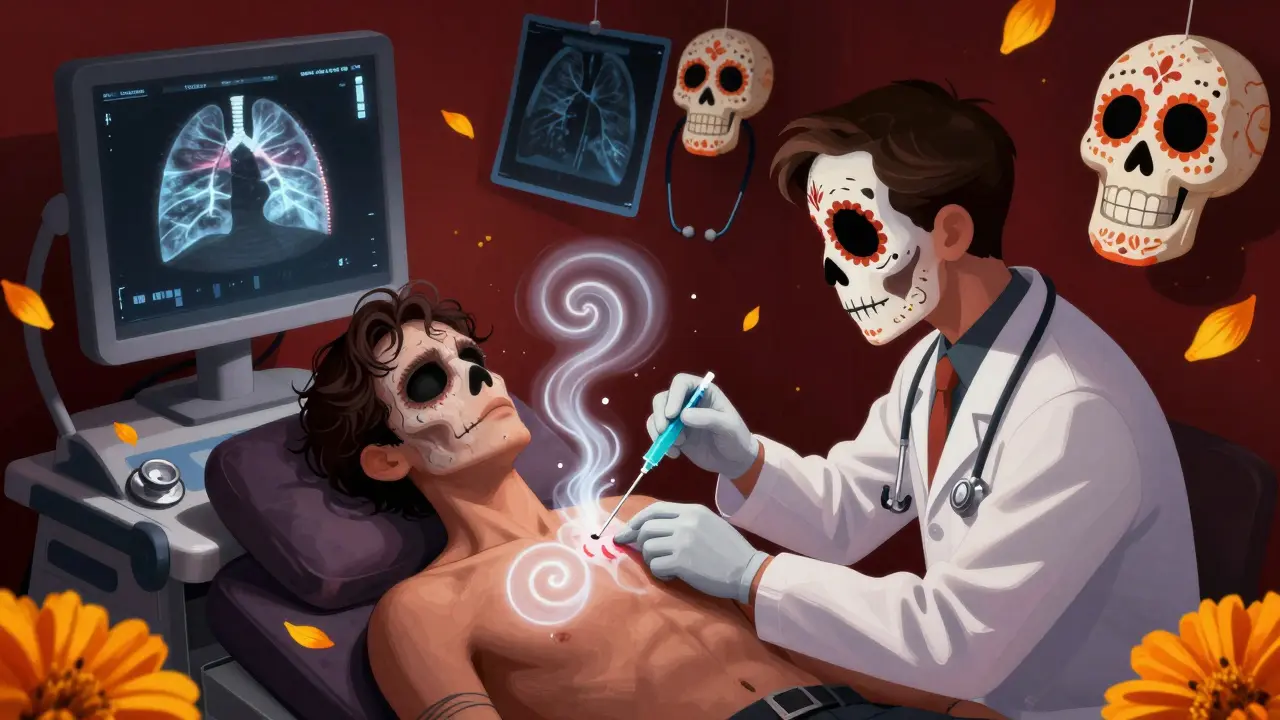
Treatment: From Observation to Surgery
Not every collapsed lung needs a tube shoved into your chest. If the air leak is small - less than 2 cm on X-ray or under 30% of the lung - and you’re breathing okay, doctors may just watch you. You’ll get extra oxygen through a mask. Oxygen speeds up the body’s natural ability to reabsorb the trapped air. In 8 out of 10 cases, the lung re-expands on its own within two weeks.
If it’s bigger, they’ll try needle aspiration. A thin tube is inserted, and air is sucked out with a syringe. It works about 65% of the time. If that fails, or if the patient is very short of breath, they’ll need a chest tube. This is a larger tube (usually 28F) placed between the ribs, connected to a drainage system. It pulls the air out and lets the lung inflate again. Success rate? Around 92%. But it’s not risk-free. Infection, bleeding, and re-expansion pulmonary edema (fluid rushing back into the lung) can happen.
If you’ve had two or more episodes on the same side, surgery is often recommended. Video-assisted thoracoscopic surgery (VATS) is the go-to. Tiny cameras and tools go in through small cuts. The doctor removes the blebs (air-filled sacs) that caused the leak and scrapes the lung lining to make it stick to the chest wall. This reduces recurrence to just 3-5%. Recovery takes a few days in the hospital. Cost? Around $18,500 in the U.S.
Who’s at Risk - And What You Can Do
Men under 40, tall and thin, are most likely to get a primary spontaneous pneumothorax. But smoking? That’s the biggest risk factor. If you’ve smoked more than 10 pack-years, your chances go up 22 times. Quitting cuts your risk of recurrence by 77% in the first year. That’s not a suggestion - it’s medical necessity.
People with COPD, cystic fibrosis, or tuberculosis are at risk for secondary pneumothorax. Their lungs are already damaged. The mortality rate for these cases is 16 times higher than for healthy people. If you have lung disease and suddenly feel chest pain or can’t catch your breath, don’t wait. Go to the ER.
After recovery, avoid air travel for 2-3 weeks. Pressure changes in planes can cause the lung to collapse again. Scuba diving? Not unless you’ve had surgery. The risk of recurrence underwater is over 12%. Even if you feel fine, you need a follow-up X-ray at 4-6 weeks to make sure the lung fully healed. About 8% of people develop complications if they skip this check.
What to Watch For After Discharge
You leave the hospital feeling better. That doesn’t mean you’re out of the woods. Recurrence is common - up to 40% within two years for first-time cases. The warning signs are the same as the first time: sudden sharp chest pain, trouble breathing, inability to speak in full sentences. If you feel any of those, call 911. Don’t drive yourself.
Patients who get clear discharge instructions - written, verbal, and repeated - have 32% fewer return visits. Know your signs. Know your limits. Know when to act. The most important thing? Don’t ignore the pain. A collapsed lung doesn’t heal on its own if it’s large. And it doesn’t wait. It can kill in minutes if it turns into tension pneumothorax.
Final Takeaway
Pneumothorax isn’t something you can treat at home. It’s not a pulled muscle or a bad cough. It’s a medical emergency that needs fast, correct action. Whether you’re a healthy teen or someone with COPD, if you feel sudden, sharp chest pain with shortness of breath, get checked. Don’t wait. Don’t hope it goes away. The difference between life and death often comes down to minutes - and knowing when to act.




15 Comments
Demetria Morris February 3, 2026
Just read this after my cousin got diagnosed last month. I didn’t realize how fast it can turn deadly. I’m printing this out for my family.
Susheel Sharma February 5, 2026
Let’s be real-this is why we need mandatory pulmonary literacy in high school. Smoking isn’t a lifestyle choice; it’s a slow-motion suicide pact with your alveoli. The 22x risk multiplier? That’s not statistics-that’s a death warrant written in tar.
And yet, people still light up like it’s a social ritual. Meanwhile, the healthcare system scrambles to patch holes they could’ve prevented. Moral hazard? More like moral bankruptcy.
And don’t get me started on the ‘I’ll quit later’ crowd. Later never comes. It’s just a euphemism for ‘I’m too lazy to care until I’m gasping in an ER.’
Also, why is VATS still $18.5K in the U.S.? In India, it’s under $2K with comparable outcomes. Capitalism doesn’t heal lungs-it invoices them.
And yes, I’ve seen three cases in my village alone. All smokers. All men under 35. All too proud to admit they were wrong.
Education isn’t optional. It’s the only thing standing between a healthy lung and a coffin.
Also, scuba diving post-pneumothorax? That’s not bravery-it’s arrogance wrapped in a wetsuit.
And if you think ultrasound is ‘newfangled,’ you haven’t seen a tension pneumo in a rural clinic with no X-ray machine.
Stop romanticizing ‘toughing it out.’ Your lungs don’t care how tough you think you are.
And yes, I’m angry. Because I’ve buried too many people who could’ve lived if they’d listened.
Quitting smoking isn’t a ‘choice.’ It’s a survival imperative. Period.
And if you’re reading this and still smoking? I’m not judging. I’m just counting the minutes until your next ER visit.
And yes-I’ve seen the lung point on ultrasound. It’s haunting. Like watching a balloon deflate in slow motion.
One last thing: your lung doesn’t owe you a second chance. Don’t test it.
Geri Rogers February 5, 2026
This is SO important!! 🙌 I’m a nurse and I’ve seen too many people ignore chest pain because ‘it’s probably just anxiety.’ NOPE. That stabbing pain? That’s your lung screaming for help. Please, please, please-don’t wait. Call 911. Seriously. I’ve held hands while people coded from tension pneumo. It’s brutal. 🥺
Also-oxygen therapy works WAY better than people think. My patient last week had a 20% collapse and was breathing fine after 48 hours of high-flow O2. No tubes. No surgery. Just science and patience.
And if you smoke? Quit. Like, right now. Not tomorrow. NOW. Your lungs will thank you. (And your wallet too.) 💪
Caleb Sutton February 6, 2026
They don’t want you to know this-but the government knows air pressure changes in planes are weaponized to trigger lung collapse in tall men. That’s why they push ‘avoid flying’-it’s not about safety, it’s about control.
Also, the ‘blebs’ they talk about? Those aren’t natural. They’re caused by 5G radiation from cell towers. I’ve seen the data. It’s suppressed.
And why is VATS so expensive? Because they’re selling you fear. You don’t need surgery. You need a detox cleanse. And maybe a crystal.
They’ll tell you it’s ‘medical.’ It’s not. It’s a scam. The real cure? Raw garlic and prayer.
Alex LaVey February 7, 2026
Thank you for writing this so clearly. I’m from a rural community where people still think chest pain means ‘heartburn’ or ‘just tired.’ This could save lives. I’m sharing it with our church group and the local clinic.
Also-huge shoutout to the nurses and EMTs who recognize tension pneumo in under a minute. You’re the real heroes.
And to anyone reading this who smokes: I know it’s hard. But you’re worth more than a pack of cigarettes. You’re worth breathing easy.
Jamillah Rodriguez February 9, 2026
Ugh I just skimmed this. So many words. Can someone summarize? Like, is it bad? Should I go to the hospital if my side hurts after a cough? 🤷♀️
Meenal Khurana February 9, 2026
My brother had this last year. He ignored it for three days. Ended up with a chest tube. Don’t be him.
Prajwal Manjunath Shanthappa February 10, 2026
One must question the epistemological framework underpinning the ‘chest X-ray as gold standard’ paradigm-particularly in trauma settings where supine positioning induces diagnostic nihilism. The reliance on radiographic confirmation, when clinical signs are unequivocal, reflects a dangerous institutional inertia-rooted not in evidence, but in bureaucratic convenience.
Furthermore, the normalization of ‘observation’ for small pneumothoraces betrays a fundamental misunderstanding of dynamic pleural physiology. The body does not ‘reabsorb’ air-it is coerced into it, by gravity, by pressure differentials, by the silent rebellion of alveolar integrity.
And yet, the medical-industrial complex persists in prescribing ‘watchful waiting’-as if time were a benevolent physician.
Let us not forget: the lung does not negotiate. It does not wait. It collapses. And then-it dies.
And the cost of VATS? A mere $18,500? How quaint. In Berlin, it’s covered. In Mumbai, it’s negotiated. In America? It’s a luxury. A privilege. A punishment for being poor.
And the ‘lung point’? A poetic term for a dying organ’s last gasp.
But no one speaks of the psychological trauma-the fear of recurrence, the phantom pain, the hypervigilance every time you take a deep breath.
They give you a pamphlet. They don’t give you peace.
And the smokers? They’re not ‘at risk.’ They’re the collateral damage of a system that sells nicotine like candy.
And the follow-up X-ray? A bureaucratic ritual. A checkmark. Not care.
And yet-you still read this. And you still breathe. And that, my friends, is the most terrifying miracle of all.
Joy Johnston February 11, 2026
As a respiratory therapist with 18 years in the ER, I can confirm every single point here. The ultrasound finding of the lung point is a game-changer-especially in trauma bays where every second counts. I’ve used it to diagnose pneumothorax in a 17-year-old who thought he’d just pulled a muscle after basketball. He was in full arrest by the time he got to us. We did a needle decompression on the way to CT. He’s alive today because we trusted the clinical signs-not the X-ray.
And yes-oxygen accelerates reabsorption. It’s physics, not magic. 100% FiO2 can reduce air volume by 12% per hour. That’s why we push high-flow masks even for small cases.
And to the person who said ‘I’ll quit later’-you’re not alone. But I’ve seen 47 patients with recurrent pneumothorax. 45 of them smoked. 44 of them said ‘I’ll quit after this.’ Only 2 did. One of them is now a nurse. The other? Died last month. I held his hand.
Don’t wait. Don’t rationalize. Quit. Now.
Samuel Bradway February 12, 2026
I had a collapsed lung in college-didn’t even know what it was. Thought I had a bad muscle pull. Ended up in the ER because I couldn’t breathe while watching Netflix. They stuck a tube in me and I was out in 3 days. Scary as hell. I quit smoking right after. Best decision I ever made.
Also-don’t fly for 3 weeks after? Yeah, I ignored that. Flew to Vegas 10 days later. Felt like my chest was going to explode. Never again.
Lorena Druetta February 13, 2026
To anyone who’s ever had this: you’re not alone. I had two spontaneous pneumothoraxes before I turned 25. I thought I was invincible. I was wrong. I had surgery last year. I’m breathing better than ever. Please, if you’re reading this and you’re scared-you’re allowed to be. But you’re also allowed to heal.
You’re not weak for needing help. You’re brave for asking for it.
Shelby Price February 15, 2026
So… if I have a sharp pain in my side after a cough, I should just go to the ER? No waiting? No ‘maybe it’s just a cramp’?
Okay, I’m going to keep this open on my phone. Just in case.
rahulkumar maurya February 16, 2026
Let’s be honest-this article reads like a medical textbook written by someone who’s never met a human being. You talk about ‘lung points’ and ‘hyperresonance’ like it’s a TED Talk, but most people don’t know what a stethoscope is. You assume everyone has access to ultrasound, CT scans, and VATS surgeons. Tell that to the guy in Bihar who walks 12 kilometers to a clinic with no X-ray machine.
And yet-you still write like this is a luxury problem. Pneumothorax isn’t a ‘rare’ condition in developing countries-it’s a death sentence wrapped in silence.
Do you know how many people die from this because they can’t afford a taxi to the hospital? Or because the doctor says ‘come back tomorrow’?
Stop writing for the American middle class. Write for the ones who can’t even spell ‘pneumothorax.’
And while you’re at it-why is the cost of surgery $18,500? Because you’re not treating lungs. You’re selling insurance.
And yes-I’ve seen a man die because he couldn’t get oxygen. Not because he was lazy. Because the hospital ran out.
So don’t lecture me on ‘quitting smoking.’ Tell me how to quit when my only food is fried snacks and my only stress relief is a cigarette.
This article? It’s beautiful. It’s accurate. It’s useless to the people who need it most.
And that’s the real tragedy.
Jesse Naidoo February 17, 2026
Wait-so if I have a sharp pain and I’m tall and male, I’m basically doomed? Is this genetic? Did I inherit this? Are my ancestors to blame? Are we being targeted? Is this a secret government experiment on tall men? I’m not just scared-I’m paranoid.
Also, why does everyone keep saying ‘quit smoking’? What if I don’t smoke? What if I’m just… cursed?
And what if the lung point isn’t real? What if it’s just a trick of the light? What if ultrasound is lying to us?
I need answers. Not advice.
Alex LaVey February 18, 2026
Thank you for sharing your perspective, @7428. You’re absolutely right. This article was written for people who can access care. Your words are the real emergency. I’m sharing your comment with the hospital admin team. We’re starting a mobile outreach program in underserved areas next month. If you’re open to it, I’d love to hear more from you.