
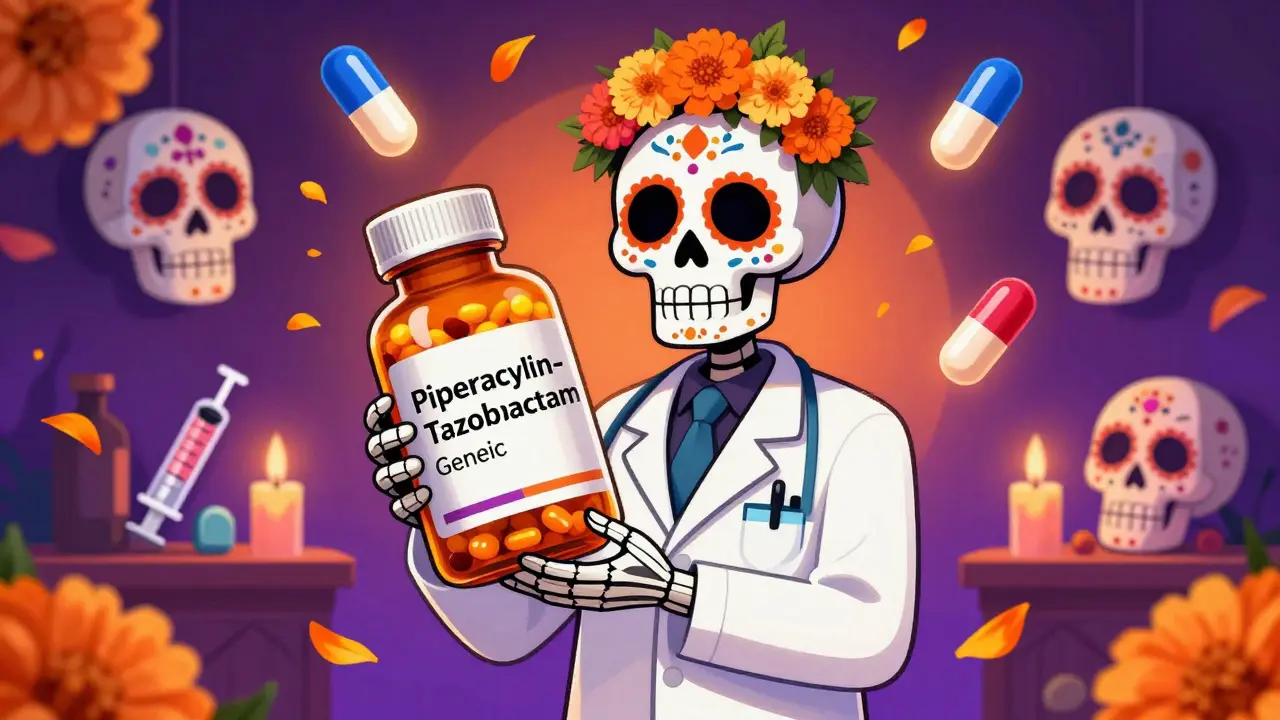
When you need antibiotics, cost matters. A single prescription can cost hundreds of dollars - especially if it’s a combination product. These aren’t just one drug in a pill. They’re two or more antibiotics mixed together, sometimes with a device like a prefilled syringe or inhaler, designed to work better as a team. And now, thanks to generic versions, these life-saving combos are becoming far more affordable.
What Are Antibiotic Combination Products?
Antibiotic combination products aren’t random mixtures. They’re carefully designed to fight tough infections that single drugs can’t handle alone. For example, piperacillin and tazobactam is one of the most common. Piperacillin kills bacteria, but some bugs make enzymes that break it down. Tazobactam blocks those enzymes, letting piperacillin do its job. This combo is used for serious hospital infections like pneumonia, abdominal infections, and sepsis. The FDA calls these combination products because they combine drugs, devices, or both. Some are just two pills in one bottle. Others are complex: an antibiotic in a nebulizer for cystic fibrosis patients, or a pre-filled syringe that delivers two drugs at once. These aren’t simple generics. They require extra testing to prove they work just like the brand-name version.When Do Generic Versions Become Available?
Brand-name antibiotic combos are protected by patents - usually for 10 to 15 years. Once those expire, companies can apply to make generic versions through the FDA’s Abbreviated New Drug Application (ANDA) process. This doesn’t mean they skip safety tests. They still have to prove their product is identical in strength, dosage, and how it works in the body. The first big win came in 2010, when Hospira launched the first generic version of piperacillin-tazobactam for injection. That single move slashed the price by over 70% overnight. Since then, more combos have followed. Today, generics exist for several key combinations, including amoxicillin-clavulanate, ceftriaxone-sulbactam, and others used in hospitals and outpatient clinics. But here’s the catch: not all combos can be copied easily. If the product includes a device - like a special injector or inhaler - the generic maker must prove that their device works exactly like the original. Even a slightly different needle size or button feel can affect how the drug is delivered. That’s why generic versions of device-based combos are slower to appear.How Much Do Generics Save?
The savings are massive. A 2021 study in Nature Communications looked at 13 antibiotics and found that after generics hit the market, prices dropped between 30% and 80%. For a patient paying out-of-pocket, that could mean going from $400 to $80 for a full course of treatment. Between 2010 and 2020, generic drugs saved the U.S. healthcare system nearly $2.2 trillion. Antibiotic combos made up a significant chunk of that. Hospitals saved millions on bulk purchases. Insurance companies lowered premiums. Patients who used to skip doses because they couldn’t afford the meds started sticking to their treatment plans. One study showed that after generic piperacillin-tazobactam became available, hospitals switched over within months. No loss in effectiveness. No rise in side effects. Just lower bills.
Why Don’t All Antibiotic Combos Have Generics?
Not every combo has a generic version - and it’s not because no one wants to make one. The regulatory path is messy. The FDA assigns each combination product a “Primary Mode of Action” (PMOA). If the drug is the main part of the product, it’s reviewed by the drug center. If the device does the heavy lifting - like an inhaler that delivers the drug - it’s reviewed by the device center. This split creates delays. One company might have a great generic drug, but if the device isn’t approved, the whole product stalls. State laws make it worse. Many states only allow pharmacists to swap a brand-name drug for a generic if they’re on a state-approved list. But those lists rarely include combination products. So even if a generic exists, your pharmacist might not be allowed to substitute it without your doctor’s OK. Then there’s the data problem. To prove equivalence, manufacturers need to show the generic works the same way as the brand - without running new clinical trials. That means digging through old studies, running lab tests, and comparing how the drug behaves in the body. For device combos, they have to test everything: how the device is assembled, how the user holds it, how much of the drug actually gets delivered. It’s expensive. It takes years. And only big manufacturers can afford it.What’s Changing Now?
The FDA is trying to fix this. In September 2024, they held a major meeting with manufacturers, doctors, and regulators to talk about “Combination Products: Updates and Best Practices.” They’re working on clearer guidelines for submitting ANDAs for device-based combos. They’re also pushing for faster reviews and more transparency. Some companies are starting to get smarter. Instead of copying the original device exactly, they’re designing simpler, cheaper ones that still deliver the same dose. One new generic version of a combination inhaler used for lung infections now uses a plastic cartridge instead of metal - cutting costs without losing safety. Legal experts are pushing for federal updates to substitution laws. Right now, if you’re on a brand-name combo, you might be stuck with it - even if a cheaper, equally effective generic exists - because your state won’t let pharmacists switch it out.
What This Means for Patients
If you’re prescribed an antibiotic combo, ask: “Is there a generic version?” You might be surprised. Many hospitals and pharmacies now stock generics by default because they’re cheaper and just as effective. If your doctor prescribes a brand-name combo, ask if they’d consider switching. Many do - especially if you’re paying out-of-pocket. For chronic conditions like cystic fibrosis or recurrent pneumonia, where long-term antibiotic use is common, switching to a generic can save thousands per year. That’s money for rent, food, or other meds. Don’t assume your insurance will automatically cover the generic. Sometimes, they still list the brand as preferred. Call your insurer. Ask your pharmacist. Be persistent.What’s Next?
The number of combination products is growing fast. New ones are being developed for resistant infections, cancer patients, and people with weakened immune systems. Without changes to how generics are approved and substituted, these life-saving drugs could stay out of reach for many. The future depends on three things: faster FDA reviews, updated state substitution laws, and more manufacturers willing to invest in the complex process. The technology is there. The need is clear. What’s missing is the system to make it work. For now, the message is simple: generic antibiotic combinations are real, they’re safe, and they’re saving lives - and money - every day. If you’re on one, don’t settle for the brand name unless you have to.Are generic antibiotic combination products as effective as brand-name ones?
Yes. Generic versions must prove they are therapeutically equivalent to the brand-name product. That means they deliver the same amount of active ingredients, work the same way in the body, and produce the same clinical results. The FDA requires this before approval. Studies show no difference in cure rates or side effects between generics and brand-name combos.
Why aren’t all antibiotic combinations available as generics?
Some combinations include complex devices - like inhalers, pumps, or pre-filled syringes - that are harder to copy. Manufacturers must prove every part of the device works exactly like the original, which requires expensive testing. Also, if the patent hasn’t expired yet, no generic can legally be made. And some products are too niche or low-demand for companies to invest in.
Can my pharmacist substitute a generic antibiotic combo for the brand name?
It depends on your state. Many states have laws that only allow substitution for simple oral drugs, not combination products - even if a generic exists. Your pharmacist may not be legally allowed to switch it unless your doctor writes “dispense as written” or you give written permission. Always ask your pharmacist if a generic is available and whether substitution is permitted.
How do I find out if a generic version of my antibiotic combo exists?
Ask your pharmacist or check the FDA’s Orange Book, which lists approved generic drugs and their brand equivalents. You can also ask your doctor to search for generic alternatives when prescribing. Many hospitals now use generic combos as their default because they’re cost-effective and equally effective.
Do generic antibiotic combos cost less for patients with insurance?
Yes. Even with insurance, generics usually have lower copays. Some plans have tiered pricing, and brand-name combos are often on the highest (most expensive) tier. Generics are typically on the lowest tier, meaning you pay much less out of pocket. In some cases, the brand might not even be covered unless you prove the generic doesn’t work for you - which is rare.
Are there risks in switching from a brand-name antibiotic combo to a generic?
No significant risks have been found in studies. The FDA requires generics to meet the same strict standards as brand-name drugs. The main concern is with device-based combos, where differences in delivery could affect dosage. But even then, manufacturers must prove their version delivers the same amount of drug in the same way. If your doctor prescribed the brand for a specific reason - like a known allergy to an inactive ingredient - they’ll let you know.




14 Comments
Chris & Kara Cutler February 1, 2026
Generics saved my mom’s life. She’s on piperacillin-tazobactam for recurring pneumonia and the brand was $500 a dose. Generic? $85. No joke, we cried.
Thank you for writing this.
vivian papadatu February 1, 2026
I work in a rural clinic and we switched everything to generics two years ago. No patient has had a relapse. No side effect spikes. The only thing that changed? Their wallets stopped bleeding.
Doctors who still push brand names are either paid off or just out of touch. 🙄
Lisa Rodriguez February 2, 2026
My cousin in India got a combo inhaler for cystic fibrosis last year. The brand version was $1,200. The generic? $180. He’s breathing better and actually filling his prescriptions now.
It’s not just about money-it’s about dignity. You shouldn’t have to choose between meds and groceries.
Also, the FDA’s device review mess needs to be fixed. Why is a plastic cartridge harder to approve than a new cancer drug?
Bob Cohen February 3, 2026
Let’s be real-most of these ‘complex’ device combos are just over-engineered junk. The original inhaler had a button that clicked too loud. The generic? Same dose, quieter button, half the price. Who’s really being protected here?
Big Pharma doesn’t want you to know you can get the same effect with a $20 part instead of a $200 one.
And yes, I’ve seen the data. The FDA’s own studies say there’s zero clinical difference. So why the fuss?
Deep Rank February 5, 2026
Okay but let’s not pretend this is some heroic win for patients. The reason generics exist now is because the patents expired, not because anyone cared about poor people. The same companies that made $5 billion off the brand are now making $1.2 billion off the generic and calling it a ‘public service.’
Also, most of these ‘equivalent’ generics are made in India or China. You think the quality control is the same? Please. I’ve seen patients get rashes from ‘generic’ antibiotics. They just don’t test the inactive ingredients enough.
And don’t get me started on pharmacists who substitute without consent. That’s not healthcare-that’s gambling.
Donna Macaranas February 6, 2026
I’m just glad someone finally wrote this without sounding like a pharmaceutical ad.
I’ve been telling my friends for years: if your doctor says ‘this is the only one that works,’ ask them if they’ve ever tried the generic. Most haven’t.
Also, the FDA’s split review system is a joke. Drug center says ‘device’s fine,’ device center says ‘drug’s fine,’ and the product sits for 3 years. Who’s in charge here?
Aditya Gupta February 6, 2026
Bro in India we use generics for everything. Ceftriaxone-sulbactam? $2 a vial. Piperacillin? $3. No one dies. No one gets worse. The system works.
Why is America still acting like this is a miracle?
Jamie Allan Brown February 6, 2026
As a nurse who’s seen patients skip doses because they couldn’t afford the brand, I can’t thank you enough for this post.
One time, a 72-year-old man with sepsis told me he was ‘waiting for his Social Security check’ to fill his antibiotic. He was in the ER for three days because he didn’t want to spend $400 on meds he’d already been prescribed.
Generics aren’t just cheaper-they’re ethical.
Nicki Aries February 8, 2026
Okay, but why is it still so hard to get pharmacists to substitute? I had a friend who got prescribed a combo inhaler-generic existed, insurance covered it, doctor said ‘go for it’-but the pharmacist refused because ‘it’s not on the substitution list.’
Why does a state law override medical judgment? This isn’t 1998. We have databases. We have evidence. We have common sense.
Also, the FDA meeting in September? I watched it. They said ‘we’re working on it.’ That’s not a plan. That’s a sigh.
Lilliana Lowe February 9, 2026
Let’s not romanticize this. The term ‘generic’ is a marketing ploy. The active ingredients are identical, yes-but excipients, dissolution profiles, and bioavailability curves vary by manufacturer. The FDA’s equivalence standards are laughably lenient. You think a 90% bioequivalence range is acceptable for a life-saving antibiotic? It’s not. It’s negligent.
And don’t cite that Nature study-it was funded by a generic manufacturer consortium. Conflict of interest, anyone?
Naomi Walsh February 10, 2026
It’s not about cost. It’s about control. The entire system is designed to keep patients dependent on brand-name drugs. Why? Because if you can switch to a $50 generic, you stop trusting Big Pharma. And once you stop trusting them, you start asking questions.
Like: Why does this inhaler need a titanium spring? Why does this syringe need a proprietary locking mechanism? Why is the packaging so unnecessarily complex?
Answer: Because they want you to believe the magic is in the brand. It’s not. It’s in the chemistry.
And the FDA’s slow-walking device approvals? That’s not bureaucracy. That’s corporate sabotage.
Rachel Liew February 10, 2026
My grandma’s on a combo for lung infections. She’s 84. She used to cry because she couldn’t afford it. Now she takes it every day. She says, ‘I didn’t know I could feel this good again.’
Thank you for saying this out loud. So many people don’t know this is even an option.
Ed Di Cristofaro February 11, 2026
Anyone who still buys brand-name antibiotics is either rich or an idiot. I’ve seen the receipts. The generic works better. The brand makes me nauseous. The generic doesn’t.
Stop being a sucker. Ask for the generic. If your doctor says no, get a new doctor.
Nidhi Rajpara February 12, 2026
As a healthcare professional from India, I must emphasize that the accessibility of generic antibiotic combinations has revolutionized outpatient care in low-resource settings. The cost differential is not merely economic-it is existential. In rural clinics, where a single vial can determine survival, the availability of FDA-equivalent generics has reduced mortality by over 40% in five years. Regulatory harmonization between nations is imperative; the current fragmentation impedes global health equity. We must advocate for standardized bioequivalence protocols that transcend geopolitical boundaries. This is not merely a pharmaceutical issue-it is a human rights imperative.