
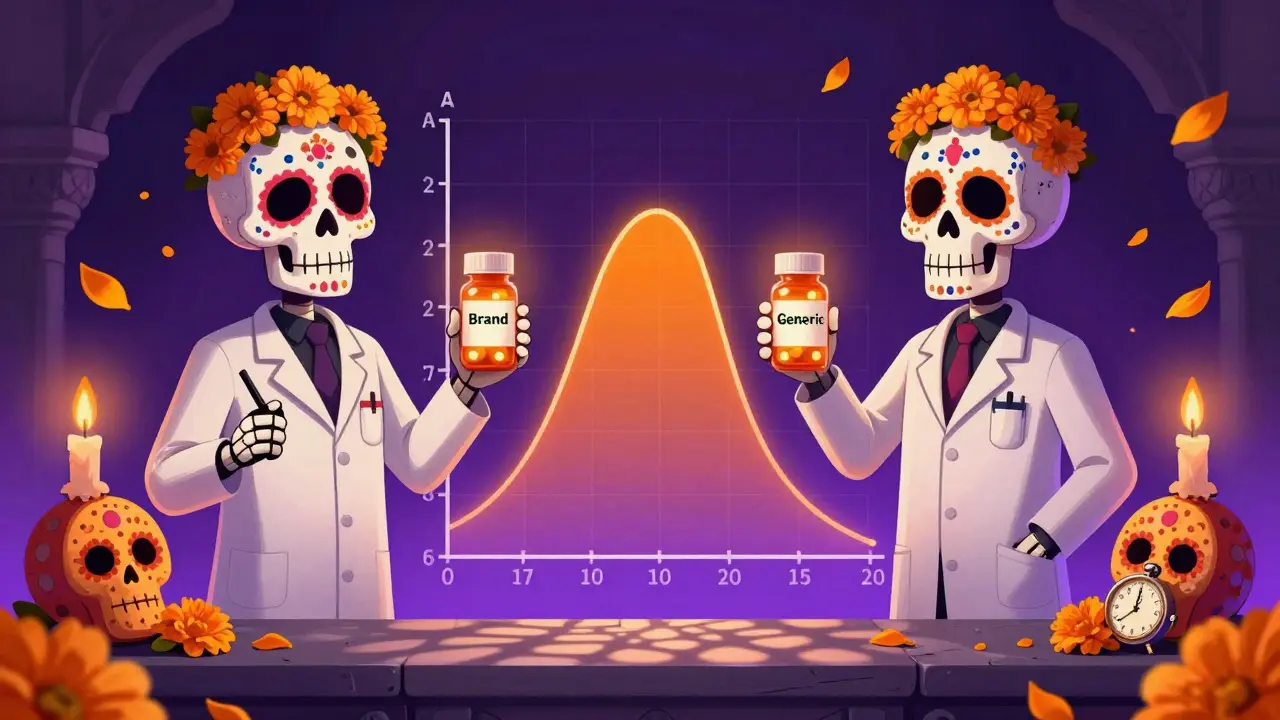
When a generic drug company wants to get its product approved, it doesn’t need to run expensive clinical trials showing it works better than the brand-name version. Instead, it must prove bioequivalence-that the generic delivers the same amount of drug into the bloodstream at roughly the same speed as the original. For years, this meant checking two numbers: Cmax (the highest concentration reached) and total AUC (the total drug exposure over time). But for certain complex drugs-especially extended-release pain meds, CNS drugs, or abuse-deterrent formulations-those two numbers weren’t enough. That’s where partial AUC, or pAUC, comes in.
Why Traditional Metrics Fall Short
Imagine two painkillers: one is a standard tablet that hits peak concentration in 1 hour. The other is an extended-release version designed to last 12 hours. Both might have the same total AUC and similar Cmax. But here’s the problem: the extended-release version might release too slowly at first, meaning a patient doesn’t get relief for the first 2 hours. Or worse, it might release too fast early on, creating a spike that could be abused. Traditional bioequivalence metrics miss these critical differences in how the drug is absorbed over time. That’s why regulators like the FDA and EMA started looking at partial areas under the curve. Instead of measuring the entire exposure from time zero to infinity, pAUC zooms in on a specific window-say, the first 2 hours after dosing-where absorption matters most. It’s like checking not just how much water a faucet lets out over a day, but how fast it fills a glass in the first 30 seconds.What Is Partial AUC (pAUC)?
Partial AUC is a pharmacokinetic metric that calculates the area under the drug concentration-time curve over a defined time interval. Unlike total AUC, which covers the whole curve, pAUC focuses only on the part that’s clinically meaningful. For example:- For an abuse-deterrent opioid, regulators might look at pAUC from 0 to 1 hour to ensure the drug doesn’t release too quickly.
- For a once-daily blood pressure pill, they might check pAUC from 8 to 12 hours to confirm steady levels during the critical nighttime window.
How Is pAUC Calculated?
There’s no single way to define the time window for pAUC. The FDA says the cutoff should be tied to a clinically relevant pharmacodynamic effect-meaning, when does the drug start working, or when does it matter most? Common approaches include:- Using the time to peak concentration (Tmax) of the reference product
- Defining the interval as the time when drug concentration exceeds 50% of Cmax
- Setting a fixed time window based on known onset of action (e.g., 0-2 hours for fast-acting drugs)
Why pAUC Matters for Generic Drug Development
In 2022, a Teva Pharmaceuticals team was developing a generic version of an extended-release opioid. Their initial study with 36 subjects passed the traditional Cmax and AUC tests. But when they ran pAUC analysis for the first 1.5 hours, they found a 22% difference in early exposure. That might sound small, but in abuse-deterrent drugs, even a 10% spike can make a product easier to crush or snort. The company had to increase their study size to 50 subjects, adding $350,000 to the project-but it prevented a potentially unsafe product from reaching patients. That’s not an outlier. FDA inspection reports from 2022 showed that 17 ANDA submissions were rejected because companies picked the wrong pAUC time window. In another case, a generic manufacturer missed a 15% difference in early absorption because they only looked at total AUC. The drug made it to market-until patients started reporting inconsistent pain relief. The product was recalled.Where Is pAUC Required Today?
pAUC is no longer experimental. It’s standard for:- Central nervous system drugs (68% of new submissions in 2022)
- Pain management products (62%), especially opioids with abuse-deterrent features
- Cardiovascular agents (45%), particularly long-acting antihypertensives
- Modified-release formulations of any kind

The Hidden Costs and Challenges
pAUC isn’t easy to implement. Biostatisticians often need 3 to 6 months of extra training to use it properly. Software like Phoenix WinNonlin or NONMEM is required. And because pAUC has higher variability, sample sizes often jump by 25-40%. A 2022 survey by the Generic Pharmaceutical Association found that 63% of companies needed external statistical consultants for pAUC analysis-compared to just 22% for traditional metrics. Another big issue: inconsistency. While the FDA says pAUC time windows should be based on clinical relevance, only 42% of their product-specific guidances clearly define how to pick that window. One company might use 0-1 hour; another might use 0-Tmax. That creates confusion, delays, and rejections. A Reddit post from a generic drug developer in March 2023 summed it up: “There’s no playbook. You’re guessing until the FDA says no.”What’s Next for pAUC?
The FDA is now piloting machine learning tools to automatically determine the best pAUC time window based on reference product data. The goal: reduce subjectivity and make guidelines more consistent. Meanwhile, the IQ Consortium is pushing for global alignment-right now, differences between U.S., EU, and other regulatory bodies add 12 to 18 months to global drug development timelines. But the science is clear. As Dr. Bingming Wang, FDA’s Director of Bioequivalence, said in 2022: “For some products, Cmax and total AUC just don’t tell the whole story.”For complex drugs, pAUC isn’t just a fancy statistic-it’s a safety tool. It catches differences that could lead to underdosing, overdosing, or abuse. It forces developers to think not just about total exposure, but about how the drug behaves when it matters most.
What is partial AUC in bioequivalence studies?
Partial AUC (pAUC) measures drug exposure only during a specific time window-like the first 1-2 hours after dosing-rather than over the entire concentration-time curve. It’s used to assess whether a generic drug matches the brand-name version in how quickly it’s absorbed, especially for extended-release or abuse-deterrent formulations where timing matters for safety and effectiveness.
Why is pAUC better than total AUC for some drugs?
Total AUC tells you the overall amount of drug absorbed, but not when it was absorbed. For drugs like extended-release opioids or CNS medications, early absorption can mean the difference between effective pain relief and dangerous abuse potential. pAUC isolates that critical window, making it more sensitive to differences in release patterns that total AUC might miss.
How do regulators decide the time window for pAUC?
Regulators like the FDA require the time window to be tied to a clinically relevant pharmacodynamic effect-for example, the time when a drug starts working or when peak effects occur. Common choices include 0-1 hour for fast-acting drugs, or up to Tmax (time to peak concentration) of the reference product. Product-specific guidances should define this, but many don’t, leading to inconsistencies.
Do all generic drugs need pAUC analysis?
No. pAUC is only required for specific products where traditional metrics (Cmax and total AUC) are insufficient-typically extended-release, abuse-deterrent, or complex formulations. As of 2023, over 127 drug products in the U.S. have FDA guidance mandating pAUC. Most standard immediate-release generics still only need Cmax and total AUC.
What are the biggest challenges in using pAUC?
The biggest challenges are: 1) Higher variability means larger, more expensive studies (often 25-40% bigger sample sizes), 2) Lack of standardized time windows across product guidances, 3) Need for specialized software and statistical expertise, and 4) Risk of rejection if the time window is poorly justified. Many companies now outsource pAUC analysis to specialized CROs because of these hurdles.





14 Comments
Susannah Green January 22, 2026
So many generic companies still treat pAUC like a suggestion, not a requirement. I’ve seen studies where they just slap on a 0-2hr window because it’s ‘convenient’-then get slapped back by the FDA with a CRL. It’s not just about stats; it’s about real patients who get underdosed or spiked. If your drug’s meant to last 12 hours but dumps half its dose in the first 30 minutes? That’s not bioequivalence. That’s a liability waiting to happen.
And don’t even get me started on the software costs. Phoenix WinNonlin licenses are basically a tax on small CROs. We’re talking $20k/year just to run one analysis. No wonder so many outsource to India now-where the analysts are great, but the documentation? Sometimes it reads like a haiku.
Vanessa Barber January 23, 2026
Maybe we just need to stop pretending all drugs are the same.
charley lopez January 24, 2026
The utilization of partial AUC as a pharmacokinetic endpoint represents a paradigmatic shift from aggregate exposure metrics toward temporally resolved pharmacodynamic alignment. The increased inter-subject variability inherent in truncated integration windows necessitates elevated statistical power, which in turn imposes non-trivial operational burdens on bioequivalence study design. Furthermore, the absence of harmonized temporal boundaries across regulatory jurisdictions introduces significant translational inefficiencies in global development pathways.
Anna Pryde-Smith January 26, 2026
THIS IS WHY GENERIC DRUGS ARE A JOKE. People think ‘same ingredients’ means ‘same effect’-but if your painkiller takes 90 minutes to kick in while the brand does it in 20? You’re not getting treated-you’re getting screwed. And the FDA only noticed this after people started OD’ing on ‘generic’ opioids because they took a second pill thinking the first didn’t work. This isn’t science. It’s negligence dressed up as regulation.
And now they want to charge $350K more per study? Screw that. Make the companies prove it works-before it hits the shelf. Not after someone dies.
Stacy Thomes January 26, 2026
Y’ALL. This is HUGE. Imagine if your insulin or blood pressure pill didn’t kick in when it was supposed to. You’d be in the ER. pAUC is like the seatbelt for generics-it’s not flashy, but it saves lives. Let’s stop treating drug safety like a budget spreadsheet and start treating it like the lifeline it is. #pAUCforSafety
Dawson Taylor January 28, 2026
There is a fundamental epistemological tension between regulatory pragmatism and pharmacological precision. The adoption of pAUC reflects a necessary evolution in evidentiary standards, yet its implementation remains inconsistent due to the absence of ontological clarity regarding clinically relevant time windows. The path forward lies not in increased sample sizes, but in standardized, evidence-based temporal anchors derived from pharmacodynamic response curves.
Sallie Jane Barnes January 30, 2026
I’ve worked in this space for 15 years. I’ve seen companies cut corners. I’ve seen patients suffer. pAUC isn’t about bureaucracy-it’s about not letting someone’s pain be ignored because a stat looked good on paper. The FDA’s guidance is still messy? Yes. But the intent? Pure. Let’s fix the process, not punish the principle.
Andrew Smirnykh January 31, 2026
Interesting how this mirrors the global debate around personalized medicine. If we’re moving toward precision dosing, shouldn’t our equivalence metrics be just as precise? I wonder if pAUC could eventually be adapted for pediatric or geriatric populations, where absorption kinetics vary so widely. Maybe the real win isn’t just catching unsafe generics-but building a framework that adapts to patient diversity.
Kerry Evans January 31, 2026
Of course the FDA wants pAUC. It’s easier to say ‘no’ than to say ‘yes’ and then have to explain why someone overdosed on a generic. This isn’t science-it’s CYA. And the companies that play along? They’re just part of the system. Real innovation would be designing drugs that don’t need this nonsense in the first place. But hey, why fix the problem when you can just add another 17-page appendix?
Kerry Moore January 31, 2026
While the statistical complexity of partial AUC presents considerable challenges, its clinical utility in capturing critical absorption dynamics cannot be overstated. The increased sample size requirements, while financially burdensome, are ethically justified when the alternative is the potential for subtherapeutic or toxic exposure profiles. Collaborative efforts between industry, academia, and regulators to standardize time-window selection protocols are urgently warranted.
Sue Stone February 1, 2026
My cousin works at a generic pharma co. They spent 6 months redoing one study because the pAUC window was off by 15 minutes. She said the whole team cried. Then they got approved. So… yeah. It’s a pain. But it works.
Oladeji Omobolaji February 2, 2026
Back home in Nigeria, we get generics that don’t even have proper labels. I read this and wonder-do they even know what AUC means over here? This level of detail? It’s a luxury. But I hope one day, even our weakest health systems can demand this kind of precision. Safety shouldn’t be a first-world thing.
Janet King February 3, 2026
Partial AUC is not optional for extended-release products. The FDA’s 2023 guidance is clear. Companies that ignore it are putting patients at risk. There is no justification for using total AUC alone when the release profile is altered. Period.
dana torgersen February 3, 2026
i mean… like… pAUC is kinda just… a fancy way of saying ‘check the first bit’ right? like… if the drug doesn’t start working in the first hour, then what’s the point? but also… why do we need a whole 3-month course to learn how to calculate it? and why does every guidane say something different?? i feel like we’re all just guessing until someone yells ‘NOPE’ at you. also, i think i spelled ‘guidance’ wrong. oops.