
Every year in the U.S., about 2 million people break a bone because their bones have become too weak. Most of these fractures happen in people over 50, and they’re not from falls off ladders or sports injuries. These are fragility fractures - breaks from standing height or even just turning over in bed. The cost? Around $52 billion annually. But here’s the truth most people don’t hear: taking a daily calcium pill and a vitamin D gummy won’t stop most fractures - unless you’re truly deficient.
Why Calcium and Vitamin D Alone Usually Don’t Work
For years, doctors told everyone over 50 to take calcium and vitamin D to protect bones. It made sense: calcium builds bone, vitamin D helps absorb it. But the science doesn’t back up the blanket recommendation. A major 2019 analysis of over 34,000 people found that vitamin D alone - even at 800 IU per day - didn’t lower fracture risk at all. Not hip fractures. Not wrist fractures. Nothing.
The same study looked at people taking both calcium and vitamin D together. The results? A small but real benefit - but only if you were already low on both. If your vitamin D level was below 20 ng/mL and you were eating less than 700 mg of calcium daily, then adding 1,000-1,200 mg of calcium and 800-1,000 IU of vitamin D cut hip fractures by 16%. That’s meaningful. But if you’re eating dairy, getting sunlight, and taking a multivitamin? You’re probably not deficient. And for those people, extra supplements do nothing.
The Women’s Health Initiative, which tracked nearly 36,000 postmenopausal women for seven years, found no reduction in fractures from 400 IU of vitamin D and 1,000 mg of calcium. The U.S. Preventive Services Task Force (USPSTF) now gives a clear “D” rating to this low-dose combo for healthy older women - meaning the harms likely outweigh the benefits.
When Calcium and Vitamin D Actually Help
There’s a group where this combo still saves lives: nursing home residents and people with severe deficiency. The landmark 1992 study by Chapuy showed a 43% drop in hip fractures among elderly nursing home patients given 800 IU of vitamin D and 1,200 mg of calcium daily. Why? Their average vitamin D level was only 12.3 ng/mL - dangerously low. Most people in the U.S. don’t get that low unless they’re housebound, dark-skinned, or on certain medications.
If you’re 75, rarely go outside, and eat mostly processed food, you might be in this group. But if you’re active, eat leafy greens and dairy, and get a little sun, you probably don’t need extra. The key is testing. The Endocrine Society recommends checking your 25-hydroxyvitamin D level before starting high-dose supplements. If it’s under 20 ng/mL, then yes - supplement. If it’s above 30 ng/mL, you’re good.
And here’s a hidden risk: too much calcium. The WHI trial found a 17% higher chance of kidney stones in women taking 1,000 mg of calcium daily. Some studies even link high-dose calcium to a slightly higher risk of heart problems. That’s why it’s better to get calcium from food - yogurt, cheese, sardines, kale - and only fill the gap with supplements if needed.
Bone-Building Medications: The Real Game Changers
If supplements are weak tea, bone-building drugs are espresso. These aren’t just for people with osteoporosis - they’re for anyone who’s already broken a bone from a minor fall. That’s called a fragility fracture, and it’s your body’s alarm bell.
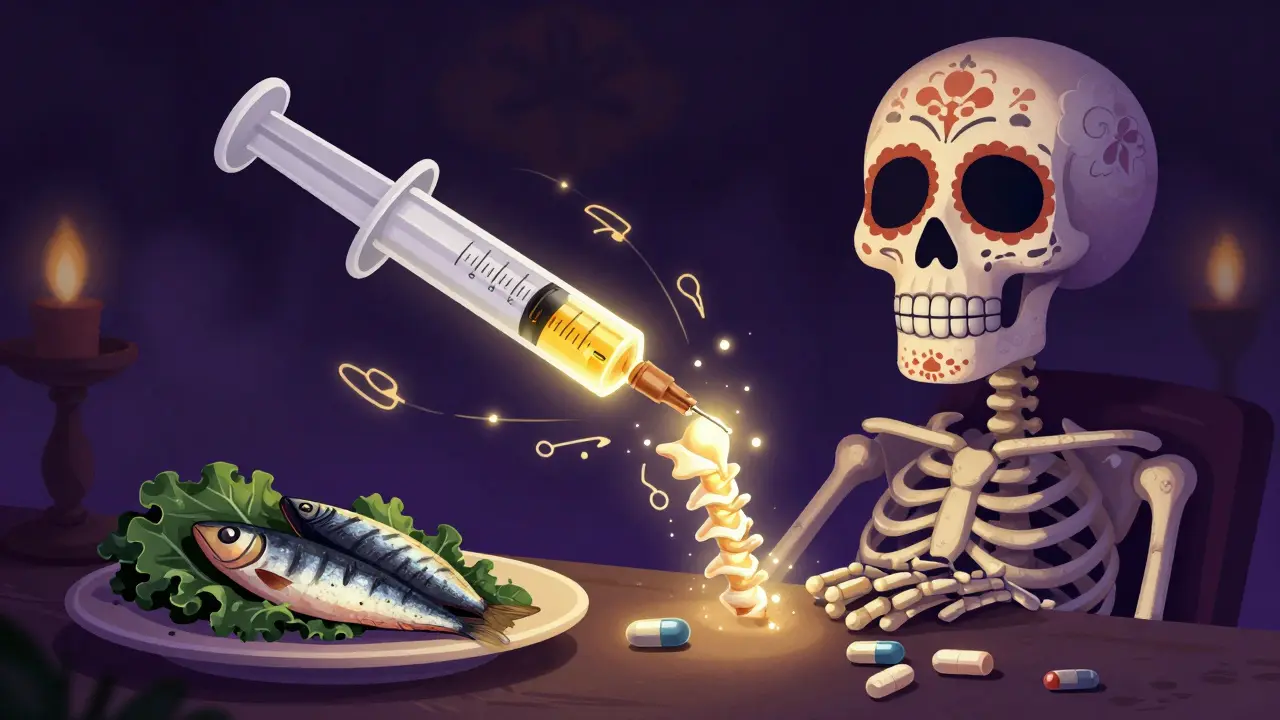
Bisphosphonates like alendronate (Fosamax) and zoledronic acid (Reclast) are the most common. They work by slowing down bone breakdown. In the Fracture Intervention Trial, alendronate cut vertebral fractures by 44%. Zoledronic acid, given as a yearly IV infusion, reduced hip fractures by 41% over 18 months. That’s not a small win - that’s life-changing.
Then there’s denosumab (Prolia), a biologic shot given every six months. It’s even stronger than bisphosphonates at reducing spine fractures, and it’s often used when bisphosphonates don’t work or cause stomach upset. But if you stop denosumab suddenly, you can lose bone fast - so you need a backup plan.
The newest drugs - teriparatide (Forteo) and romosozumab (Evenity) - actually rebuild bone. Teriparatide, a daily injection, is used for severe cases. In trials, it cut vertebral fractures by 65%. Romosozumab, given as monthly shots, builds bone faster than anything else. One study showed a 73% greater reduction in new spine fractures compared to bisphosphonates alone when used in sequence.
But these aren’t magic bullets. They come with risks. Bisphosphonates can rarely cause jawbone death (osteonecrosis) or unusual thigh bone fractures after five or more years of use. Denosumab requires strict adherence - missing a shot can trigger rapid bone loss. And all of them cost money. Zoledronic acid can run $1,000 per infusion without insurance.
Who Needs Medication - and Who Doesn’t
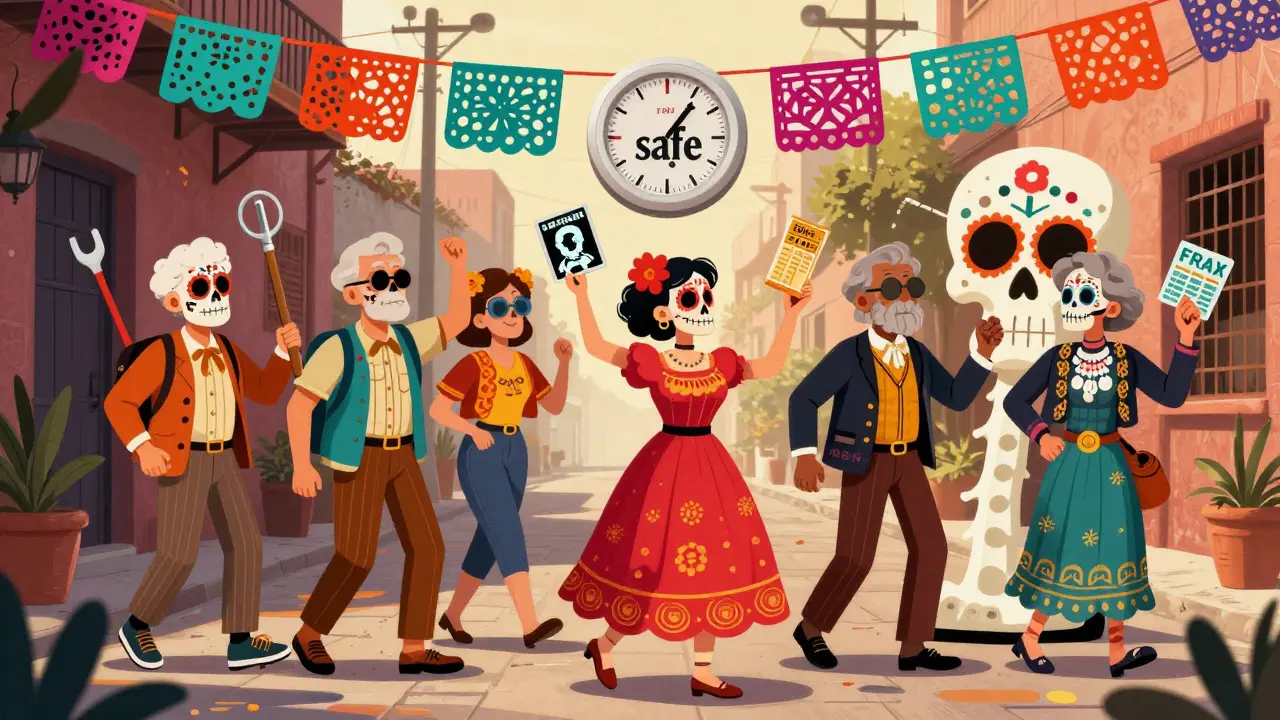
Not everyone with low bone density needs drugs. The Fracture Risk Assessment Tool (FRAX®) helps doctors decide. It takes your age, sex, weight, history of fractures, steroid use, and more - then calculates your 10-year risk of a major fracture. In the U.S., if your risk is over 20%, guidelines say you should start medication.
But here’s what most doctors don’t say: if you’ve already had a fragility fracture, you’re automatically high risk - no calculator needed. You don’t need to wait for a DEXA scan to show osteoporosis. That broken wrist or vertebra? That’s your diagnosis.
And yet, many people refuse meds. A 2022 survey found that 68% of patients on bisphosphonates had stomach problems - nausea, heartburn, pain - and over 20% quit within a year. Some people can’t swallow pills. Others are scared of side effects. That’s why doctors now offer alternatives: yearly IV infusions, or even switching to denosumab if oral meds cause trouble.
The Real Problem: Compliance and Cost
The biggest failure in fracture prevention isn’t the science - it’s the human side. Studies show more than half of people stop their osteoporosis meds within a year. Why? Side effects, forgetfulness, cost, or just thinking “I feel fine, so I don’t need it.”
But here’s the cold truth: osteoporosis has no symptoms until you break something. That’s why prevention isn’t about feeling good - it’s about avoiding the hospital, the surgery, the loss of independence.
One Mayo Clinic study followed 127 people who’d already broken a bone. Half got vitamin D repletion (to over 30 ng/mL) plus alendronate. The result? A 58% drop in new fractures. That’s not luck - that’s smart, targeted care.
Cost is another barrier. Generic alendronate costs as little as $10 a month. But newer drugs like romosozumab can run over $10,000 a year. Insurance often requires trying cheaper options first. That’s why your doctor might start you on a bisphosphonate before jumping to the fancy stuff.
What You Can Do Right Now
- Get tested. Ask for a 25-hydroxyvitamin D blood test. If it’s under 30 ng/mL, talk about supplementation.
- Eat your calcium. Aim for 1,000-1,200 mg daily from food - yogurt, milk, fortified plant milks, canned salmon, kale, almonds.
- Move your body. Weight-bearing exercise - walking, dancing, lifting weights - is the best bone builder you have. Do it 30 minutes a day, 5 days a week.
- Don’t smoke. Limit alcohol. Smoking cuts bone density. More than two drinks a day increases fracture risk.
- Get your fall risk checked. Vision problems, weak legs, cluttered floors - these are bigger risks than low calcium. Ask your doctor about balance training or a home safety check.
- If you’ve broken a bone from a minor fall, don’t wait. See a specialist. Get a FRAX score. Ask about medication. One fracture means you’re at high risk for the next.
What’s Coming Next
The field is moving fast. In 2023, the FDA approved abaloparatide-SC for men with osteoporosis - finally expanding options beyond women. The VITAL-DEP trial, still recruiting, is testing whether high-dose vitamin D helps fracture prevention in people with both low vitamin D and depression - a group that’s often overlooked.
And the big shift? From pills to sequences. Instead of just taking one drug forever, doctors are now starting with bone-building agents like teriparatide, then switching to antiresorptives like denosumab. This “anabolic-antiresorptive” approach is proving to be the most powerful strategy for high-risk patients.
The message isn’t simple. But it’s clear: calcium and vitamin D aren’t the heroes most people think they are. For most, they’re just background players. The real power lies in knowing your risk, testing your levels, and - when needed - using the right medication at the right time.



8 Comments
Diksha Srivastava January 30, 2026
Love this breakdown so much! I used to think popping calcium gummies was enough, but now I get it - it’s not about supplements, it’s about knowing your body. My grandma broke her hip at 78 and we didn’t realize she hadn’t seen sunlight in months. After she started getting her levels checked and walking daily, no more falls. Small changes, huge impact.
Sidhanth SY January 31, 2026
Been reading up on this since my dad got diagnosed. Honestly, I was shocked how little the vitamin D and calcium hype holds up for most people. My uncle’s been on alendronate for 3 years - no side effects, no fractures. Meanwhile, my aunt’s still taking 3 calcium pills a day and just broke her wrist last month. Guess who had the normal vitamin D? Exactly.
Adarsh Uttral February 1, 2026
so like… if u rnt housebound and eat cheese and walk outside sometimes u prolly dont need the pills? wild. i thought everyone over 50 was supposed to be chugging calcium like it was water. also why does everyone act like bisphosphonates are some scary drug? my neighbor takes hers once a week and says it’s easier than remembering to take her blood pressure med.
Niamh Trihy February 1, 2026
As a geriatric nurse in Dublin, I’ve seen this play out daily. The real tragedy isn’t the lack of meds - it’s the lack of screening. We test vitamin D levels on every admission over 65 now. If it’s under 30, we start supplementation immediately. If they’ve had a fragility fracture, we refer to bone clinic within 48 hours. Prevention isn’t optional - it’s standard of care.
KATHRYN JOHNSON February 3, 2026
It’s embarrassing how America ignores science. We waste billions on useless supplements while Europe and Canada implement mandatory bone health screenings for seniors. Our healthcare system prioritizes profit over prevention. If you break a bone after 50, you should be automatically enrolled in a bone health program - not left to Google it.
Sazzy De February 4, 2026
My mom took Fosamax for a year and got so sick she quit. Then she switched to the yearly infusion and it was fine. She walks every morning, eats yogurt, and got her vitamin D checked - it was 38. No pills needed. The key is doing something consistent, not taking everything the doctor pushes. You gotta listen to your body.
Amy Insalaco February 6, 2026
It’s fascinating how the pharmaceutical-industrial complex has successfully pathologized normal aging through the osteoporosis screening paradigm. The FRAX algorithm, while statistically robust, is fundamentally a risk-aversion tool designed to maximize pharmaceutical utilization rather than optimize physiological resilience. The anabolic-antiresorptive sequencing paradigm, while biologically elegant, still operates within a biomedical reductionist framework that neglects the epigenetic, microbiome, and inflammatory modulators of bone turnover - all of which are demonstrably influenced by circadian rhythm, phytonutrient density, and mechanical loading patterns outside the pharmacological intervention model.
Natasha Plebani February 6, 2026
There’s a deeper truth here that rarely gets voiced: bone health isn’t about calcium or drugs - it’s about embodiment. We’ve detached from our physicality. We sit. We scroll. We fear movement. We treat bones like static structures rather than dynamic, responsive tissues. The real fracture prevention isn’t in a pill - it’s in standing up, lifting something heavy, feeling your feet on the ground, and moving like your body was meant to. Medications can slow the decay, but only lived experience rebuilds the strength.