
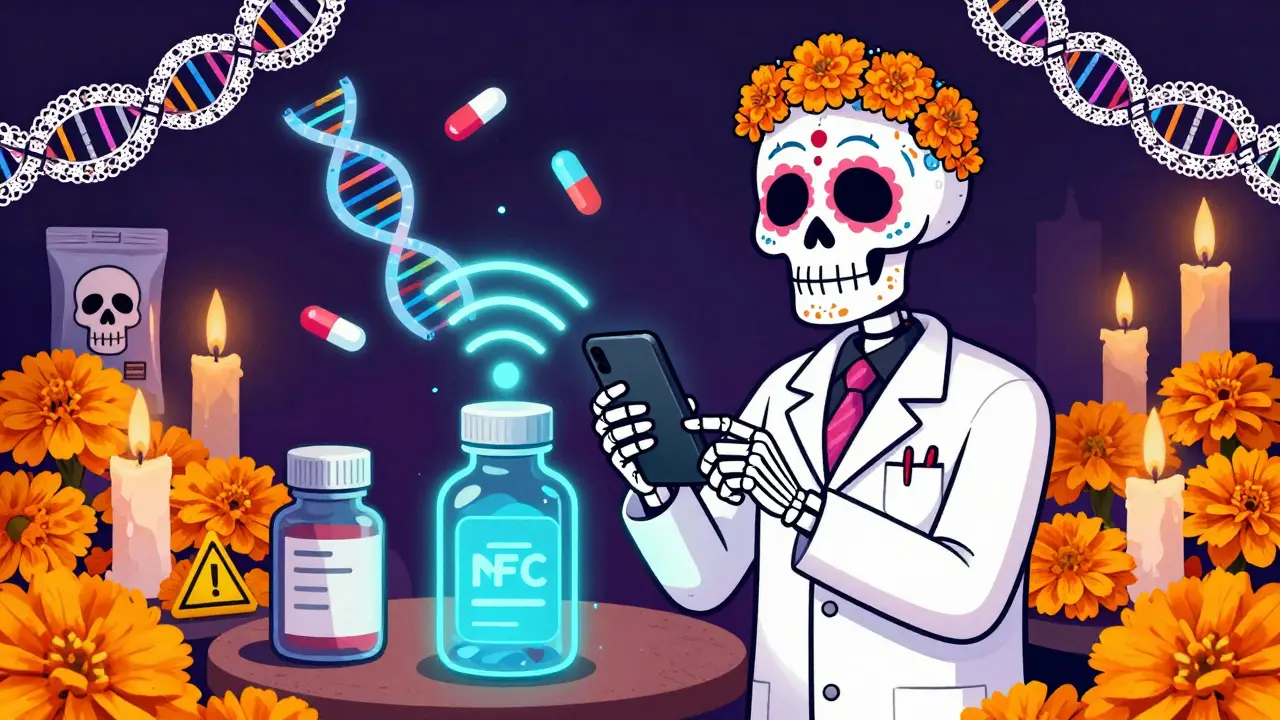
Every year, millions of people around the world take pills they think are real medicine-only to find out too late they were poisoned by fakes. Counterfeit drugs don’t just miss the active ingredient; they often contain rat poison, floor cleaner, or chalk. In low- and middle-income countries, 1 in 10 medical products is fake or substandard, according to the World Health Organization. And even in wealthy nations like the U.S. and Germany, supply chain gaps let dangerous fakes slip through. The good news? A wave of new technologies is finally turning the tide.
What’s Changing in the Fight Against Fake Drugs?
The old methods-simple barcodes, basic holograms, or printed QR codes-are no longer enough. Counterfeiters now use high-resolution printers, AI-generated packaging designs, and stolen serial numbers to mimic real products. What’s working today isn’t just about making it look real-it’s about making it impossible to copy. The biggest shift? Unit-level serialization. Instead of tracking a box of 100 pills, every single pill bottle, blister pack, or vial now gets its own unique digital ID. This isn’t optional anymore. By November 2025, the U.S. Drug Supply Chain Security Act (DSCSA) will require every prescription drug in the country to have this traceable code. The EU’s Falsified Medicines Directive already enforces this. If you’re a pharmacy, distributor, or manufacturer, you’re either compliant or facing fines, recalls, or shutdowns.NFC: The Smartphone That Checks Your Medicine
Imagine tapping your phone on a medicine bottle and instantly seeing its full history: where it was made, which warehouse it passed through, the temperature it was stored at, and whether it’s real. That’s NFC technology-and it’s becoming the gold standard. NFC chips, embedded in packaging, store encrypted data that can’t be copied. Unlike QR codes (which can be photographed and printed by anyone), NFC uses cryptographic authentication. ForgeStop’s 2025 tests showed NFC verification is 37% faster than barcode scanners and cuts false positives by 92%. In Latin America, a pharmacy chain using NFC saw counterfeit incidents drop by 98% in six months. Pharmacists now verify over 1,200 bottles a day with just a tap-adding only 3 to 5 seconds to each sale. And it’s not just for pharmacies. Patients can check their own meds at home. All you need is a smartphone made in the last five years. Over 89% of phones shipped in 2025 support NFC, making this the most scalable solution yet.Blockchain: The Unbreakable Ledger
NFC tells you if a bottle is real. Blockchain tells you how it got there. Think of blockchain as a public, unchangeable logbook. Every time a drug moves-from factory to distributor to hospital-it’s recorded. Temperature spikes? Logged. Delayed shipment? Logged. Tampered seal? Logged. No one can delete or alter it. Companies like De Beers used this for diamonds. Now, pharma giants are adapting it for medicines. The catch? It’s slow to set up. Gartner says full blockchain integration takes 18 to 24 months. That’s why most companies start with serialization and layer blockchain on top. But for high-value drugs-like cancer treatments or insulin-this is becoming non-negotiable. Regulators demand it. Patients demand transparency. And with new EU Digital Product Passport rules coming in 2027, every drug will eventually need a digital twin.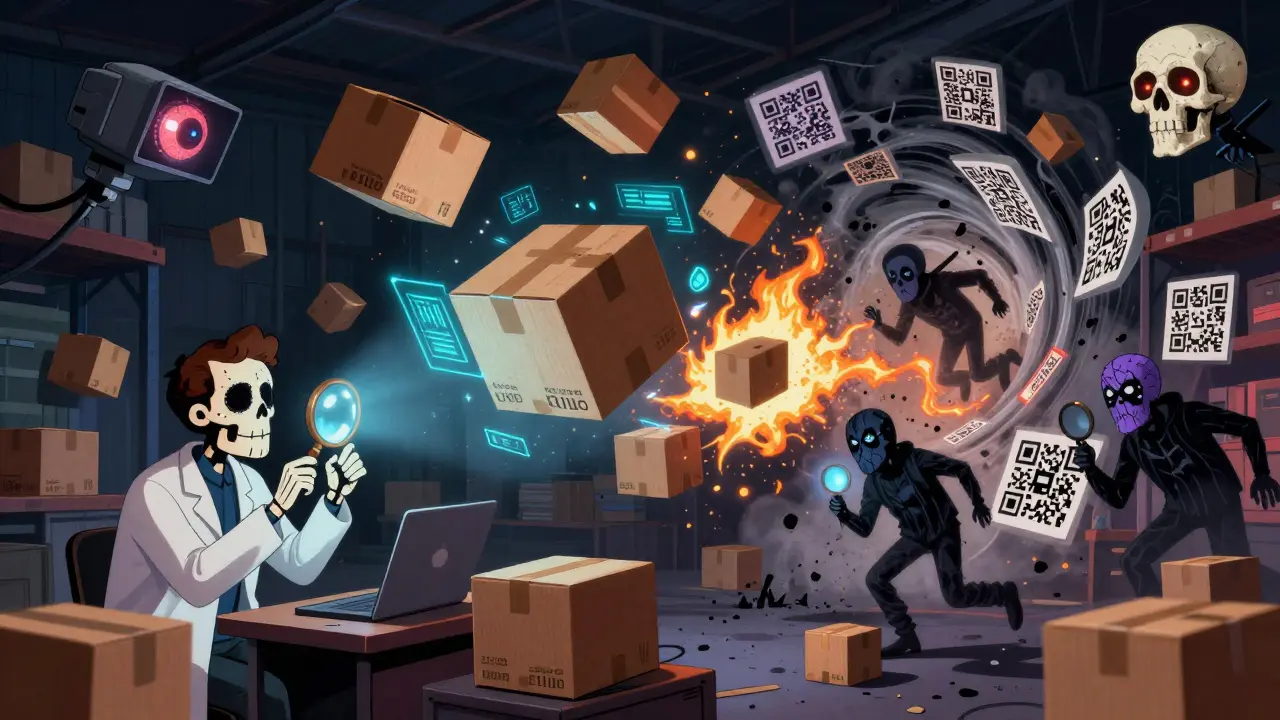
DNA Markers: The Secret Code Only Labs Can Read
Some drugs are so valuable-or so dangerous-that even NFC isn’t enough. That’s where DNA-based authentication comes in. Scientists embed tiny, unique strands of synthetic DNA into the packaging or even the drug itself. These markers are invisible to the eye, undetectable by scanners, and impossible to replicate without a lab. Only authorized testers with the right equipment can read them. It’s like a biological fingerprint for medicine. The downside? Cost. Each DNA tag adds $0.15 to $0.25 per unit. Compare that to standard serialization at $0.02 to $0.05. Right now, it’s only used for high-risk products: opioids, vaccines, or biologics. But as the tech improves, prices are falling. Expect to see it in more places by 2028.AI and Smart Cameras: The Eyes of the Supply Chain
Factories and warehouses are now using AI-powered cameras to spot fakes before they leave the building. These systems don’t just look for logos or colors-they analyze texture, ink reflectivity, label alignment, and even microscopic imperfections. Companies like Cognitivemarket Research report detection accuracy hitting 99.2% in controlled labs. Real-world conditions are trickier-lighting changes, packaging wrinkles, dirt on the label-but accuracy has jumped from 89.7% in 2024 to 94.3% in mid-2025. These systems don’t replace humans-they empower them. A worker with a tablet can scan a box and get an instant alert: “Suspicious ink pattern. Verify manually.”Why QR Codes Are Failing (and What to Do Instead)
You’ve probably seen QR codes on medicine boxes. They seem convenient. But here’s the truth: 78% of pharmaceutical QR codes fail security audits. Why? Because they’re just images. Anyone can copy them. In Q3 2025, a major U.S. drugmaker lost $147 million when fraudsters scanned real QR codes, printed fake labels, and flooded the market with poison pills. The system didn’t check if the code was linked to a real product-it just checked if the code existed. The fix? Cryptographic QR codes. These are rare, but they exist. They require a server check every time the code is scanned. But even then, NFC is faster, more secure, and works without internet. If you’re choosing between QR and NFC, pick NFC. Every time.
The Cost of Doing Nothing
Some companies delay adoption because of cost. But the price of inaction is worse. In 2025, new U.S. tariffs on pharmaceutical imports from China and India-called the “Liberation Day Tariffs”-raised production costs by 12% to 18% and added 21 to 45 days to supply chains. That’s not just money. It’s risk. Longer delays mean more opportunities for fakes to slip in. Meanwhile, the anti-counterfeit market is exploding. It hit $177.92 billion in 2024 and is on track to reach $345.93 billion by 2030. That’s not just tech companies making money-it’s lives being saved.What Should Pharmacies and Patients Do Now?
If you’re a pharmacist:- Check if your inventory system supports GS1 standards for serialization.
- Upgrade to NFC-enabled verification tools-don’t rely on QR codes.
- Train staff to verify every high-risk drug (antibiotics, insulin, painkillers) at point of sale.
- Use tools like TraceLink or ForgeStop-they offer 24/7 support and 97% first-contact resolution.
- Always check your medicine. If it came with an NFC tag, tap it with your phone.
- Don’t buy drugs from unknown websites or street vendors-even if they look real.
- Report suspicious packaging to your pharmacy or the FDA’s MedWatch program.
The Future Is Multi-Layered
No single technology is perfect. That’s why the smartest companies are stacking them. A pill bottle might have:- An NFC chip for instant phone verification
- A hologram that shifts color when tilted
- A UV-visible serial number
- A DNA marker only a lab can detect
- A blockchain record of its journey
How can I tell if my medicine is fake?
If your medicine has an NFC chip, tap it with your smartphone-it will show you the product’s full history. Look for tamper-evident seals like shrink bands or induction seals. Check for spelling errors, blurry printing, or mismatched colors. If you’re unsure, call your pharmacy or use the FDA’s MedWatch program to report it.
Are QR codes on medicine bottles safe?
Most are not. Over 78% of pharmaceutical QR codes can be easily copied by counterfeiters because they lack encryption. A real QR code should link to a secure server that verifies the product’s unique serial number in real time. If scanning the code doesn’t require internet or shows no verification details, it’s likely fake or insecure.
What’s the difference between serialization and blockchain in pharma?
Serialization assigns a unique code to each medicine unit for tracking. Blockchain is a digital ledger that records every movement of that unit across the supply chain. Serialization tells you if a bottle is real. Blockchain tells you how it got there and whether it was stored properly. Most companies use both together.
Why is NFC better than traditional barcodes?
Barcodes are just images-easy to copy. NFC chips store encrypted data and require authentication before revealing information. NFC verification is 37% faster, reduces false positives by 92%, and works without line-of-sight. You can tap an NFC tag through a purse or pocket. Barcodes need perfect lighting and alignment.
Can AI really detect fake drugs?
Yes, but not alone. AI-powered cameras can spot tiny differences in ink, texture, or label alignment with 94.3% accuracy in 2025. But they work best alongside human review and digital verification. They’re used mostly in factories and warehouses to catch fakes before they ship-not at the pharmacy counter.
Is DNA-based authentication available to the public?
No. DNA markers are used only by manufacturers and regulators. They require lab equipment to detect and are too expensive for mass use-costing 5 to 10 times more than standard serialization. You won’t be able to check them yourself. But their presence means the product has passed the highest level of security.
What should small pharmacies do if they can’t afford new tech?
Start with the basics: only buy from licensed distributors, check for tamper-evident packaging, and report anything suspicious. Use free tools like the FDA’s Drug Supply Chain Security Act (DSCSA) resources. Many software providers offer tiered pricing for small businesses. Don’t wait for perfection-start with verification, even if it’s manual.


11 Comments
Sumit Sharma January 12, 2026
NFC is the only viable solution for unit-level serialization-period. QR codes are a joke; they’re static images vulnerable to brute-force replication. The 92% reduction in false positives isn’t a statistic-it’s a lifeline. In India, where counterfeit antimalarials kill 50,000 annually, this tech isn’t optional-it’s existential. If your pharmacy still uses barcodes, you’re complicit.
Jay Powers January 13, 2026
I get that tech is cool but lets not forget the real issue here-access. In rural areas even smartphones are a luxury. NFC sounds great until you’re in a village with no signal and no charger. We need low tech solutions too like tamper-evident seals and training for community health workers. Not everyone lives in a tech bubble.
Lawrence Jung January 14, 2026
Blockchain for medicine is just another overhyped solution chasing venture capital. You think a ledger changes human behavior No. The real problem is corruption in supply chains and lack of enforcement. Tech can’t fix a system where officials take bribes to let fake drugs through. All this NFC and DNA nonsense is just a distraction from the root cause: governance failure.
Alice Elanora Shepherd January 16, 2026
It’s important to note that while NFC is highly effective, its adoption must be accompanied by patient education. Many users don’t know how to interpret the data they receive-even if the system works perfectly. A simple, multilingual interface with visual cues (green = safe, red = alert) is critical. Also, ensure accessibility for visually impaired users through voice-guided verification. This isn’t just engineering-it’s public health design.
Christina Widodo January 17, 2026
Wait so if I tap my phone on my insulin bottle and it says it’s legit, does that mean it’s 100% safe? What if the whole batch was contaminated before it got tagged? Doesn’t this just verify the packaging, not the actual contents? I’m worried this gives people false confidence.
Prachi Chauhan January 18, 2026
Real talk: I’ve seen fake drugs in my village. They look real. Taste real. Even the packaging feels right. But the pills make you dizzy. No one has phones. No one knows NFC. So what do we do? We trust the pharmacy. But if the pharmacy is getting them from shady suppliers? We’re screwed. Tech helps, but we need real people checking real things. No app replaces a trained pharmacist.
jordan shiyangeni January 20, 2026
Let’s be brutally honest: the entire pharmaceutical industry is a profit-driven cartel that prioritizes margins over safety. They’ve known about counterfeit drugs for decades and did nothing-until regulators forced them to act. Now they’re selling us ‘anti-counterfeit tech’ as a premium feature, while still charging $1,200 for insulin. This isn’t innovation-it’s extortion dressed up in blockchain buzzwords. The real crime isn’t fake pills-it’s the greed that lets them exist in the first place.
Abner San Diego January 21, 2026
Why are we spending billions on NFC chips when China and India are making 80% of the world’s meds? This is just another way for U.S. pharma to protect their monopoly. Let them fix their own supply chains. We don’t need to pay extra for tech that just makes the rich feel safe while the poor still die from fake antibiotics. This whole thing feels like corporate theater.
Eileen Reilly January 22, 2026
Okay so I scanned my blood pressure med and it said ‘verified’ but the bottle looked slightly off? Like the cap was a tiny bit looser? Should I trust the app or my gut? Also the UI was glitchy and said ‘server timeout’ twice. So now I’m just paranoid AF. Also why does my phone need to be on 70% battery to scan? This tech is trash.
Monica Puglia January 24, 2026
I just tapped my new ADHD med and it showed me the whole journey-from factory to my local CVS. 🤯 I cried. I’ve been scared to take my meds for years because of fake stories online. This makes me feel safe for the first time. Thank you to the engineers who built this. You’re literally saving lives. 💙📱
Cecelia Alta January 25, 2026
So let me get this straight-NFC, blockchain, DNA markers, AI cameras… all of this just to stop people from copying a label? We’re spending billions to outsmart a guy with a printer and a Google search. Meanwhile, real problems like drug shortages, price gouging, and mental health access are ignored. This is like installing a titanium lock on a house that’s on fire. We’re fixing the wrong thing. And don’t even get me started on how this tech will be weaponized against low-income patients later. ‘Sorry ma’am, your phone doesn’t support the latest NFC protocol-your insulin is now unverified.’