
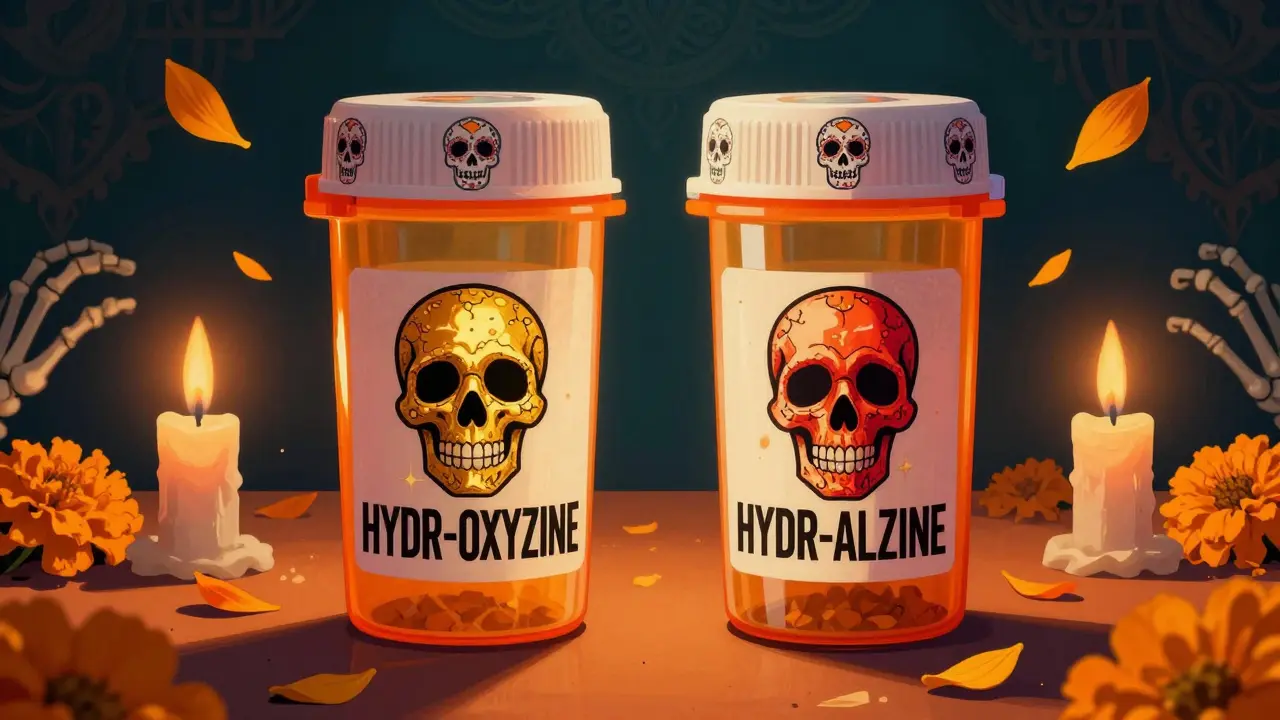
Every year, thousands of people in the U.S. get the wrong medication-not because of a mistake in dosage, but because two drug names look or sound almost identical. Look-alike and sound-alike (LASA) drug names are one of the most common causes of preventable medication errors. A prescription for hydroCODONE might be confused with hydroALAzine. vinBLAStine could be mistaken for vinCRIStine. These aren’t typos. They’re visual and auditory traps built into the names themselves.
The problem isn’t rare. According to the Institute for Safe Medication Practices (ISMP), about 25% of all reported medication errors involve LASA drug names. The U.S. Food and Drug Administration (FDA) has been working on this since 2001, and as of 2023, they’ve officially flagged 35 high-risk drug pairs that need special handling. These aren’t just theoretical risks-they’ve caused real harm. Studies show that 34% of these errors reach the patient, and 7% result in actual injury.
What Is Tall Man Lettering-and Why It Matters
The most widely used tool to fight LASA errors is called tall man lettering (TML). It’s simple: capitalize the letters that make two similar drug names different. Instead of writing hydrOXYzine and hydrALAzine, you write them as hydrOXYzine and hydrALazine. The uppercase letters jump out visually, making it harder to mix them up.
This isn’t just a suggestion-it’s a standard. The FDA, in partnership with ISMP and the Institute for Healthcare Improvement, created clear guidelines for TML. They recommend capitalizing 2-4 letters that create the clearest visual distinction. The font size for these capitalized sections must be at least 12-point, and there must be a 4.5:1 contrast ratio against the label background to ensure readability.
Research proves it works. A 2006 study in Human Factors found that TML reduced visual confusion by 32%. When combined with color coding, that number jumps to 47%. But TML alone isn’t enough. One pharmacist in Seattle told me, “I’ve seen labels with perfect TML, but the EHR system didn’t show it. Nurses got confused because the screen and the paper didn’t match.” Inconsistency is the enemy here.
How Electronic Systems Make (or Break) LASA Safety
Most prescriptions today are entered into Electronic Health Records (EHRs) or pharmacy systems. These systems are where most LASA errors happen-not on paper, but in dropdown menus.
Here’s what good systems do:
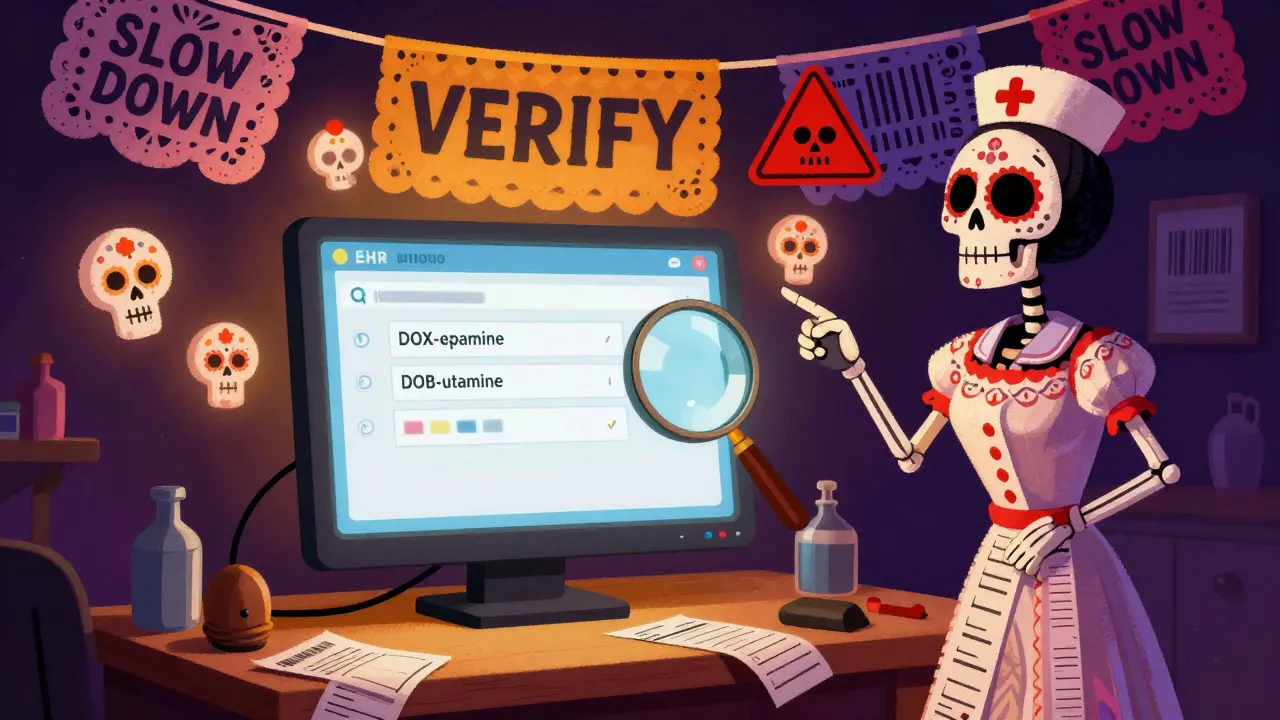
- They block confusing drug names from appearing next to each other in search results. If you type “dox,” the system won’t show doXEPamine and doBUTamine side by side. This cuts selection errors by 41%.
- They require at least 5 letters before showing drug options. Typing “do” might bring up 20 drugs. Typing “dox” narrows it to two. That simple rule reduces error-prone lists by 68%.
- They only trigger alerts for the FDA’s official high-risk pairs. Too many alerts? Clinicians start ignoring them. A 2021 JAMA Internal Medicine study found that 49% of LASA alerts were overridden because they were too frequent or irrelevant.
As of 2023, 92% of acute care EHR systems in the U.S. are certified to meet these standards. But that doesn’t mean they’re all used correctly. A 2022 survey of 1,247 pharmacists found that 65% reported inconsistent TML display across systems. One nurse said: “My hospital’s EHR uses TML, but the MAR (medication administration record) doesn’t. I’m checking two different versions of the same drug.” That kind of mismatch is dangerous.
The Hidden Danger: Handwritten Prescriptions
Even with all the tech, handwritten prescriptions still exist-especially in urgent care, nursing homes, and rural clinics. And they’re the #1 source of LASA errors outside of digital systems.
Reddit’s r/Pharmacy community reported that 41% of LASA errors they’ve seen came from poor handwriting. A sloppy “O” looks like a “0.” A slanted “l” looks like a “1.” “Hydroxyzine” written fast becomes “hydroxyzine,” which looks identical to “hydroxyzine” (a non-existent drug) or gets misread as “hydroxyzine” (which doesn’t exist either). The brain fills in the gaps-and that’s where mistakes happen.
Even when the handwriting is legible, TML is often missing. The American Society of Health-System Pharmacists found that 42% of handwritten orders omit tall man lettering entirely. No capitalization. No visual cues. Just two names that look too similar.
That’s why the FDA and Joint Commission now require healthcare facilities to maintain and review an annual list of LASA medications. If your clinic still uses handwritten scripts for high-risk drugs like insulin, anticoagulants, or opioids, you’re operating with a blind spot.
What You Can Do: A 3-Step Verification System
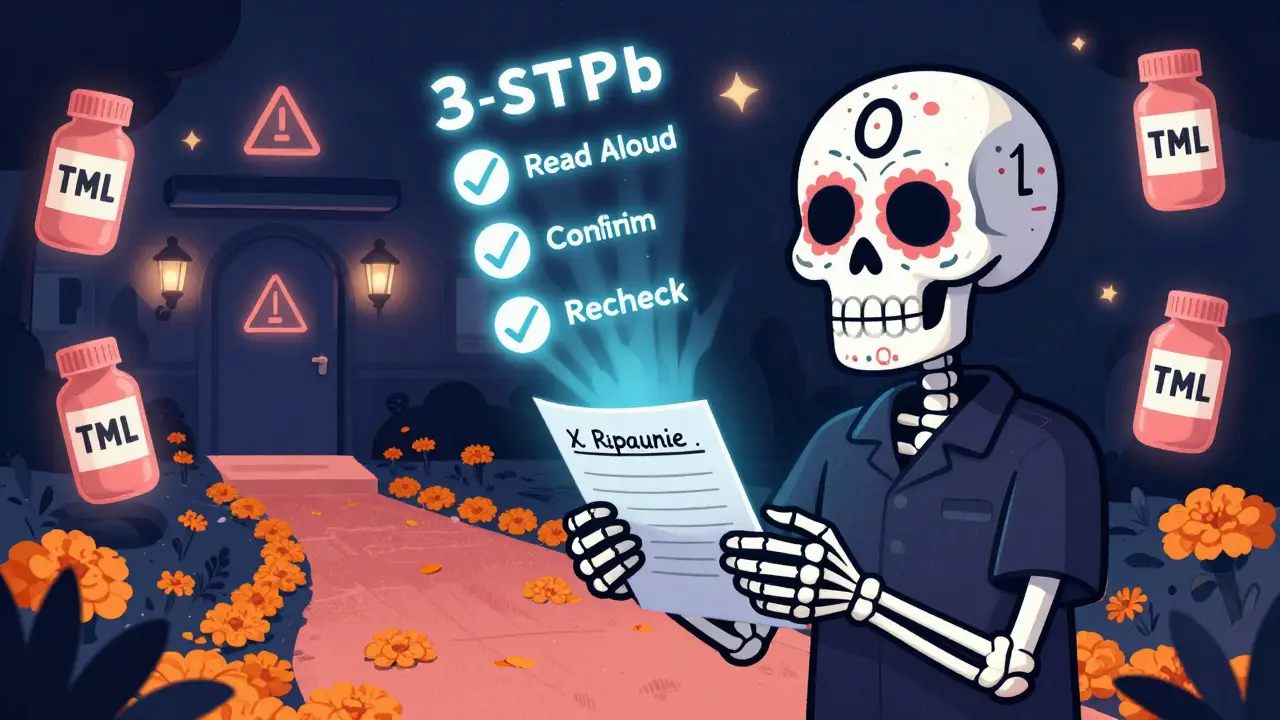
You don’t need to be a pharmacist to help prevent these errors. If you’re picking up a prescription, giving medication to a loved one, or working in a care setting, use this simple 3-step method:
- Read the full label aloud. Don’t just glance. Say the name out loud: “HydroOXYzine, 10 mg.” Hearing it helps catch sound-alike errors.
- Confirm with another person. If you’re a nurse or pharmacist, have a colleague check the label before you hand it off. If you’re a patient, ask the pharmacist: “Is this the same as the one I got last time?”
- Read it again when you get to the point of use. Before you take the pill, before you inject it, before you give it to someone else-read the label one more time. A 2022 study in the American Journal of Health-System Pharmacy showed this step alone reduces errors by 52%.
At Johns Hopkins Hospital, this process was part of a larger safety program that cut LASA errors by 67% over two years. It’s not fancy. It’s just slow, deliberate, and repeatable.
Barcodes, Alerts, and AI-The Next Layer of Protection
Technology is getting smarter. Barcode scanning at the point of administration reduces medication errors by 81%. Every time a nurse scans a patient’s wristband and the drug’s barcode, the system checks: Is this the right drug? Right patient? Right dose? Right time? If it doesn’t match, it stops the process.
But barcode systems cost money-around $153,000 per hospital to install and train staff. Not every clinic can afford it. That’s why simpler tools still matter.
Computer alerts can help, but they’re flawed. If you get 20 alerts a shift, you’ll start clicking “OK” without reading. The trick is to limit alerts to only the most dangerous pairs. Google Health’s Med-PaLM 2 AI model can predict LASA risk with 89% accuracy, but it’s still in testing. The FDA’s own algorithm, which uses the BI-SIM and ALINE methods, is already used to screen new drug names before they hit the market. Between 2018 and 2023, it blocked 17 drug names that would’ve been too confusing to use safely.
And now, the FDA is expanding its list. In September 2023, they added 12 new LASA pairs to the official TML list. That brings the total to 35. By December 2024, all U.S. healthcare systems must implement these changes. That includes pharmacies, hospitals, clinics, and even automated dispensing cabinets.
What’s Next? The Push for Full System Integration
The future of LASA safety isn’t just about better labels. It’s about making the whole system smarter.
One emerging trend is adding the purpose of treatment to the label. Instead of just seeing “Valtrex,” you see “Valtrex (for herpes simplex).” That extra context makes it harder to confuse it with “Valcyte (for cytomegalovirus).” A 2023 pilot at a major hospital showed that adding this detail reduced selection errors by 54%.
Another big step: integrating LASA checks into medication reconciliation-the process of comparing a patient’s current meds with what’s being prescribed. When a patient moves from hospital to home, or from one doctor to another, these checks are often skipped. New pilot programs show that including LASA alerts during reconciliation cuts transition errors by 63%.
By 2026, the ISMP wants TML to be mandatory everywhere in the U.S. That means every prescription, every label, every screen. No exceptions.
Final Takeaway: Don’t Rely on Luck
Look-alike drug names aren’t going away. New drugs are always being developed, and some will inevitably sound like others. But we don’t have to accept the risk.
It’s not enough to hope the label is clear. It’s not enough to trust the system. You have to be part of the solution.
Here’s what you can do right now:
- If you’re a patient: Always read the label twice. Ask the pharmacist: “Is this one of those similar-sounding drugs?”
- If you’re a caregiver: Never assume. Verify the name, the dose, and the reason.
- If you’re a healthcare worker: Use TML as a tool, not a cure. Combine it with verification, scanning, and communication.
The goal isn’t perfection. It’s prevention. One extra second reading a label. One extra question asked. One extra check. That’s what stops a mistake from becoming a tragedy.



14 Comments
Betty Bomber January 27, 2026
Been a nurse for 12 years and I still catch myself glancing at labels too fast. One time I almost gave someone hydralazine instead of hydroxyzine because I was rushing between rooms. TML saved me - the OXY jumped out. Never underestimate the power of slowing down.
Marian Gilan January 28, 2026
theyre all in on this tml thing but what if its just a distraction? what if the real problem is the fda letting pharma companies name drugs like theyre playing scrabble with a hangover? hydrocodone? hydroalazine? who thought this up? someone on acid in 1987?
Mohammed Rizvi January 28, 2026
so the system has 35 dangerous pairs but there are like 10,000 drugs out there? we’re playing whack-a-mole with alphabet soup and calling it a safety protocol. someone’s making bank on this chaos.
Conor Murphy January 29, 2026
Just want to say thank you for writing this. I’m a med student and this stuff terrifies me - but knowing how to spot it makes me feel a little less helpless. TML + double-checking = my new mantra. 💙
Conor Flannelly January 30, 2026
It’s funny how we’ve built entire systems around human error instead of just designing better language. Why not just give drugs names like ‘CancerKiller-7’ or ‘HeartHelp-Alpha’? We’re not naming stars here - we’re naming life-or-death tools. If a drug name needs a 12-point font and a contrast ratio to be read correctly, maybe it’s not a name, it’s a bug.
Curtis Younker January 31, 2026
My aunt got the wrong med last year because her EHR didn’t show TML on the printout. She ended up in the ER. The hospital said ‘it’s not our fault the printer didn’t render uppercase letters right.’ I’m sorry - that’s not a technical glitch, that’s a moral failure. We’ve got the tools. We just don’t care enough to use them right. Let’s fix this. Not tomorrow. Today.
Shawn Raja February 1, 2026
Oh wow, so the FDA’s been ‘working on this’ since 2001? And we’re still at 35 pairs? That’s like 2 new dangerous pairs per decade. Meanwhile, Big Pharma churns out 50 new drugs a year with names like ‘Zylopril’ and ‘Dexaflon’ - all of which sound like they were generated by a drunk AI that only knows 7 vowels. The system is broken. We’re not fixing it. We’re just adding more capital letters to the funeral pyre.
Nicholas Miter February 1, 2026
handwritten scripts are still a thing? in 2024? my grandma’s nursing home still uses those. i saw a script that said ‘morphine’ but the ‘o’ was a dot and the ‘i’ was a line - looked like ‘mrphine’. they gave her 3x the dose. she lived. but not everyone does. this isn’t a tech problem. it’s a culture problem.
Skye Kooyman February 3, 2026
read it twice
Aishah Bango February 3, 2026
People keep saying ‘just use TML’ like it’s magic. But if your EHR doesn’t display it right, if your printer strips the caps, if your nurse is tired and distracted - none of this matters. You can’t fix human negligence with typography. We need mandatory retraining every 6 months. Not just ‘oh we updated the software.’ People need to be held accountable.
Simran Kaur February 5, 2026
My cousin in Mumbai got a wrong injection because the label said ‘Insulin-100’ and the script said ‘Insulin-10’ - no TML, no barcode, just a nurse squinting under a flickering bulb. I cried for three days. This isn’t an American problem. It’s a global failure. We treat medication like it’s a grocery list. It’s not. It’s a live wire.
Alexandra Enns February 6, 2026
Why are we letting Americans dictate how drugs are named? Canada’s system is way cleaner. We don’t have this ‘hydro’ nonsense. We use proper scientific names. If you can’t pronounce it, it shouldn’t be on the market. This is why the US has the highest drug error rate. You people name everything after your exes.
Patrick Merrell February 7, 2026
Let me guess - the same people who designed the ‘doxycycline’ and ‘dobutamine’ dropdown menu also designed the iPhone keyboard. This isn’t a medical issue. It’s a design failure. Someone got paid to make this confusing. And now we’re all paying for it with our lives. #PharmaCrime
eric fert February 8, 2026
Okay, so let’s be real here - we’re not talking about a ‘medication error’ here. We’re talking about a systemic, institutionalized form of negligence that’s been quietly killing people for decades. The FDA doesn’t care. The hospitals don’t care. The pharmaceutical companies actively profit from this ambiguity because it creates dependency on ‘safety solutions’ they sell back to you. TML? Barcodes? AI? All of it’s just a tax on your suffering. They don’t want to fix the names. They want you to pay for the bandage. And the worst part? We’re all complicit. We click ‘OK’ on every alert. We don’t read the labels. We trust the system. And that’s the real tragedy. This isn’t about capital letters. It’s about a society that’s stopped caring enough to ask why.