

Getting your medication right isn’t just about taking it - it’s about taking it correctly and consistently. For people managing asthma, COPD, diabetes, or chronic pain, inhalers, patches, and injectables are lifelines. But here’s the hard truth: nearly 4 out of 10 people don’t use them as prescribed. That’s not laziness. It’s confusion, discomfort, forgetfulness, or fear - and it’s costing lives.
In the U.S., poor adherence to these delivery methods contributes to over 125,000 preventable deaths every year. It also drives up healthcare costs by $100 billion to $289 billion annually. The good news? Simple, smart changes can turn this around.
Why Inhalers Are So Hard to Use Right
Inhalers look simple. Press. Breathe in. Done. But in reality, fewer than 50% of people use them correctly. A 2022 study in Respiratory Therapy found that even patients who think they’re doing it right often miss the timing, breath hold, or coordination needed for the medicine to reach the lungs.
That’s where smart inhalers come in. Devices like Propeller Health’s sensor attach to standard inhalers and record every puff. They sync with apps to show you when you used it, how hard you inhaled, and even if your technique was off. One user on Reddit said their adherence jumped from 55% to 82% in three months. But not everyone sticks with it. Some found the constant reminders stressful. Others had app crashes on older Android phones.
What works better than tech alone? Hands-on training. A pharmacist spending 20 minutes showing you how to hold the inhaler, breathe in slowly, and hold your breath for 5 seconds can improve proper use by 40%. Do this once, then check back in 30 days. That kind of follow-up cuts hospital visits by nearly 30%.
Patches: Discreet, But Not Always Reliable
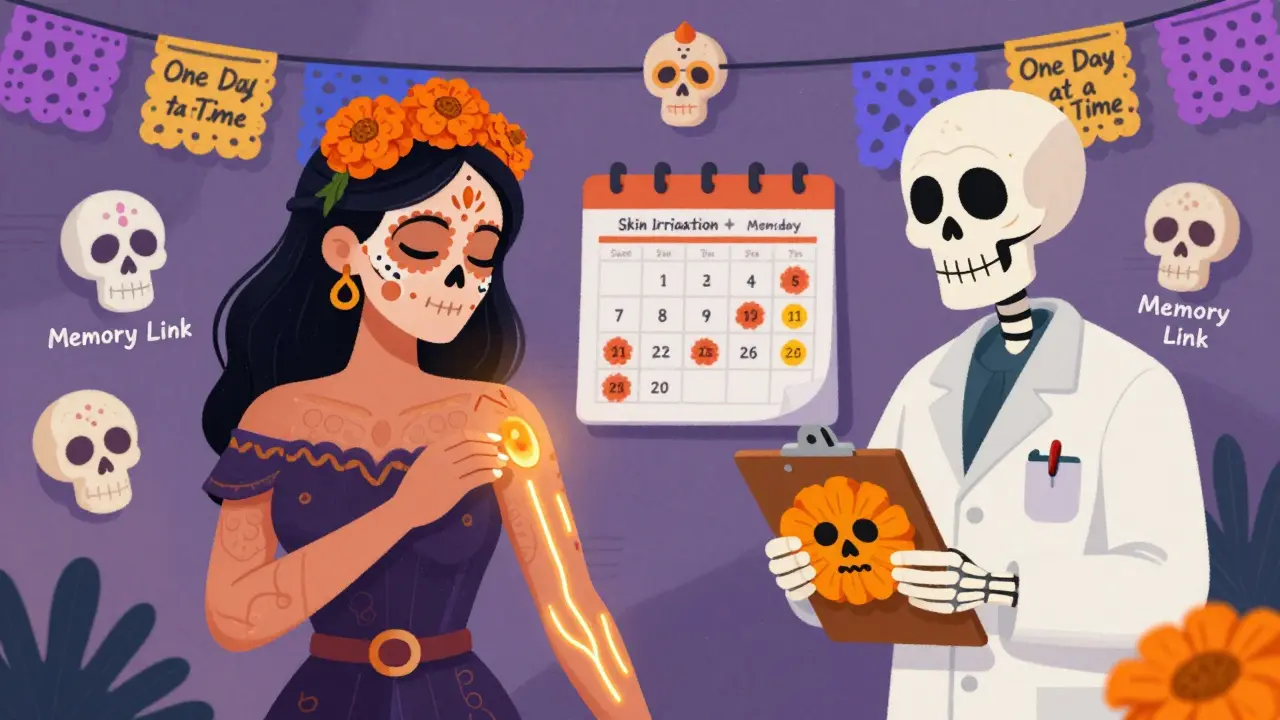
Patches - whether for nicotine, estrogen, pain relief, or diabetes - are popular because they’re invisible. You stick it on your arm or back and forget it. But that’s also the problem. People forget they’re even wearing one. Some remove it early. Others reapply too soon. A 2022 survey from the American Diabetes Association found that 31% of patch users had skin irritation that made them skip doses.
Here’s a trick that works: pair the patch with a daily habit. Put it on right after brushing your teeth or before your morning coffee. Use a calendar or a simple sticker chart. For people who need long-term meds like fentanyl or testosterone, extended-release patches (like those from Johnson & Johnson) are easier to stick with than daily pills. They don’t need to be taken at exact times, which reduces the mental load.
There’s also a newer option: wearable sensors. Proteus Digital Health’s system embeds a tiny, FDA-approved sensor inside the patch. When it hits your stomach acid, it sends a signal to your phone. It’s accurate - 98% reliable. But it’s expensive. And only a few insurance plans cover it. For most people, a sticky note on the bathroom mirror still beats a $300 sensor.
Injectables: The Fear Factor
Insulin pens, hormone shots, migraine treatments - these are often the hardest to stick with. Why? Fear. Pain. Embarrassment. The thought of jabbing yourself every day feels overwhelming. A Novo Nordisk study in 2023 found that 22% of users found companion apps too complex, especially for older adults helping a spouse.
Smart pens change that. Novo Nordisk’s connected insulin pens track dose, time, and even injection site. They alert you if you’ve missed a dose or if you’re using too much. In one trial, users improved dose accuracy by 27%. But the real win? Confidence. One user told a support group: “Knowing my doctor saw I took it every day made me feel like I wasn’t failing.”
For people who dread needles, switching to an auto-injector helps. These devices look like a pen, but you just press them against your skin - no aiming, no seeing the needle. Some even have voice prompts. If you’re on long-term injectables, ask your pharmacist about extended-release versions. A single monthly shot of a drug like semaglutide beats daily injections for many people.
The Real Secret: It’s Not the Device - It’s the Plan
There’s no magic gadget that fixes adherence. The best tools fail if they don’t match the person using them. A 2023 Harvard Medical School review pointed to five key reasons people stop taking meds:
- Affordability - Is the cost too high?
- Accessibility - Can you get refills easily?
- Acceptability - Does it feel embarrassing or stigmatizing?
- Awareness - Do you even know how it works?
- Activation - Do you feel in control of your own care?
The most effective programs start by asking: “What’s stopping you?” Not “Why aren’t you taking your meds?”
Try this: Ask your pharmacist for the Morisky 8-item scale. It’s a short questionnaire that finds your personal barriers. Maybe you’re forgetting because you travel. Maybe you’re afraid of side effects. Maybe your insurance won’t cover the sensor. Once you know the real reason, you can fix it.
For example: If you’re afraid of needles, get training. If you can’t afford the smart inhaler, ask about manufacturer discounts. If you hate apps, use a paper log. One man in Seattle with COPD kept a notebook. Every time he used his inhaler, he wrote “✓.” His doctor checked it monthly. His hospital visits dropped by 60%.
What Actually Works - And What Doesn’t
Not all advice is equal. Here’s what the data says:
| Strategy | Improves Adherence | Improves Health Outcomes | Cost |
|---|---|---|---|
| Smart inhaler with app | Up to 35% | Mixed | $100-$300/year |
| Pharmacist counseling | 25-40% | Yes - 28% fewer hospitalizations | Low (often covered) |
| Electronic reminders (text/app) | Up to 22% | No | Free-$20/year |
| Extended-release formulations | Up to 25% | Yes - better quality of life | Higher upfront cost |
| Smart injectable pens | 27% better accuracy | Yes - fewer complications | $200-$400/year |
| Simple pillbox or calendar | 8-15% | Mild improvement | Free |
Notice something? The cheapest options often have the biggest impact. A pharmacist who listens. A calendar. A monthly check-in. These cost little but build trust - and trust keeps people on track.
What to Do Right Now
If you’re struggling with inhalers, patches, or injectables, start here:
- Use the Morisky 8-item scale (search online - it’s free). Answer honestly. What’s your biggest barrier?
- Ask your pharmacist: “Can you watch me use my inhaler?” or “Can we try a different patch brand?”
- If you’re on insulin or a long-term injectable, ask about extended-release versions. You might need fewer shots.
- Link your dose to a daily habit: after brushing teeth, before lunch, when you turn on the TV.
- If you use tech, test it for 30 days. If it causes stress, ditch it. Your health doesn’t need another app.
Adherence isn’t about discipline. It’s about design. The system should work for you - not the other way around.
Why do so many people stop taking their inhalers even when they’re prescribed?
Many stop because they don’t feel better right away - or they think they’re using it wrong. Inhalers deliver medicine deep into the lungs, but if you don’t coordinate your breath with the puff, most of it hits your throat. That causes dry mouth or hoarseness, which feels like a side effect. People think the medicine isn’t working, so they quit. Training with a pharmacist can fix this in one session.
Are smart patches worth the cost?
For most people, no. Smart patches with ingestible sensors cost $200-$400 a year and aren’t covered by most insurance. They’re accurate, but the real issue isn’t forgetting - it’s skin irritation, discomfort, or not knowing when to replace it. A simple reminder on your phone or a sticky note works just as well for less than $5 a year.
Can I use a pillbox for my injectables or patches?
Yes - and you should. A pillbox doesn’t have to hold pills. Use it to track patches or injectables by day. Put a patch in the Monday compartment. Mark the injection date on a calendar inside the box. It’s low-tech, but studies show visual tracking improves adherence by 15% even without apps or sensors.
Does insurance cover smart inhalers or connected pens?
Sometimes. Only 37% of commercial plans cover smart inhaler sensors. Medicare Advantage plans have improved coverage, rising from 12% in 2020 to 29% in 2023. Connected insulin pens are more likely to be covered if prescribed for diabetes. Always ask your pharmacy to check your plan - many manufacturers offer free trials or discounts.
What if I’m embarrassed to use an inhaler in public?
You’re not alone. Many people avoid using inhalers in public because they fear being judged. Newer inhalers are quiet, compact, and look like a small pen. Some even come with a carrying case. Practice at home until you’re confident. If you’re still uncomfortable, ask your doctor about a nebulizer - it’s less discreet but easier to use on the go. Your health matters more than what others think.






13 Comments
Agbogla Bischof March 25, 2026
The data here is solid, but let’s not overlook the real barrier: access. In Nigeria, even basic inhalers are hard to find outside major cities. Smart devices? Forget it. What works is community health workers going door-to-door with visual aids - pictures of proper inhaler use, simple checklists. No apps needed. One clinic in Lagos cut non-adherence by 50% just by training local volunteers to demonstrate technique monthly. It’s not tech - it’s trust.
Elaine Parra March 27, 2026
This whole article reads like a corporate PR piece disguised as public health advice. Smart inhalers cost $300 a year? And you’re telling people to ‘ask their pharmacist’? Meanwhile, Medicare still won’t cover the basics for half of seniors. This isn’t about technique - it’s about profit. Pharma companies push expensive gadgets because they make money. The real solution? Single-payer. Universal access. Stop glorifying Band-Aid fixes while the system burns.
Natasha Rodríguez Lara March 27, 2026
I really appreciate how this post highlights cultural and emotional barriers - not just clinical ones. I work with immigrant communities, and so many people avoid injectables because they associate needles with trauma - past medical experiences, or even political violence in their home countries. A simple conversation, in their language, with someone who looks like them, changes everything. The ‘fear factor’ isn’t about pain - it’s about powerlessness. We need more culturally competent care, not more sensors.
peter vencken March 28, 2026
I’ve been on insulin for 12 years. The smart pen? Game changer. But honestly? The thing that kept me going wasn’t the app - it was my mom. She’d call me every morning at 7 a.m. just to ask if I took it. No pressure. Just love. Tech helps, but humans? Humans stick. If you’re struggling, find your person. Even if it’s just a friend who texts you ‘did you do it today?’ - that’s the real hack.
Chris Farley March 30, 2026
So let me get this straight - we’re spending billions on sensors because people can’t remember to take their meds? Maybe the problem isn’t the device. Maybe it’s that people are lazy. I’ve seen people skip chemo because they didn’t like the side effects. This isn’t a design flaw - it’s a character flaw. Stop coddling people. If you can’t follow basic instructions, maybe you shouldn’t be on life-saving meds at all.
Darlene Gomez March 30, 2026
I think Chris is missing the point - and I get why. It’s easier to blame people than to fix systems. But here’s what I’ve seen in my work as a nurse: people aren’t lazy. They’re overwhelmed. They’re working two jobs, caring for kids, dealing with anxiety, and trying to remember if they took their patch today. The answer isn’t punishment - it’s simplification. A sticky note. A phone alarm. A pharmacist who listens. We don’t need more tech. We need more humanity.
Katie Putbrese March 31, 2026
I’m sick of this ‘everyone’s entitled to convenience’ mentality. If you can’t handle a simple inhaler or a patch, maybe you’re not ready for chronic disease management. I’ve got a friend who’s diabetic and uses a needle every day. No app. No sensor. Just discipline. Why can’t everyone do that? Maybe if we stopped treating people like fragile children, they’d start acting like adults.
Jacob Hessler April 1, 2026
I tried the smart inhaler. Broke after 2 weeks. App crashed. Battery died. Felt like a failure. Then I just started putting a sticker on my calendar every time I used it. Done. No tech. No stress. My doctor was like ‘wow, you’re the first person who actually showed up with a paper log.’ Turns out, low-tech works if you stick with it. No shame in that.
Amber Gray April 2, 2026
I just use my phone’s alarm 😎
Danielle Arnold April 4, 2026
So let me get this straight - you wrote a 2000-word essay on how to use a patch... and the best solution is a sticky note? I’m impressed. Truly. Maybe next time you can explain how to tie your shoes. I’m sure that’ll be a viral post.
James Moreau April 5, 2026
I’ve been using a pillbox for my patches for years. I put Monday’s patch in the Monday slot, Tuesday’s in Tuesday’s - even if it’s not a pill. It’s visual. It’s tactile. It works. No app. No sensor. Just a $5 plastic box. And honestly? My doctor says I’m one of the most consistent patients he’s ever had. Sometimes the simplest thing is the most powerful.
Seth Eugenne April 6, 2026
I just want to say - thank you for writing this. I’ve been struggling with my injectable for months. I was ashamed to admit I was scared. But reading this - especially the part about confidence - made me feel seen. I talked to my pharmacist yesterday. She watched me use the pen. We laughed. I didn’t feel like a failure. I felt like a person. That’s worth more than any app.
Brandon Shatley April 6, 2026
My grandma used to say ‘if it ain’t broke, don’t fix it.’ She had asthma. Used her inhaler every day. No app. No sensor. Just remembered after she brushed her teeth. And she lived to 92. Maybe we’re overthinking this. Sometimes the best tech is just a habit.