

When you have inflammatory bowel disease (IBD)-whether it’s Crohn’s disease or ulcerative colitis-and you’re thinking about getting pregnant, the biggest question isn’t just can I get pregnant? It’s: can I stay safe while I am?
For years, women with IBD were told to stop their medications before trying to conceive. Many did-and paid the price. Uncontrolled inflammation doesn’t just mean more bathroom trips or belly pain. It means higher chances of preterm birth, low birth weight, and even stillbirth. Studies show that women with active IBD at conception are more than twice as likely to have a baby born too early compared to those in remission. The truth? The biggest threat to your baby isn’t your medicine-it’s your disease.
What Medications Are Safe During Pregnancy?
Not all IBD drugs are created equal when it comes to pregnancy. Some are proven safe. Others are risky. And a few? They’re outright dangerous.
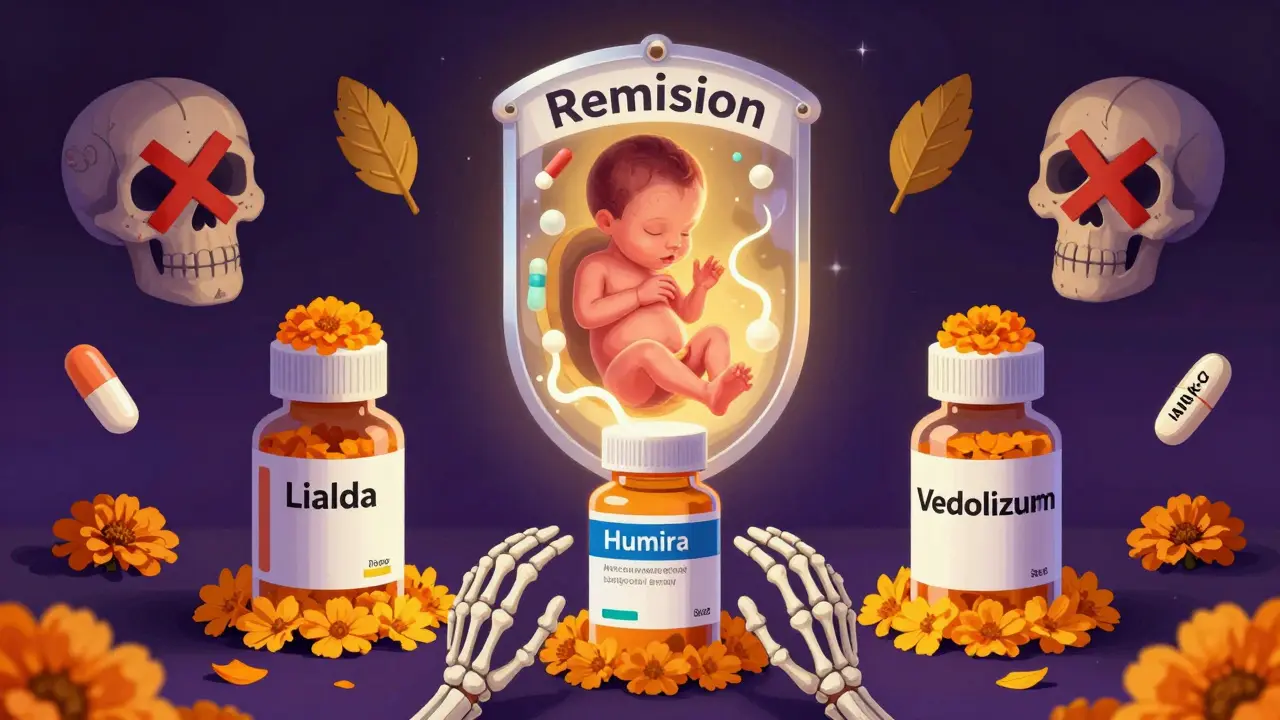
Aminosalicylates (5-ASAs) like mesalamine and sulfasalazine are the go-to for most women. These are the old-school, well-studied drugs that have been used for decades. The data is clear: they don’t increase the risk of birth defects. The Crohn’s & Colitis Foundation and European experts both say you can keep taking them. But here’s the catch: not all mesalamine brands are safe. Asacol HD contains a coating called dibutyl phthalate (DBP), which animal studies and human case reports link to genital abnormalities in male babies. If you’re on Asacol HD, talk to your doctor about switching to Lialda, Delzicol, or Apriso-these don’t use DBP. Your pill might look the same, but the coating isn’t.
Sulfasalazine is also safe, but it blocks folate absorption. That’s why your doctor will likely prescribe a higher dose of folic acid-5 mg daily-starting before you even try to conceive. Folate isn’t just for preventing spina bifida; it helps your baby’s entire nervous system develop properly.
Biologics: The New Normal
Biologics like infliximab (Remicade), adalimumab (Humira), and vedolizumab (Entyvio) used to be a mystery in pregnancy. Now, we have data from over 2,000 pregnancies tracked in the PIANO registry-the largest, longest-running study of its kind. The results? No increase in birth defects. No spike in miscarriages. No rise in preterm births compared to the general population.
Anti-TNF drugs (infliximab and adalimumab) cross the placenta more in the third trimester. That means your baby could have higher drug levels at birth. For that reason, many doctors stop the last dose around week 30-32. This reduces the chance of your newborn having a suppressed immune system in the first few months. It’s not because the drug is dangerous-it’s because we’re being extra careful.
Vedolizumab doesn’t cross the placenta as easily. That’s why it’s often preferred for women who are already on it when they get pregnant. The CONCEIVE study tracked 103 pregnancies and found no serious safety signals. One early red flag-lower live birth rates-turned out to be because many of those women had active disease. When disease activity was controlled, birth rates matched the norm.
Ustekinumab (Stelara) has been studied in over 680 pregnancies. No increased risk of birth defects. No higher rates of infection in babies. The data is still growing, but so far, it’s very reassuring. Newer biologics like risankizumab and mirikizumab are still being tracked, but early numbers look promising.
What to Avoid at All Costs
Some medications have no place in pregnancy. Ever.
Methotrexate is a known teratogen. It causes severe birth defects-cleft palate, skull deformities, heart problems. The risk is 17-27%. If you’re on it, you need to stop at least 3 months before trying to conceive. Your doctor will switch you to something safe, like azathioprine or a biologic.
Thalidomide is another absolute no. It caused thousands of birth defects in the 1950s and 60s. Even tiny doses can harm a developing fetus. It’s not used for IBD anymore, but if you’re on it for another condition, you need to plan ahead.
JAK inhibitors like tofacitinib and upadacitinib are newer. They work differently than biologics, and we don’t fully understand how they affect early development. While small studies haven’t shown clear harm, experts still recommend stopping them 1-6 weeks before conception. The risk isn’t proven-but the potential is too big to ignore.
Timing Matters: Plan Ahead
You can’t wait until you miss your period to start thinking about this. The best time to get your IBD under control is before you get pregnant.
Experts recommend being in remission-no symptoms, no inflammation on colonoscopy-for at least 3 months before conceiving. Why? Because flares during pregnancy are harder to treat. Steroids, which are sometimes used to calm flares, carry their own risks. Taking them in the first trimester increases the chance of cleft lip or palate by 1.4 to 2.3 times.
Work with your gastroenterologist and OB-GYN together. Make a plan. Adjust meds. Check your nutrient levels. Get your folic acid right. This isn’t just about avoiding risks-it’s about setting yourself up for the best possible outcome.
What About Breastfeeding?
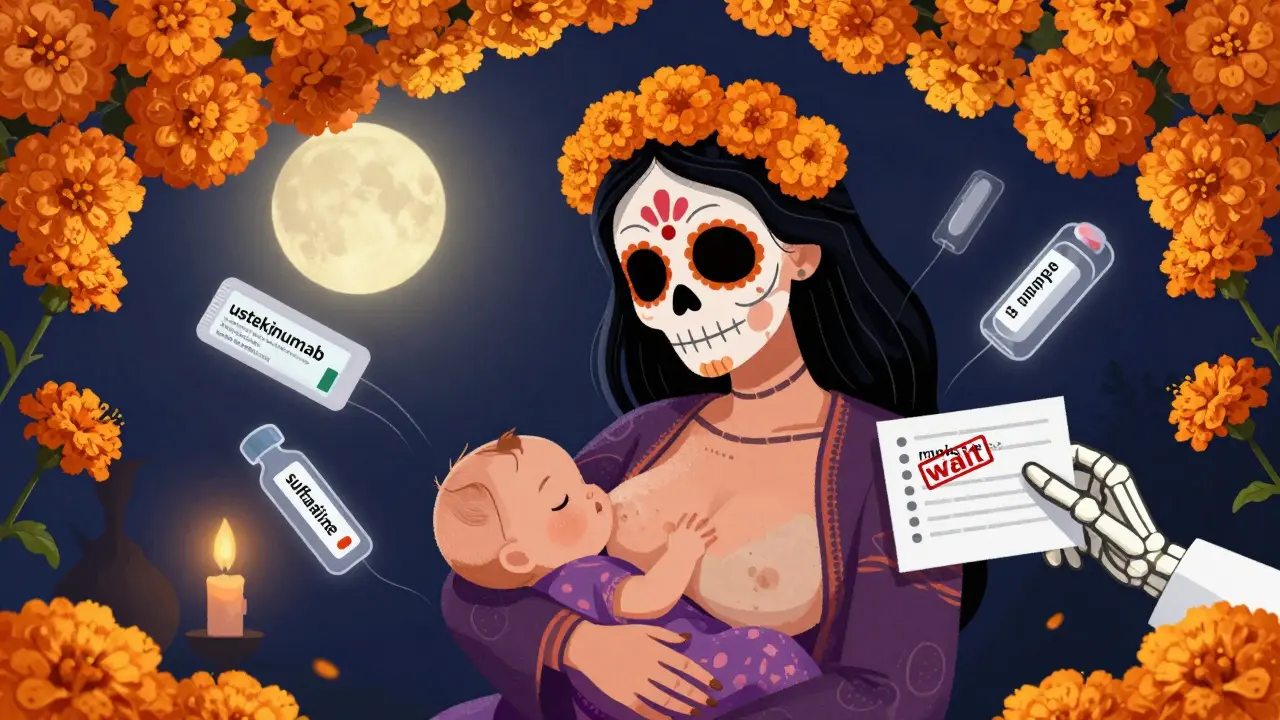
Yes, you can breastfeed while on most IBD medications. The drugs that cross the placenta don’t necessarily show up in breast milk in harmful amounts.
5-ASAs, anti-TNFs, vedolizumab, and ustekinumab are all considered compatible with breastfeeding. Even sulfasalazine is generally safe, though your baby might need monitoring for rare side effects like diarrhea or rash. The amount that passes into milk is tiny-far less than what the baby would get from being exposed in the womb.
One thing to remember: if your baby was exposed to anti-TNF drugs late in pregnancy, avoid live vaccines like rotavirus in the first 6 months. The drug might still be in their system. Your pediatrician will know what to do.
What’s New in 2026?
The science is moving fast. In 2024, the first major randomized trial comparing vedolizumab to anti-TNF drugs in pregnancy started reporting results. Early data suggests both are equally safe. Newer drugs like mirikizumab now come with mandatory pregnancy registries so we can track outcomes in real time.
Researchers are also building tools to predict how much of a drug crosses the placenta-based on your weight, trimester, and medication type. By 2025, doctors may use a simple calculator to personalize dosing during pregnancy, so you get the right amount without over- or under-treating.
The biggest shift? We’re no longer asking, “Is this drug safe?” We’re asking, “Is it safer to stay on it or stop it?” And the answer, almost always, is: stay on it.
What If You’re Already Pregnant and Not on Medication?
If you’ve stopped your meds because you were scared, don’t panic. But don’t wait either. Call your GI doctor today. Even if you’re 12 weeks along, it’s not too late to get back on track. Many women have started biologics in the second trimester and gone on to have healthy babies.
Don’t let fear of medication make your pregnancy riskier than it needs to be. Your baby’s health depends on your gut being calm-not on avoiding every pill.
Bottom Line
Having IBD doesn’t mean you can’t have a healthy baby. It just means you need a smarter plan. The safest thing you can do is keep your disease under control. Most IBD medications are safe during pregnancy. The ones that aren’t? We know them. We avoid them.
Work with your team. Get your medications right. Take your folic acid. Avoid steroids in the first trimester. And remember: you’re not taking drugs to harm your baby-you’re taking them to protect them.






13 Comments
Dolores Rider January 24, 2026
ok but what if the phthalates in Asacol HD are just the tip of the iceberg??? 🤔 what if BIG PHARMA is hiding that ALL mesalamine brands are secretly linked to autism?? i read a forum post from a mom in 2021 who said her kid started having meltdowns at age 3 and the doctor whispered "it’s the coating"... i’m not saying it’s true but... i’m not saying it’s not 😳
Vatsal Patel January 25, 2026
So let me get this straight: we’re now treating pregnancy like a controlled lab experiment where the fetus is just a passive data point? We’ve replaced faith with pharmacology, and now we’re told to trust a registry over intuition? The real tragedy isn’t the disease-it’s that we’ve forgotten how to listen to our bodies and instead outsource survival to clinical trials.
Gina Beard January 25, 2026
Most of these meds are fine. But folic acid dosage matters. 5mg isn't excessive-it's necessary. If your doctor gives you 400mcg, ask why.
Juan Reibelo January 26, 2026
I appreciate how thorough this is. Really. But I want to say: if you’re reading this and you’re scared-please, reach out. You’re not alone. I was on Humira during both pregnancies. My kids are 7 and 4 now. One loves dinosaurs. The other thinks broccoli is a weapon. No birth defects. No immune suppression. Just two healthy, chaotic humans who survived their mama’s IBD-and her terrible cooking.
Heather McCubbin January 27, 2026
They say biologics are safe but what about the kids who grow up and realize their immune system was never theirs to begin with?? 🤯 I mean like... who signed the consent form for the baby??
Shanta Blank January 28, 2026
Oh sweet mercy the pharmaceutical industry has turned motherhood into a drug compliance checklist 🙄 I’m just here waiting for the day they start injecting babies with anti-TNFs at birth just to "prevent future flares". Next they’ll be giving toddlers a subscription to Entyvio. I’m not mad. I’m just disappointed.
Tiffany Wagner January 29, 2026
my doctor switched me from asacol to lialda before i got pregnant and i’m so glad she did. no issues. baby’s 18 months old and still eats everything. i just take my pills like vitamins now. peace.
Viola Li January 30, 2026
Stop telling women to stay on meds. What if the real problem is that we’re medicating away natural bodily wisdom? Maybe inflammation is the body trying to tell you something. Maybe you should fast. Maybe you should chant. Maybe you should stop listening to doctors who’ve never held a crying baby at 3am.
venkatesh karumanchi January 31, 2026
Stay strong, mama. Your body is fighting for your baby even when it feels like it’s working against you. I’ve seen it-women with Crohn’s who carry their babies with grace, even when the pain is loud. You’re not broken. You’re brave. 💪
Jenna Allison February 1, 2026
Important note: vedolizumab doesn’t cross the placenta much because it’s an integrin blocker-it targets gut-specific lymphocytes, not systemic ones. That’s why it’s safer. Also, confirm your sulfasalazine isn’t expired. Folate absorption drops if the med’s degraded.
Kat Peterson February 2, 2026
So… we’re just supposed to trust a registry? 🤷♀️ I mean… who funded it? Did the same people who made the pills also run the study? I’m not saying it’s bad… I’m just saying… I’m not drinking the Kool-Aid. 🍹 #StayWoke
Himanshu Singh February 3, 2026
Life doesn’t wait for perfect timing. I started Humira at 14 weeks. My daughter is now 2. She laughs like a bell. My gut is quiet. The meds didn’t steal my joy-they gave me back my life. You’ve got this. 🌱
Jamie Hooper February 4, 2026
lol i just googled "can i take humira while preggo" and the first result was this post. thanks man. i was about to quit my meds and start eating only kale and moonlight. now i feel better. also i spelled pregnancy wrong. oops.