

When you take two powerful drugs together-each with a razor-thin line between helping you and harming you-the stakes aren’t just high. They’re life-or-death. This is the reality for patients on combination NTI drugs: narrow therapeutic index medications used together to treat complex conditions like heart failure, epilepsy, or certain cancers. But here’s the problem: while single NTI drugs like warfarin or levothyroxine have generic versions, almost no combination NTI products do. And that gap isn’t just a regulatory footnote-it’s leaving patients vulnerable, overpaying, and at risk.
What Exactly Are NTI Drugs?
NTI stands for narrow therapeutic index. These are drugs where the difference between a safe, effective dose and a toxic one is tiny. Think of it like walking a tightrope. Too little, and the drug doesn’t work. Too much, and you could have a stroke, organ damage, or even die. The FDA defines NTI drugs by five key traits: minimal separation between therapeutic and toxic levels, serious risks from small concentration changes, need for frequent blood monitoring, low variation within the same person, and the need for frequent small dose tweaks. Common examples include warfarin (blood thinner), levothyroxine (thyroid hormone), lithium (mood stabilizer), digoxin (heart medication), phenytoin (anti-seizure), and carbamazepine. Each of these has a very specific window where it works. Outside that window? Danger.Why Combination NTI Therapy Exists
Doctors don’t prescribe combination NTI drugs lightly. They do it because single drugs aren’t enough. In cancer, for example, combining methotrexate with another targeted agent can stop resistant cells from growing. In heart disease, pairing warfarin with amiodarone might be the only way to control dangerous rhythms. In tuberculosis, combining isoniazid with rifampin prevents drug resistance. The logic is sound: two drugs working together can be more effective and reduce the chance of treatment failure. But here’s the catch-when you combine two drugs that each have a narrow window, the margin for error doesn’t just double. It multiplies. A 5% change in the absorption of one drug might be manageable. But if both drugs shift by 5% at the same time? That’s a 10% total variation. And for NTI drugs, even a 10% shift can mean hospitalization.The Generic Substitution Problem
Generic drugs are supposed to be cheaper, safer, and just as good as brand-name versions. For most medications, they are. But for NTI drugs, the rules changed in 2014-and again in 2022. The FDA now requires generic NTI drugs to prove bioequivalence within a tighter range: 90% to 111.11% for peak blood levels (Cmax) and 90% to 112% for total exposure (AUC). For regular drugs, the range is 80% to 125%. That’s a massive difference. It means generic manufacturers must hit the exact same absorption profile as the brand-with far less room for error. Now imagine trying to do that with two NTI drugs in one pill. That’s a fixed-dose combination. The FDA has no approved method to prove two NTI drugs in a single tablet behave the same way every time, in every patient. The math doesn’t add up. If each drug has a 22% allowable variation, combining them creates a 44% total variation window. That’s not safe. It’s not even close. As a result, there are zero FDA-approved fixed-dose combinations of two NTI drugs in the U.S. market. While generic warfarin has 11 approved applications, no combo pill with warfarin + another NTI drug exists. Same for lithium + anticonvulsants. Same for digoxin + beta-blockers. The market is completely empty.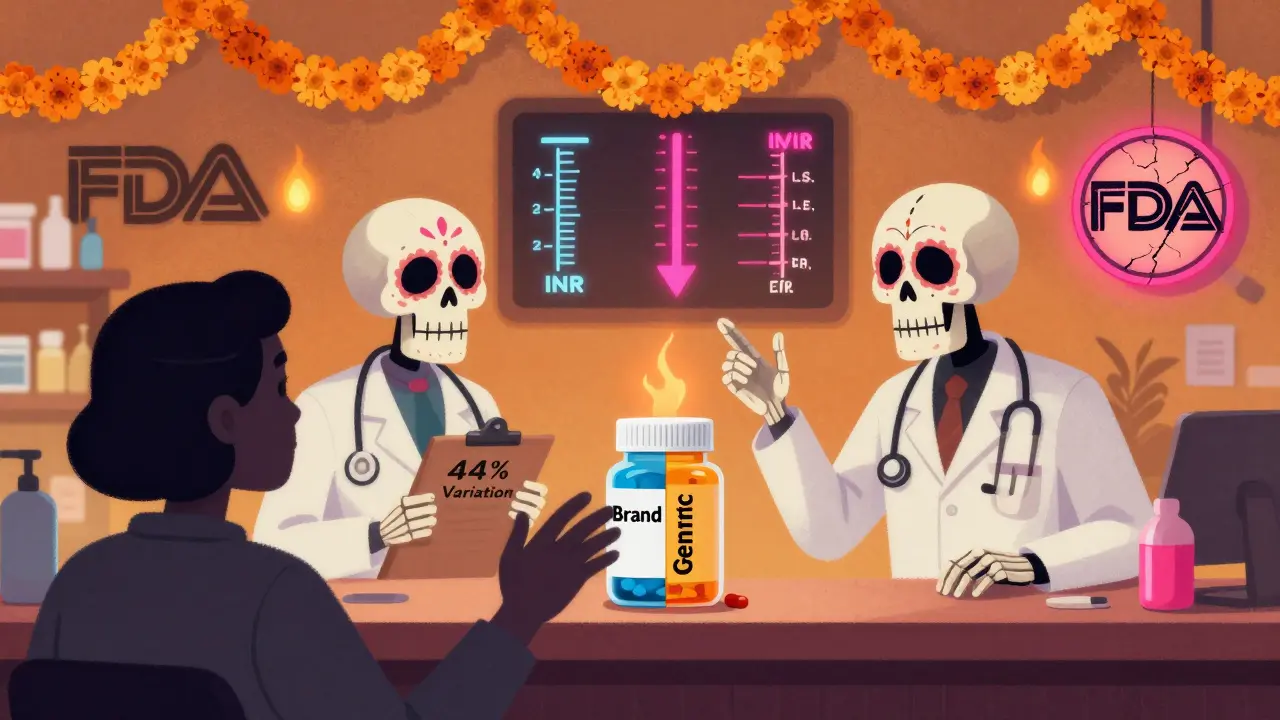
What Happens When Pharmacies Switch Generics?
Even without fixed-dose combinations, patients often get separate generic NTI drugs from different manufacturers. That’s where things get dangerous. A 2020 JAMA Internal Medicine study found that when patients on a combination therapy containing one NTI drug switched to a generic version, their risk of adverse events jumped 27%. For non-NTI combinations? Only 8%. One patient on warfarin and amiodarone (both NTI) saw their INR spike from 2.5 to 6.8 in three days after a pharmacy switch-leading to emergency hospitalization. A 2023 survey of 856 pharmacists showed 78.3% had seen treatment failure after switching generics in NTI combinations. Over 40% reported serious events: bleeding, seizures, arrhythmias, kidney damage. On Reddit and patient forums, stories are consistent: “My INR went wild after they switched my warfarin.” “My thyroid levels crashed when they changed my levothyroxine brand.” “I ended up in the ER because my meds were ‘the same’-but they weren’t.” The American Society of Health-System Pharmacists (ASHP) issued a formal statement in 2021: “Automatic substitution of generic NTI drugs in combination regimens presents an unacceptable risk.”Why Europe Is Different
Some point to Europe as proof it can work. The EMA approved generic levothyroxine combinations in 2015. But here’s what’s missing from that story: European monitoring is far more intensive. Patients get blood tests every 2-4 weeks after a switch. Dose adjustments happen fast. Pharmacies track every batch. And the system is built for it. In the U.S., most patients don’t get that level of care. Outpatient clinics rarely have the staff or resources. Insurance doesn’t cover frequent INR or lithium level checks. The result? Patients are left guessing. A Drugs.com survey of 1,247 patients found 63.4% had adverse effects after switching to generics in combination therapy-compared to just 18.2% on brand-name versions.The Cost of Waiting
The financial impact isn’t just about the drug price. It’s about the hidden costs. Patients on combination NTI therapy spend $1,200-$2,500 a year on blood tests alone. For non-NTI combos? $400-$800. That’s triple the monitoring cost. And it’s not optional. Without frequent testing, you’re flying blind. Doctors need 6-8 weeks to stabilize a patient on a combination NTI regimen. They make an average of 3.2 dose changes during that time. For non-NTI combos? Just 1.8 changes. More visits. More labs. More time off work. More stress. Pharmacists need over 120 hours of specialized training to manage these regimens safely. Few have it. And documentation? FDA-approved NTI monotherapy labels score 4.2 out of 5 for clarity. Combination NTI products? 2.8. That’s not a typo. The instructions are confusing, incomplete, or missing.
Who’s Blocking Progress?
It’s not just the science. It’s the system. Generic manufacturers like Teva and Sandoz argue modern manufacturing can achieve the precision needed. But the FDA’s 2023 draft guidance says otherwise. For combinations with two NTI drugs, they’re proposing even tighter standards: 90%-107.69% for Cmax and 90%-110% for AUC. That’s a 17.69% window for one drug and a 20% window for the other. Combined? That’s still a 37.69% total variation. Still too wide. The FDA admits the current bioequivalence models don’t capture real-world variability. Dr. Donald Berry put it bluntly in Nature Reviews Drug Discovery: “The 90-111% window still allows 22% total variation. When you combine two such drugs, that becomes clinically significant.” Meanwhile, the market is growing. NTI drugs hit $48.7 billion globally in 2023. But combination NTI products? Less than 0.3% of that. The U.S. accounts for nearly half of NTI sales-but has almost no access to affordable combination options. Enterprise hospitals are 3.2 times more likely to block automatic substitution than community pharmacies. Why? Because they’ve seen the outcomes.The Way Forward
There’s no easy fix. But there are steps. First: stop automatic substitution. If a patient is on a combination of NTI drugs, they should stay on the same brand and generic versions of each component unless the doctor and pharmacist agree-and only after thorough monitoring. Second: push for better monitoring systems. Insurance companies need to cover frequent lab tests. Clinics need dedicated NTI pharmacists. Electronic alerts should flag when a patient on NTI combo therapy gets a generic switch. Third: fund research. The FDA’s 2024 pilot program on “precision bioequivalence” using pharmacometric modeling could be a breakthrough. Instead of testing blood levels in 24 healthy volunteers, use computer models based on real patient data. That’s the future. Until then, the gap remains. Patients needing combination NTI therapy are caught between the promise of generics and the reality of risk. The drugs exist. The need is clear. But the safe, affordable solution? It’s still out of reach.What Patients Should Do
If you’re on a combination therapy with any NTI drug:- Ask your doctor: “Is either drug on the NTI list?”
- Ask your pharmacist: “Are these generics from the same manufacturer as before?”
- Never accept a switch without a blood test within 7 days.
- Keep a log of symptoms: fatigue, dizziness, bruising, irregular heartbeat.
- Request a written prescription specifying brand name if your condition is unstable.
What does NTI mean in medication?
NTI stands for narrow therapeutic index. It means the drug has a very small window between the dose that works and the dose that causes harm. Even small changes in how the drug is absorbed can lead to serious side effects or treatment failure. Examples include warfarin, lithium, and levothyroxine.
Why are there no generic combination NTI drugs in the U.S.?
Because current bioequivalence standards can’t reliably prove that two NTI drugs in one pill will behave the same way in every patient. The FDA requires extremely tight blood concentration ranges for NTI drugs, and combining two of them multiplies the risk of variation. No manufacturer has been able to meet the required standards, so no combination NTI generics are approved.
Can I switch to a generic if I’m on a combination NTI therapy?
It’s risky. Even switching one component to a different generic can cause instability. The American Society of Health-System Pharmacists advises against automatic substitution. Always consult your doctor and get a blood test within a week of any switch. If your condition is unstable, ask for brand-name drugs.
How often should I get blood tests on combination NTI drugs?
When starting or changing any component, get tested within 3-7 days. After stabilization, testing every 4-8 weeks is typical. But if you switch generics, get tested again immediately. Some patients need monthly tests for years.
Are combination NTI drugs more expensive than single NTI drugs?
Yes-because you usually can’t get them as generics. You’re often paying full price for both drugs. Plus, you’ll spend $1,200-$2,500 a year on blood tests alone, compared to $400-$800 for non-NTI combinations. The total cost is much higher, even if the drug price seems similar.
What’s being done to fix this problem?
The FDA is testing new methods using computer modeling to predict how combination NTI drugs behave in real patients, not just healthy volunteers. This could lead to better standards by 2026. But until then, progress is slow. The science is hard, and the regulatory path is unclear. Patients are paying the price.





9 Comments
Harsh Khandelwal December 25, 2025
So let me get this straight - the FDA won’t approve combo NTI generics because it’s ‘too risky’… but they’re fine letting Big Pharma charge $12k a year for brand-name pills while patients bleed out from INR spikes? This ain’t science, it’s a cartel. Someone’s making bank off our blood tests and ER visits. The real NTI here? Trust in the system.
Christine Détraz December 26, 2025
I’ve been on warfarin + amiodarone for 8 years. I switched generics once - didn’t realize it until my INR hit 7.4. Took three weeks to stabilize. Now I refuse any switch without my pharmacist calling me first. It’s not about brand loyalty. It’s about survival. The system’s broken, but we can still fight it - one blood test at a time.
John Pearce CP December 26, 2025
The FDA’s standards are not too strict - they are precisely calibrated to prevent American lives from being sacrificed on the altar of cheap generics. Any nation that permits unverified combination NTI products is inviting medical chaos. We have the highest standard of pharmaceutical safety in the world. Do not confuse this with corporate greed. This is competence.
Isaac Bonillo Alcaina December 27, 2025
You people are delusional. The fact that you think switching generics is ‘risky’ is proof you don’t understand pharmacokinetics. If the FDA says it’s bioequivalent, it’s bioequivalent. The real issue? You’re not monitoring yourself. Stop blaming the system. Start taking responsibility. Your INR isn’t magic. It’s math. Do the math.
Bhargav Patel December 28, 2025
There is a philosophical tension here between equity and precision. Generics exist to democratize access - yet NTI drugs demand an almost monastic level of control. To force affordability upon a domain that requires absolute fidelity is to mistake compassion for cruelty. Perhaps the answer is not more generics, but better infrastructure: subsidized monitoring, pharmacist-led clinics, and AI-driven dose prediction. We must elevate care, not just reduce cost.
suhani mathur December 28, 2025
Oh wow, so the FDA’s ‘tight standards’ are why you’re paying $2500 a year for blood tests instead of $50 for a pill? Brilliant. Let me guess - the same people who say ‘trust the science’ also think ‘natural’ means ‘organic kale smoothies.’ The real NTI here? Your patience with bureaucracy.
Diana Alime December 30, 2025
i swear to god i switched my levothyroxine and felt like a zombie for 3 weeks. my dr was like ‘it’s the same stuff’ and i was like… then why do i feel like i’m slowly turning into a corpse? also my pharmacy gave me a different brand each time. no one cares. i’m just a number in the system. i hate this.
Bartholomew Henry Allen January 1, 2026
Europe does it differently because they have socialized medicine. We have freedom. Freedom to pay more. Freedom to choose brand. Freedom to demand safety. Stop comparing us to countries that ration care. We don’t need their system. We have ours. And it works - for those who can afford it.
Andrea Di Candia January 2, 2026
There’s hope in the FDA’s pilot program. If we can model real patient data instead of testing on 24 healthy college kids, we might finally bridge the gap between affordability and safety. It’s not about being anti-generic. It’s about being pro-patient. We can do better. We just need to listen - not just to regulators, but to the people whose lives are in the balance.