

When you’re managing a chronic condition like high blood pressure or diabetes, your doctor might prescribe a combo generic-a single pill that combines two or more medications. It sounds convenient, right? But here’s the real question: are you paying way more than you need to? The answer, backed by hard data, is often yes.
In 2016, Medicare Part D spent $925 million more on 29 branded fixed-dose combination (FDC) drugs than it would have if patients had taken the same ingredients as separate generic pills. That’s not a typo. That’s over $900 million in unnecessary spending in just one year. And this isn’t an outlier. It’s a pattern.
How Combo Drugs Work (and Why They Cost So Much)
A fixed-dose combination pill joins two active ingredients into one tablet or capsule. Think of it like a pre-mixed smoothie instead of buying the banana, yogurt, and honey separately. The idea is simple: fewer pills, better adherence. And for some people, that matters. But the pricing? It’s broken.
Branded combo drugs are often priced as if they’re brand-new inventions-even when one or both ingredients have been generic for years. For example, Janumet (sitagliptin + metformin) cost Medicare $1.4 billion in 2016. Meanwhile, generic metformin? At Walmart’s $4 program, a 30-day supply costs $4. The sitagliptin component? Still under patent. But instead of charging just the cost of that one new drug plus the pennies for metformin, the combo was priced at $472 per month. That’s over 100 times more than the generic component alone.
This isn’t pricing based on value. It’s pricing based on opportunity. When a drug company combines an off-patent drug with a newer, still-patented one, they can slap on a premium price. Researchers call this “evergreening”-a way to extend profits long after the original drug’s patent expires.
The Math Doesn’t Add Up
Let’s break down the numbers with real examples:
- Entresto (sacubitril + valsartan): $500/month. Generic valsartan? $12/month. Sacubitril alone? Still expensive, but not $500.
- Kazano (alogliptin + metformin): $425/month. Generic metformin? Less than $10. That’s $415 for one pill that’s mostly just the new drug.
- Janumet (sitagliptin + metformin): $472/month. Generic metformin? $4. That’s a $468 markup on a single ingredient that’s been cheap for years.
According to IQVIA’s 2022 analysis, branded FDCs typically cost 60% of what two separate branded drugs would cost. Sounds good? Until you realize that when both components are generic, the combo still costs 3-5 times more than buying them separately. That’s not a discount-it’s a markup.
The problem isn’t just Medicare. It’s every patient on private insurance, too. The Congressional Budget Office found that Medicare pays 22-33% more for brand-name drugs than the VA does for the exact same medications. So if you’re on a private plan, you’re likely paying more than you should, too.

Why Do Pharmacies and Doctors Keep Prescribing Them?
There’s a real benefit: fewer pills. For someone taking five different medications a day, a combo pill can make a huge difference. Studies show patients are 15-20% more likely to stick with their treatment when they have fewer pills to manage. That’s not trivial. Missed doses lead to hospitalizations, ER visits, and higher long-term costs.
But here’s the catch: those adherence benefits don’t require a branded combo. Generic versions of combo pills exist too-and they’re way cheaper. In fact, the FDA reports that generic drugs cost 80-85% less than brand-name equivalents. So why aren’t more doctors prescribing generic combos?
Because many don’t know they’re available. Or because drug reps push branded combos. Or because insurance formularies favor them. In 2022, 62% of Medicare Part D plans required prior authorization before covering high-cost combos-meaning doctors had to jump through hoops just to get a patient the pill they prescribed. Meanwhile, generic alternatives sat on the shelf, ignored.
What’s Being Done About It?
Change is coming, slowly.
The Inflation Reduction Act of 2022 gave Medicare the power to negotiate prices for the most expensive drugs. That includes combo pills. And it’s already working. In 2023, Novartis launched the Entresto Access Program, offering the branded combo for a $10 co-pay to eligible Medicare patients. Sounds generous? It is-until you realize that even at $10, it’s still far more than the $16 it would cost to buy generic valsartan and sacubitril separately.
The FDA’s Generic Drug User Fee Amendments (GDUFA III), finalized in 2022, is speeding up approval for generic versions of combo drugs. More competition means lower prices. But it takes time. In the meantime, pharmacy benefit managers (PBMs) are starting to push back. Some are creating “carve-outs”-removing high-cost combos from standard formularies unless there’s no alternative. Others are offering “preferred generic” incentives: if your doctor prescribes two separate generics instead of a combo, your copay drops.
What You Can Do Right Now
You don’t have to wait for policy changes. Here’s what to ask your doctor and pharmacist:
- Are both components available as generics? If yes, ask if you can get them as separate pills.
- Is there a generic combo version? Some exist-like the generic version of Amlodipine/Olmesartan. It’s 70% cheaper than the brand.
- What’s the cash price if I pay out-of-pocket? Sometimes, paying cash for two generics is cheaper than your insurance copay for a combo.
- Can I split the pills? Some pills can be safely split. A 20mg tablet might be cheaper than two 10mg tablets.
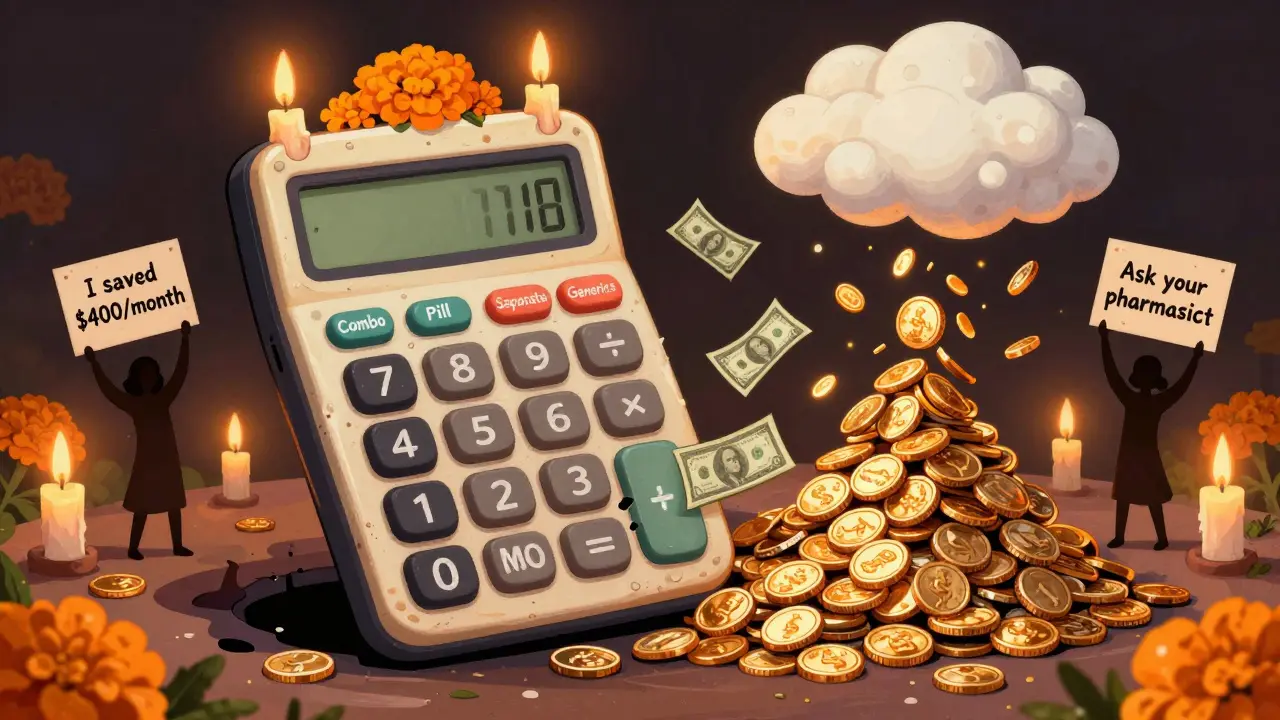
One patient in Seattle, 68, was taking a branded combo for hypertension. She asked her pharmacist to check prices. Turns out, buying generic amlodipine and losartan separately cost $18/month. The combo? $420 with insurance. She switched. Saved $400 a month. No side effects. No loss of effectiveness.
The Bottom Line
Combo pills aren’t evil. They’re useful. But they’re not always necessary-and they’re almost always overpriced. The system is rigged to profit from convenience, not from health.
If you’re on a combo drug, especially one with a generic component, ask: Am I paying for a pill-or for a marketing strategy?
There’s no shame in choosing two pills over one. If your doctor says it’s not safe, ask for the evidence. If your pharmacy says it’s not covered, ask them to check the cash price. You might be surprised.
The math is clear: combo generics can save you hundreds. You just have to ask for them.


15 Comments
Sabrina Sanches March 11, 2026
I switched from Janumet to generic metformin + sitagliptin separately and saved $380/month. My pharmacist helped me find the best prices at Walmart and Costco. No difference in how I feel. Why do we even accept this nonsense?
Sally Lloyd March 12, 2026
They say it's for adherence... but what if the real reason is that the FDA approves these combos faster when they're branded? And then the manufacturers lock in pricing before generics can catch up? Something smells off.
Emma Deasy March 13, 2026
This is not just a healthcare issue-it's a moral catastrophe. A single pill that costs $472 when its components together cost $8? This isn't capitalism. This is predatory exploitation dressed up as innovation. And the fact that doctors still prescribe it without questioning? That's complicity.
tamilan Nadar March 15, 2026
In India, we get combo generics for under $5/month. The same drugs. Same dosages. Same quality. The US system is broken. We pay 10x for the same medicine because of how insurance and patents are tangled. It's not about science-it's about profit.
Adam M March 15, 2026
If you're taking a combo pill and not asking this question, you're being robbed.
Rosemary Chude-Sokei March 16, 2026
I appreciate the data here. I work in pharmacy and can confirm: most patients don’t know generic combos exist. We’re not trained to push them. The system doesn’t incentivize it. But when patients ask? We can help. It’s not about blame-it’s about awareness.
Noluthando Devour Mamabolo March 16, 2026
I literally just got off a call with my PBM. They said if I switch to separate generics, my copay drops from $120 to $12. 🤯 I’m switching tomorrow. Also, emoji for emphasis: 🚨💸💊
Buddy Nataatmadja March 17, 2026
I’ve been on combo meds for 8 years. Never thought to check prices. Just assumed it was the best option. This post changed my whole approach. Thanks for the nudge.
mir yasir March 19, 2026
The economic inefficiency of branded fixed-dose combinations represents a classic case of rent-seeking behavior within pharmaceutical oligopolies. One must question the regulatory capture that permits such pricing structures under the guise of therapeutic convenience.
Stephanie Paluch March 19, 2026
I cried when I found out I was paying $400/month for something that costs $18. I’m so angry at myself for not asking sooner. But I’m glad I’m learning now. 🥹
Hugh Breen March 19, 2026
This is why we need public pharmacy options. Imagine if we had a national drug program like Canada or the UK. No more $472 pills. No more corporate greed. We can fix this. We just have to demand it. 💪🇺🇸
Byron Boror March 21, 2026
America is weak. We let corporations rip us off because we’re too lazy to take two pills. In Russia, we take 5 pills a day and we’re proud of it. This is why we’re #1.
Lorna Brown March 22, 2026
It makes me wonder: if we treat health as a commodity, rather than a right, what else are we commodifying? Is the human body just another profit center? The deeper question here isn’t about pricing-it’s about values.
Rex Regum March 24, 2026
You’re all being manipulated. The real issue isn’t combo pills-it’s that you trust doctors and pharmacists. They’re paid by Big Pharma. The system is designed to keep you dependent. Wake up.
Kelsey Vonk March 25, 2026
I read this and felt so much relief. I’ve been taking a combo for years and always felt guilty for wanting to save money. But this made me realize: saving money isn’t being cheap. It’s being smart. And I deserve to be smart. ❤️